
Somewhere in a quiet materials lab, a researcher is staring at a tiny scaffold of synthetic bone filler the way a founder stares at a product that's good, profitable, and just a little too slow to win the market. The composite works. It coaxes new bone to grow where bone went missing. But "works" and "works fast enough to dominate" are two very different lines on a pitch deck, and the team behind this study decided to chase the second one.
The product in question is a composite called octacalcium phosphate slash gelatin, which everyone in the field mercifully shortens to OCP/Gel. Think of it as a temporary trellis you plant in a bone defect. Your body's bone-building cells climb the trellis, lay down fresh mineral, and eventually the scaffold dissolves while real bone takes over. It's already a respectable little workhorse, and it's been studied for filling the kinds of holes that fractures, tumor removals, and dental surgeries leave behind.
The "it's good, but" problem
Here's the commercial tension that any bone-graft company knows in its bones (sorry): the human skeleton is patient, and patients are not. A scaffold that fills a defect over many months is fine for a hairline gap. But surgeons deal with bigger, nastier, more complicated defects all the time, and for those, "eventually" is a liability. Slower healing means more time in a cast, more follow-up visits, higher infection risk, and a longer runway before someone gets back to their actual life.
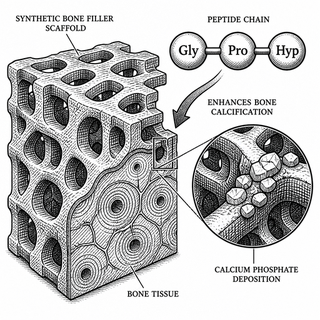
So the researchers asked the question every product team eventually asks: what cheap, simple ingredient can we bolt on to make the existing thing meaningfully better? Their answer was a collagen-mimetic peptide, or CMP, built from a repeating little chemical phrase, Gly-Pro-Hyp, stuttered over and over. If that sequence looks familiar, it should. It's a mimic of the backbone motif of collagen, the protein that makes up most of your body's structural scaffolding. The peptide is essentially a knockoff of the real thing, designed to whisper to the surrounding tissue in a language it already understands.
What the add-on actually does
The headline finding is delightfully blunt: adding CMP to the OCP/Gel composite enhanced bone formation by accelerating calcification. In plain terms, the peptide didn't reinvent the scaffold. It just told the mineralization process to hurry up. Calcification is the step where soft, mushy new tissue gets reinforced with calcium and phosphate and graduates into genuine hard bone. Speeding that step up is like handing a construction crew the concrete sooner. Same building, finished faster.
This is the part I find quietly clever from a business angle. The team didn't throw out a working platform to start over. They found an additive that improves the metric that matters most to surgeons and patients, while leaving the rest of the proven system intact. In startup terms, that's a feature release, not a painful pivot. You keep your existing manufacturing, your existing regulatory groundwork, and your existing track record, and you ship a better version. Investors love that sentence even when they don't fully understand the chemistry.
Why a collagen impersonator is the smart hire
Why mimic collagen instead of just adding real collagen? A couple of reasons that make sense once you think like someone trying to manufacture this at scale. Real collagen sourced from animals comes with batch-to-batch variability, potential immune reactions, and the general headache of biological inconsistency. A short synthetic peptide, by contrast, is defined, reproducible, and you can make a lot of it without explaining yourself to a regulatory reviewer who's had three coffees and zero patience. It behaves the same way every time, which is exactly what you want from a component you're putting inside someone's femur.
The peptide gives the cells a familiar handhold, the kind of molecular texture they expect from natural bone matrix, without dragging along the baggage of full-length collagen. It's the difference between hiring a reliable specialist for one job and adopting an entire unpredictable department.
The road from bench to bedside
Now for the obligatory reality check, because every promising scaffold has one. This is foundational research on a composite material, which means it lives at the early, hopeful end of the development pipeline. Showing enhanced bone formation in a controlled study is genuinely exciting, but it is a long, expensive, heavily regulated march from "this peptide accelerates calcification" to "this is the product your orthopedic surgeon orders by the box."
Bone-graft substitutes are a real and sizable market, which is precisely why incremental improvements like this one matter. The companies competing in this space are not looking for science fiction. They're looking for the next reliable, manufacturable, modestly-better-than-last-year product that surgeons will actually adopt. An additive that speeds up the rate-limiting step of bone formation, using a synthetic ingredient that's easy to standardize, checks an awful lot of those boxes.
The bigger pattern worth noticing
What I appreciate about studies like this is the philosophy underneath them. So much biomedical hype chases the moonshot, the total replacement, the thing that makes everything before it obsolete. This work does something humbler and arguably more useful: it takes a tool that already works and makes it work better at the one thing clinicians most wish it did faster. The peptide isn't trying to be a hero. It's trying to be a really good upgrade.
For anyone whose future involves a fracture that won't quite heal, a dental implant that needs solid bone to anchor into, or a surgery that leaves a gap where bone used to be, that quiet, steady improvement is the kind of progress that eventually shows up in a real recovery, weeks sooner than it otherwise would have. And weeks, as anyone stuck in a cast during summer will tell you, are everything.
This blog post discusses research findings and should not be taken as medical advice. If you have concerns about bone injuries, bone defects, or healing after surgery, please consult a healthcare provider. Research discussed here represents ongoing scientific investigation and clinical validation is still in progress.
All images used in this post are decorative illustrations only and do not represent or reflect the accuracy, reality, or correctness of the referenced research.
Primary Source: Addition of a collagen mimetic peptide to octacalcium phosphate/gelatin composites enhances bone formation by accelerating calcification. PubMed. 2026. PMID: 41895423