
Why does skin even close?
That sounds like the kind of question a tired parent asks while staring at a scraped knee, trying to find the good bandages and wondering why every box contains 400 tiny rectangles and exactly two useful ones. But it is actually a deep biological question. Healing is not just “skin grows back.” It is clotting, immune signaling, inflammation calming down, new tissue forming, bacteria staying out, blood vessels rebuilding, and the whole messy construction crew somehow knowing when to stop.
For kids with ordinary cuts, this usually works so well we barely think about it. For people with diabetes, especially those with diabetic foot ulcers, the system can stall. The wound stays inflamed. Infection risk climbs. Blood flow and nerve damage complicate everything. A small sore can become a long, exhausting medical problem.
That is why a recent review on chitosan-based biomaterials for diabetic ulcer management caught my attention. Not because “advanced biomaterials” sounds shiny, although it does have a certain science-fair-with-a-grant-budget charm. It is interesting because chitosan may help solve several wound-healing problems at once.
What Is Chitosan, And Why Is It In The Wound-Care Conversation?
Chitosan is a natural polymer made from chitin, a material found in shells of crustaceans and some fungi. In medicine, researchers like it because it is biodegradable, generally biocompatible, sticky in useful ways, and easy to modify.
The parent translation: it is the kind of material scientists can shape into many forms and politely ask to do different jobs.
For diabetic ulcers, those jobs matter. A dressing cannot just sit there looking clean and optimistic. Ideally, it should help stop bleeding, reduce bacteria, calm excessive inflammation, handle oxidative stress, support new tissue growth, and deliver medications in a controlled way. That is a lot to ask from something that, in everyday life, we still call a bandage.
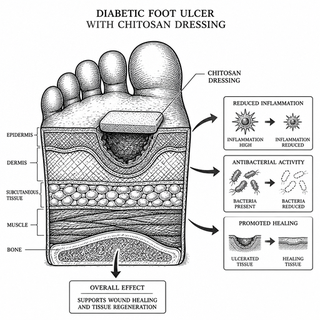
According to the reviewed research, chitosan and its derivatives bring several useful traits to the table: antibacterial activity, hemostatic effects, anti-inflammatory behavior, antioxidant properties, mucoadhesiveness, biodegradability, and even self-healing features in some engineered systems.
That last phrase, “self-healing,” does not mean the dressing becomes a tiny superhero with a cape. It means the material can recover some of its structure after being disturbed, which may help it stay useful in a wound environment that is wet, moving, enzyme-rich, and generally rude.
Why Diabetic Ulcers Are So Hard To Treat
A diabetic ulcer is not just a wound that needs more time. It is a wound stuck in the wrong phase of healing.
Normal healing has a rhythm: stop bleeding, clean up damage, rebuild tissue, remodel. Diabetic wounds often remain trapped in inflammation. High glucose, reduced circulation, nerve damage, bacterial burden, and oxidative stress can all interfere. The wound becomes less like a repair site and more like a family group chat where nobody can agree what the plan is.
That is where “smart” dressings become appealing. Instead of delivering one medicine at one speed no matter what is happening, researchers are building systems that respond to the wound environment.
The review highlights chitosan-based systems that can react to cues such as:
- pH changes
- reactive oxygen species
- temperature
- enzymes
- glucose levels
These cues are not random. Chronic wounds often have abnormal pH, high oxidative stress, infection-related enzyme activity, and glucose-related changes. A dressing that responds to those signals could release medication when and where it is most needed.
The Many Shapes Of Chitosan
One practical strength of chitosan is that it can be built into different formats.
The review discusses nanoparticles, hydrogels, nanofibers, microneedles, sponges, and 3D scaffolds. Each has a different possible role.
Hydrogels can keep a wound moist while carrying therapeutic agents. Nanofibers can mimic parts of the extracellular matrix, giving cells a structure to crawl across as they rebuild tissue. Sponges can absorb fluid. Microneedles may deliver drugs through tissue with minimal invasion. 3D scaffolds can provide a framework for regeneration.
This is where the research starts to feel less like “one magic material” and more like a toolbox. As a parent, I trust toolboxes more than magic. Magic has terrible documentation.
The Real Promise: Smarter Drug Release
The most exciting part is not simply that chitosan can be made into dressings. It is that chitosan systems can be engineered to respond.
For example, a pH-responsive dressing might release antibacterial agents when the wound environment shifts in a way that suggests infection or poor healing. A glucose-responsive system could theoretically adjust treatment based on local glucose-related conditions. A reactive oxygen species-responsive material could release antioxidants in a wound overloaded by oxidative stress.
This matters because diabetic ulcers are dynamic. A wound on Monday may not be the same biological problem on Friday. Static treatment can be blunt. Responsive systems aim to be more like a thermostat than a light switch.
That does not mean these systems are ready to replace clinical wound care tomorrow. But the concept is powerful: a dressing that senses trouble and adjusts its behavior could reduce over-treatment, under-treatment, and the endless “let’s wait and see” loop that wears families down.
What Would This Mean In Real Life?
If this technology matures, the real-world benefits could be meaningful.
Better diabetic ulcer care could mean fewer infections, fewer hospital visits, less need for repeated debridement, improved healing rates, and possibly fewer amputations. For patients and families, that means less fear around every wound check. It means a sore on the foot does not automatically become the household’s main character for the next six months.
There is also a care burden issue. Chronic wounds require time, transportation, supplies, specialist visits, and emotional stamina. A smarter dressing that supports healing more effectively could make treatment less punishing.
Of course, the big word here is “could.”
The Translation Problem
The review also looks at commercial products, patents, and clinical trials involving chitosan formulations. That is a good sign because it means the field is not only living in petri dishes and optimistic conference slides.
Still, turning a promising biomaterial into a reliable clinical product is hard. Researchers need to prove safety, consistency, manufacturing quality, storage stability, real-world usability, and clear clinical benefit. A dressing can perform beautifully in a controlled lab setup and then meet an actual wound, which behaves like it never read the protocol.
There are also patient-specific differences: circulation, infection status, ulcer depth, glucose control, other illnesses, medications, and mobility. Diabetic ulcer care is not one-size-fits-all, and no biomaterial gets to skip that reality.
Where AI Might Fit
The review points toward AI-driven design as a future direction. That could mean using computational tools to design chitosan systems, predict which formulations work best, or personalize treatment based on wound features.
I am cautiously interested in that. AI in medicine should not be treated like a wizard behind a curtain with a stethoscope. But as a tool for pattern-finding, formulation design, and prediction, it could help researchers move faster and make smarter choices.
The goal would be personalized wound care: not just “this is a diabetic ulcer,” but “this wound has these signals, this risk profile, and needs this kind of response.”
That is the kind of precision that could actually matter at the bedside.
The Parent Test
So, back to my favorite research filter: will this help my kid, my family, or someone I love?
Not today in the form of a miracle cure. But this research direction passes the “worth watching” test. Chitosan-based smart dressings are trying to address the actual complexity of diabetic ulcers, not just cover them up and hope biology gets its act together.
They combine material science, drug delivery, infection control, and responsive design in a way that feels practical. Still complicated, yes. But practical.
And if future studies show that these systems heal ulcers faster, prevent infections, and reduce serious complications, that would be more than a clever biomaterial story. That would be a real improvement for patients dealing with wounds that currently take too much time, too much care, and too much courage.
This blog post discusses research findings and should not be taken as medical advice. If you have concerns about diabetic ulcers, wound healing, diabetes-related foot wounds, or infection risk, please consult a healthcare provider. Research discussed here represents ongoing scientific investigation and clinical validation is still in progress.
All images used in this post are decorative illustrations only and do not represent or reflect the accuracy, reality, or correctness of the referenced research.
Primary Source: Chitosan-based advanced biomaterials and stimuli-responsive systems for diabetic ulcer management: From principles to translational potential. PubMed Record ID 41713994. PubMed