
If you've ever had a squeaky chair slowly turn into a full haunted-house sound effect, you already understand the basic principle behind this research. Joints are mechanical systems, cartilage is part cushion and part shock absorber, and when the maintenance crew falls behind, small problems can snowball. In facet joint osteoarthritis, the small joints at the back of the spine start losing their smooth cartilage environment, and the result can be persistent low back pain that nobody invited to the party.
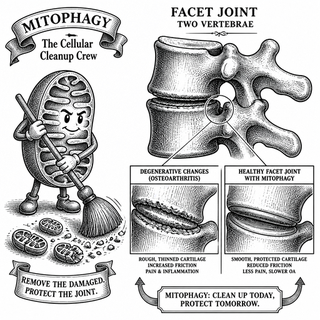
This new study looks at a compound called Asperosaponin VI, or ASA VI, and asks whether it can slow the progression of facet joint osteoarthritis by helping cartilage cells take out their mitochondrial trash. That may sound like a subplot from Star Trek: Cellular Engineering Division, but the biology is genuinely interesting.
The Facet Joint: Small Part, Big Back Pain Energy
Facet joints sit between the vertebrae and help guide spinal movement. They are not as famous as spinal discs, probably because "facet joint" sounds like something a cabinetmaker would discuss, but they matter. When these joints degenerate, the cartilage can break down, nearby bone can remodel, inflammation can rise, and the spine can become a grumpy mechanical system.
Facet joint osteoarthritis is increasingly recognized as one contributor to low back pain. The tricky part is that treatments are limited. Pain management can help, but therapies that directly slow the disease process are still an open challenge.
That is where ASA VI enters the scene, wearing a lab coat and possibly carrying a tiny mitochondrial broom.
Meet Mitophagy, the Cell’s Quality-Control Montage
Mitochondria are often described as the powerhouses of the cell, which is true, although at this point they deserve a better agent. They produce energy, manage metabolic signals, and help decide whether cells stay calm or spiral into stress responses.
But damaged mitochondria are not just lazy batteries. They can leak distress signals, disrupt metabolism, and help trigger inflammation. Cells normally handle this through mitophagy, a specialized recycling process that identifies worn-out mitochondria and sends them off for disposal.
In this study, ASA VI appeared to promote mitophagy in chondrocytes, the cartilage-producing cells inside joints. Specifically, the researchers found evidence that ASA VI activated the PINK1/Parkin pathway, one of the best-known mitochondrial quality-control systems. Think of PINK1 and Parkin as the cell’s version of a building inspector and demolition contractor: one flags the unstable structure, the other helps arrange removal before the neighborhood complains.
What the Study Did
The researchers approached the question from several angles instead of leaning on one experimental trick and calling it a day.
They used:
- Network pharmacology to predict which biological pathways ASA VI might affect
- A rat model of facet joint osteoarthritis to test effects in living tissue
- An IL-1β-induced chondrocyte model to simulate inflammatory cartilage stress in cells
- Untargeted metabolomics to see how ASA VI changed the metabolic environment
- Transcriptomics to examine gene-expression patterns
That is a fairly broad toolkit. In biomedical engineering terms, it is like checking the wiring, the plumbing, the load-bearing beams, and the thermostat before deciding why the house is making weird noises at 2 a.m.
What They Found
The study reports that ASA VI was biocompatible in the models tested and helped protect lumbar facet joint cartilage. It also appeared to support remodeling of cartilage extracellular matrix and subchondral bone, both of which are central to osteoarthritis progression.
At the cellular level, the compound seemed to improve mitochondrial function and autophagy. Metabolomics suggested that ASA VI reduced excess metabolites, strengthened activity in the tricarboxylic acid cycle, and improved the metabolic state of osteoarthritic tissue.
The TCA cycle is the cell’s energy-processing loop. If cellular metabolism were a prestige TV series, the TCA cycle would be the character who appears in every season, quietly doing essential work while flashier pathways get the dramatic lighting.
The cGAS/STING Pathway: Cellular Alarm System Gone Loud
One of the more intriguing parts of this study is the link between damaged mitochondria and the cGAS/STING pathway. This pathway is part of innate immune defense. It helps cells detect misplaced DNA, which can happen during infection or cellular damage.
The problem is that damaged mitochondria can release mitochondrial DNA into places it should not be. That can trip the cGAS/STING alarm system, leading to inflammation. A good alarm system is useful when there is a real intruder. Less useful when it behaves like a car alarm in a parking garage at midnight.
According to this research, ASA VI promoted mitochondrial cleanup through PINK1/Parkin-mediated mitophagy, which then helped suppress cGAS/STING signaling. In plain English: better mitochondrial housekeeping may reduce inflammatory overreaction.
Pyroptosis: When Cells Exit Dramatically
The study also focused on pyroptosis, a form of inflammatory programmed cell death. Unlike apoptosis, which is relatively tidy, pyroptosis is more theatrical. It is less "quietly leaving the meeting" and more "storming out, knocking over a chair, and alerting the whole office."
In cartilage, that kind of inflammatory cell death is not helpful. Chondrocytes are responsible for maintaining the extracellular matrix that keeps cartilage functional. If they die in inflammatory ways, the local environment can become even more hostile, potentially accelerating degeneration.
ASA VI appeared to reduce chondrocyte pyroptosis in the study models. The proposed chain is elegant: ASA VI activates mitophagy, damaged mitochondria are cleared, cGAS/STING signaling calms down, pyroptosis decreases, and facet joint degeneration slows.
Why This Research Is Interesting
What makes this study compelling is not simply that ASA VI had anti-inflammatory effects. Lots of compounds can look anti-inflammatory in early models. The interesting part is the mechanistic wiring: mitochondrial quality control, innate immune signaling, metabolic remodeling, and cartilage preservation all connected in one disease story.
For a condition like facet joint osteoarthritis, that matters. Osteoarthritis is not just "wear and tear," even though that phrase refuses to retire. It involves inflammation, cell stress, metabolic dysfunction, matrix breakdown, and bone-cartilage crosstalk. Targeting one upstream stress system, like damaged mitochondria, could theoretically influence several downstream problems at once.
That said, this is still early-stage research. The work includes animal and cell models, not a completed clinical trial in people with back pain. ASA VI is promising here, but it is not yet a proven treatment for facet joint osteoarthritis in humans.
What Could Come Next
The next steps would likely include more safety testing, dose optimization, pharmacokinetic studies, and eventually human clinical trials if the compound continues to perform well. Researchers would also need to determine how ASA VI could be delivered, whether it reaches facet joint tissues effectively, and how durable its effects are.
Facet joints are small, deep, and mechanically busy, which makes drug delivery less straightforward than dropping a supplement into the bloodstream and hoping for the best. Biology, as usual, did not read the easy-mode instructions.
Still, this study adds to a growing idea in osteoarthritis research: protecting cartilage may require protecting the cell’s internal machinery first. If mitochondria stay healthier, chondrocytes may be better able to maintain cartilage and avoid inflammatory self-destruction.
For anyone tracking future osteoarthritis therapies, ASA VI is worth watching. Not because it is ready for clinic tomorrow, but because it points toward a smarter target: the cellular cleanup systems that keep joint tissue from turning every stress signal into a five-alarm biochemical event.
This blog post discusses research findings and should not be taken as medical advice. If you have concerns about facet joint osteoarthritis, low back pain, or spinal joint disease, please consult a healthcare provider. Research discussed here represents ongoing scientific investigation and clinical validation is still in progress.
All images used in this post are decorative illustrations only and do not represent or reflect the accuracy, reality, or correctness of the referenced research.
Primary Source: Asperosaponin VI delays the progression of facet joint osteoarthritis by promoting mitophagy, inhibiting the cGAS/STING pathway, and attenuating chondrocyte pyroptosis. PubMed Record ID 41818945. https://pubmed.ncbi.nlm.nih.gov/41818945/