
Here's what you currently need for HIPEC, the standard way surgeons rinse the abdomen with chemotherapy after colorectal cancer surgery: a heated chemo bath, pumps, tubing, a closely monitored 60-to-90-minute circulation period, a surgical team willing to keep the operation going long past the point most of us would be eyeing the exit, and a fair amount of institutional patience. It is heroic, it is effective in the right hands, and it is also, by any reasonable measure, a production.
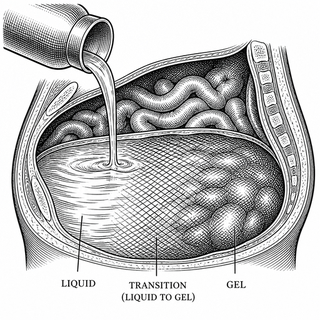
So I understand the appeal of the alternative a French research team just floated: what if you could skip the plumbing entirely and instead pour in a liquid that turns into a slow-release chemotherapy gel right there in the body? That is the pitch behind TGel-MMC, and the new paper (record 41926868 on PubMed) is the first time anyone has tested it in a large animal with actual surgical stitches involved. Let's pump the brakes a little and walk through what they did, because the idea is genuinely clever and the execution is more careful than most "first" papers.
The problem: cancer's annoying habit of coming back
Colorectal cancer surgeons have a recurring nightmare, and its name is peritoneal carcinomatosis. The peritoneum is the membrane lining your abdominal cavity, and it is a popular vacation destination for stray cancer cells that escape during or after surgery. They settle in, set up shop, and the result is one of the harder forms of recurrence to treat.
The current prophylactic answer is intraperitoneal chemotherapy, often Mitomycin C (MMC), delivered via that heated HIPEC bath I described. The drug works. The delivery method is just demanding. And because the bath washes through and drains out, the tumor cells only get a relatively brief window of exposure.
The intervention: chemistry that pays attention to temperature
The star here is a poloxamer-based thermogel. Poloxamers are a class of polymers with a delightful party trick: they are liquid when cool and turn into a gel when warmed to body temperature. (Yes, this means the material's defining feature is that it does the opposite of butter.) You pour MMC-loaded thermogel into the abdomen as a liquid, it warms up, it sets into a gel, and then it slowly releases the drug over hours instead of dumping it all at once and draining away.
That sustained-release angle is the whole point. If the cancer cells get a longer, gentler exposure rather than one quick splash, the theory goes, you might kill more of them at lower doses. Lower doses are friends to surrounding healthy tissue, which is the part of the abdomen you would very much like to keep.
What they actually tested (in increasing order of nervousness)
This is where I want to give the authors credit, because they built their case in sensible stages rather than leaping straight to "let's try it on something with a heartbeat."
In a dish. They grew CT26 colon cancer cells and exposed them to the MMC thermogel using an alamar blue assay, which is a standard way of measuring whether cells are alive and metabolically grumpy or dead and silent. Prolonged exposure to TGel-MMC boosted the drug's cytotoxicity at low doses. Good start, and exactly what the slow-release hypothesis predicts.
In mice. They checked two things: does the gel itself cause trouble, and does the drug-loaded version actually reduce tumor burden? The plain thermogel did not cause significant adhesions or widespread inflammation out to 63 days, which is reassuring because the last thing you want from your anti-cancer scaffolding is for it to glue organs together. The TGel-MMC matched plain MMC for prophylactic cytoreduction. So the gel did not blunt the drug's punch.
In pigs. Here is the headline act. Pigs got a laparotomy and anastomoses, meaning the surgeons cut into the bowel and sewed it back together, then introduced the gel. The worry with putting chemotherapy near fresh intestinal sutures is obvious and grim: chemo can impair healing, and a leaking bowel join (an anastomotic fistula) is a serious complication. Through day 15, they reported no anastomotic fistulae and no chemical peritonitis. The pharmacokinetics were the genuinely interesting bit: MMC absorption looked highly comparable to standard HIPEC, peaking at one hour and tapering over six. So the gel delivers a drug exposure curve in the same neighborhood as the established method, without the heated bath.
Now for the brake-pumping
This is a feasibility and short-term safety study, and the authors say so plainly, which I appreciate. A few things keep my enthusiasm from boiling over.
First, "no fistulae through day 15" is encouraging but it is a small window and, in pigs, presumably small numbers. Surgical safety signals from a handful of animals over two weeks are a green light to keep going, not a clearance for the operating room.
Second, and this is the big one: nobody has shown this cures anything in a large animal, because the pig study was about safety, not tumors. The efficacy evidence lives in mice and a dish. Mice are wonderful, but the graveyard of oncology is paved with therapies that dazzled in rodents and shrugged in humans.
Third, "comparable pharmacokinetics to HIPEC" is a clever framing, but matching a drug curve is not the same as matching an outcome. Equivalent absorption is a promising proxy, not a finish line.
Why it is still worth watching
If this holds up, the appeal is real. A pour-in, self-gelling, sustained-release chemotherapy that skips the heated circulation rig could make peritoneal prophylaxis simpler, faster, and available at centers that cannot run a full HIPEC program. Simpler usually means more patients can actually access it, and access is where a lot of good ideas quietly die.
The authors are asking for further investigation, not a parade, and that is the right ask. This is a solid early brick. Whether the building stands is several careful studies away.
This blog post discusses research findings and should not be taken as medical advice. If you have concerns about colorectal cancer or peritoneal recurrence, please consult a healthcare provider. Research discussed here represents ongoing scientific investigation and clinical validation is still in progress.
All images used in this post are decorative illustrations only and do not represent or reflect the accuracy, reality, or correctness of the referenced research.
Primary Source: First preclinical evaluation of a thermogel delivering mitomycin C: sustained local release with preserved surgical safety in a large animal model. PubMed. 2026. PMID: 41926868