
Pop quiz: what do a flowering garden vine, the yellow stuff in your curry, and a salad dressing that refuses to separate have in common? According to a new study, they can all be combined into a delivery system that holds together in your gut, breaks apart on cue, and survives being assembled and disassembled at least eight times without losing its nerve. If your last attempt at homemade vinaigrette separated before it reached the table, you should be a little insulted by that.
Let me back up, because there are a few moving parts here, and as a parent I have learned that "a few moving parts" is usually code for "someone is about to lose a tooth or a kidney."
The problem with getting good things into the body
Curcumin is one of those compounds that sounds like a miracle on paper. It is the pigment that makes turmeric yellow, it has been studied for inflammation and a long list of other things, and it is the subject of roughly nine thousand hopeful internet articles. The catch, and there is always a catch, is that curcumin is famously bad at actually getting absorbed. You can eat a respectable amount of it and your body shrugs, processes almost none, and moves on. It is the nutritional equivalent of a kid who "did" their homework but cannot produce it.
So scientists have spent years building tiny transport systems to smuggle compounds like curcumin where they need to go. The trouble is that a lot of these systems lean on synthetic ligands or chemical tinkering, which is fine until you remember you would like the carrier itself to be safe and boring. The dream is a delivery vehicle made of stuff that was already food-adjacent, that responds to the body on its own, without a chemistry set bolted to the side.
Enter the humble plant stem
This is where the bougainvillea comes in. Yes, the same thorny ornamental vine that grows over fences and quietly draws blood from anyone who trims it. Researchers took stems of Bougainvillea spectabilis and ran them through an acid and alkali biorefining process. The result was lignocellulose-derived colloidal particles, which the paper mercifully shortens to LCPs.
Here is the clever bit. During that processing, the particles grew carboxyl groups in place, no extra chemical decoration required. Those carboxyl groups are essentially tiny pH sensors. In plain terms, the particles can feel whether their surroundings are acidic or alkaline and behave accordingly. The plant stem learned to read the room.
Pickering emulsions, or how to make oil and water cooperate
To understand what these particles do, you need one quick concept: the Pickering emulsion. Normally oil and water want nothing to do with each other, the way two toddlers who "are not friends right now" want nothing to do with each other. A Pickering emulsion solves this by parking solid particles at the boundary between the oil and water droplets, forming a physical fence that keeps everything from merging back into a sad separated mess. No soapy chemical emulsifiers needed, just particles doing crowd control.
The LCPs in this study did exactly that, and they did it for high-internal-phase Pickering emulsions, which are the dense, packed-tight versions where droplets are crammed together like commuters on a Monday train. Under alkaline conditions, the particles stabilized the whole arrangement beautifully. Under acidic conditions, they let go in a controlled way and the emulsion came apart on purpose. Stable when you want it, falls apart when you want it. That second part is the whole point.
And the reversibility is the genuinely impressive trick. The system held over 95 percent stability across at least eight full cycles of forming and breaking apart. Eight rounds, and it still showed up to work. I have appliances that quit after eight uses, so I have a quiet respect for any plant-derived particle with that kind of stamina.
What this means for actually delivering curcumin
Once they had a pH-responsive emulsion that obeyed commands, the team loaded it with curcumin. The encapsulation efficiency reached 92.5 percent, meaning the system captured the overwhelming majority of the curcumin rather than letting it wander off. For a compound as slippery and uncooperative as curcumin, getting nine out of ten molecules to stay put is a small victory worth noting.
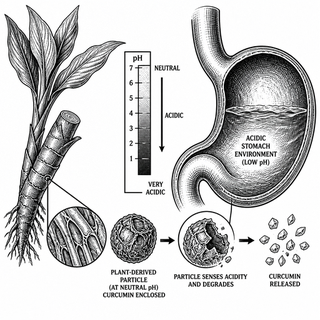
Then came the release tests. In simulated gastric fluid, the kind of acidic environment your stomach offers, the curcumin released faster, which lines up neatly with the particles' habit of demulsifying under acidic conditions. The acidic stomach is the trigger that tells the emulsion to start unpacking its cargo. The release followed a Higuchi-type pattern, which is a well-worn mathematical way of describing how a substance steadily diffuses out of a carrier over time, rather than dumping all at once like a piñata.
The cleverness here is that the whole behavior is built in. No synthetic switches, no added chemical modifications. The pH-responsiveness comes from the carboxyl groups that formed during the biorefining of a plant stem. The trigger is something the body already supplies for free: a change in acidity.
The part where I temper my own excitement
As a parent, my reflex with any promising study is to ask the unglamorous question: will this help my kid, and when? And the honest answer here is the usual one. This is laboratory work, with simulated digestive fluids rather than actual digestion, actual humans, or actual long-term safety data. Simulated gastric fluid is a reasonable stand-in, but it is not a person, and a person is a far messier and more opinionated environment than any beaker.
What makes this interesting is the direction it points. A delivery system built from agricultural and plant material, that responds to the body without synthetic add-ons, that can be reused many times over, addresses several headaches at once: the poor absorption of compounds like curcumin, the safety questions around synthetic emulsifiers, and the general wastefulness of single-use materials. Turning a thorny garden vine into a smart, reusable carrier is the kind of resourcefulness I genuinely admire, ideally from a safe distance where the thorns cannot reach me.
For now, it is a smart proof of concept with good numbers and a sensible idea behind it. The road from clever emulsion to anything on a shelf is long, paved with follow-up studies, and not remotely guaranteed. But the underlying notion, that we can coax everyday plant material into doing precise, responsive jobs inside the body, is the sort of thing worth keeping an eye on. Right after I go check whether anyone actually did their homework.
This blog post discusses research findings and should not be taken as medical advice. If you have concerns about curcumin supplementation, digestion, or any related health matter, please consult a healthcare provider. Research discussed here represents ongoing scientific investigation and clinical validation is still in progress.
All images used in this post are decorative illustrations only and do not represent or reflect the accuracy, reality, or correctness of the referenced research.
Primary Source: Lignocellulose processing-induced pH-responsive Pickering emulsions for curcumin delivery. PubMed. 2026. PMID: 41819914