
A newborn enters the world perfectly healthy, takes a first breath, and somewhere in that same tender moment quietly inherits a virus that will keep company with the liver for the rest of a long life. That is the scenario this research is built to prevent: hepatitis B passed from mother to child at birth, a handoff so silent that nobody in the delivery room would ever notice it happening. Stop it, and you spare a person decades of risk. Miss it, and the consequences unfold across a lifetime.
For most of my career, the conversation about preventing that handoff stayed on familiar ground. Find the mothers carrying the virus, work out which ones need antiviral medicine during pregnancy, treat them, and the chain breaks. Sensible, humane, well-trodden. What this study from the Gambia does is ask a question that would have struck my younger self as faintly eccentric and now strikes me as overdue: while we are busy testing all those mothers, how much carbon are we coughing into the atmosphere to do it?
The puzzle behind the puzzle
Let me set the stage, because the medicine here is genuinely elegant before we get to the bookkeeping.
Hepatitis B can travel from mother to baby during birth. We can interrupt that journey, but not everyone needs the same intervention. The mothers most likely to pass the virus along are those carrying a lot of it, and for them a course of antiviral prophylaxis during pregnancy dramatically lowers the odds of transmission. So after a woman screens positive for the hepatitis B surface antigen, which is the first flag that says "this person carries the virus," clinicians need a second test. That second test answers the operative question: is there enough virus here to warrant treatment?
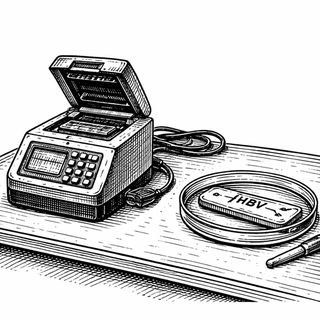
The gold standard for measuring viral load is a polymerase chain reaction test, the same PCR that became a household acronym during a certain global unpleasantness we need not relive. PCR is exquisitely sensitive. It is also, to put it gently, a high-maintenance houseguest. It wants reagents, cold storage, plastic consumables, machinery, and a steady electrical supply, none of which fall from the sky in a rural clinic.
The challenger is a rapid diagnostic test for something called hepatitis B core-related antigen, mercifully shortened to HBcrAg. Think of it as a clever proxy. Rather than counting viral copies directly, it detects a protein that tracks with how much virus is present, and it does so on a simple strip that can run on a drop of plasma or even a prick of capillary blood from a fingertip. No cold chain marathon, no humming machine.
The carbon ledger nobody used to keep
Here is where the Gambian team did something I find quietly admirable. In 2024 they ran a life cycle assessment, which is the environmental equivalent of following a receipt all the way back to the factory. They did not merely glance at the test and guess. They tallied every product and process in each diagnostic strategy and tried to account for it.
A life cycle assessment is a bit like working out the true cost of a dinner party. It is not just the food on the plate. It is the petrol to the market, the packaging, the energy to cook, the dishes afterward, and the rubbish you haul out at midnight. Applied to a diagnostic test, that means the plastics, the reagents, the electricity, the shipping, the waste stream, the lot. They did this across four real-world settings: a rural hospital, a suburban hospital, an urban hospital, and a suburban health centre. Not a tidy laboratory simulation, but the actual messy world where care happens.
Their unit of measurement was a single antenatal testing episode, beginning the moment after a positive surface antigen screen, and they reported the results in grams of carbon dioxide equivalent. One test, one carbon tally.
What they found
The headline is clean. The point-of-care PCR strategy carried a significantly heavier carbon footprint than the HBcrAg rapid diagnostic tests. Switching to the antigen strips reduced emissions substantially.
It makes intuitive sense once you picture the two side by side. PCR drags an entourage of equipment and consumables behind it like a touring rock band, while the rapid test arrives with a carry-on bag. The capillary blood version trims things even further, since it skips some of the plasma processing that PCR demands.
Now, before anyone declares the matter settled, I will play the role I have played in countless faculty meetings: the fellow at the back clearing his throat. A lighter carbon footprint is only a virtue if the test still finds the mothers who need treatment. The environmental argument and the clinical argument have to walk arm in arm, and a diagnostic that misses cases to save a few grams of carbon would be a poor bargain indeed. This study was measuring emissions, not relitigating the accuracy debate, and that distinction matters. The promise of HBcrAg testing rests on a separate body of work showing it can reasonably stand in for viral load measurement in this setting.
Why this is more interesting than it sounds
There is a larger story tucked inside this one, and it is the part I keep turning over.
Healthcare is a surprisingly thirsty consumer of carbon. By various estimates the global health sector accounts for something on the order of four to five percent of worldwide emissions, which would make it a respectable mid-sized country if it had a flag. We have spent decades, rightly, asking whether a test is sensitive, specific, affordable, and practical. Asking whether it is clean is a newer line of inquiry, and one that resource-constrained settings have every reason to lead rather than follow.
That is the second quiet triumph here. The researchers showed that a life cycle assessment is feasible in exactly the kind of setting where people assume such careful accounting is a luxury. There is a tidy irony in a rural Gambian clinic producing the sort of environmental data that many gleaming hospitals in wealthier nations have never bothered to collect. Sometimes the people with the fewest resources are the ones who count most honestly.
If this approach catches on, the implications stretch well past hepatitis B. Every diagnostic pathway, every screening program, every routine bit of laboratory work becomes a candidate for the same question: is there a way to get the same answer with a lighter touch on the planet? Multiply a modest per-test saving across millions of antenatal visits a year and the arithmetic stops being trivial.
For now, the takeaway is modest and rather lovely. In the specific business of deciding which expectant mothers need antiviral protection, a simple antigen strip may do the job while emitting far less carbon than the machinery it could replace. The baby is protected. The atmosphere breathes a little easier. It is not often that the smaller, simpler, cheaper option also turns out to be the greener one, and when those stars align, it is worth pausing to enjoy it.
This blog post discusses research findings and should not be taken as medical advice. If you have concerns about hepatitis B during pregnancy or hepatitis B vertical transmission, please consult a healthcare provider. Research discussed here represents ongoing scientific investigation and clinical validation is still in progress.
All images used in this post are decorative illustrations only and do not represent or reflect the accuracy, reality, or correctness of the referenced research.
Primary Source: Carbon emissions associated with antenatal testing for hepatitis B prophylaxis eligibility, the Gambia. PubMed. 2024. PMID: 42058608