
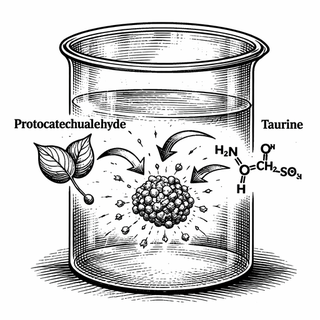
Think of the best one-pot recipes you know, the kind where you toss everything into a single vessel, let chemistry do the stirring, and walk away with something far more sophisticated than the sum of its parts. Now imagine the dish is a medicine, the pot is a beaker, and the two ingredients are a plant-derived antioxidant and a molecule your gym buddy swears is in their pre-workout. That is essentially what a team of researchers just pulled off, and the result is a tiny nanoparticle aimed squarely at one of humanity's most disproportionately annoying afflictions: the oral ulcer.
The Tiny Villain in Your Mouth
If you have ever bitten the inside of your cheek and spent the next week treating soup like a hostile interrogation, you know oral ulcers. They are the most common disease of the oral mucosa, and despite being small enough to lose in a salad, they punch comically above their weight class in misery.
The villain origin story here is a chemistry problem. When the tissue inside your mouth gets injured or inflamed, it accumulates a local overload of reactive oxygen species, or ROS. These are unstable molecules that are great in small doses and absolutely menacing in large ones, sort of like glitter. Pile up enough of them and they start tearing through tissue, which breaks things down, which leads to the open sore, which leads to more inflammation, which produces more ROS. It is a feedback loop with the energy of a group chat that will not stop pinging.
Most existing treatments mostly tell you to wait it out and avoid orange juice. So the appeal of attacking the actual root cause, that runaway oxidative chaos, is real.
Two Ingredients Walk Into a Beaker
Here is where the recipe gets fun. The researchers built their nanoparticle out of two natural-ish characters.
The first is protocatechualdehyde, a polyphenol found in plants. Polyphenols are the celebrated antioxidants you hear about in green tea and dark chocolate think tanks. Their whole personality is mopping up free radicals.
The second is taurine, which you may recognize from the ingredient list of every energy drink ever marketed to someone studying for finals. Taurine is a naturally occurring amino acid with genuine anti-inflammatory credentials, and no, it does not actually come from bulls, despite decades of branding suggesting otherwise.
Using what the team calls a one-step oxidative copolymerization strategy, they cross-linked these two molecules into pH and ROS dual-responsive nanoparticles, which they snappily abbreviate as PAT NPs. "One-step" is the part chemists get genuinely excited about, the molecular equivalent of a sheet-pan dinner instead of a five-course tasting menu. Fewer steps means fewer chances for things to go sideways and a far easier path to scaling up later.
The "Dual-Responsive" Part Is the Clever Bit
Calling these particles "dual-responsive" is not just lab-coat flair. It means the PAT NPs are designed to react to two specific conditions: changes in pH and the presence of ROS. An ulcer site happens to be both acidic and swimming in reactive oxygen species, so the nanoparticle is engineered to activate precisely where the trouble is.
This is the difference between a smoke detector that screams constantly and one that only goes off when there is actually a fire. The particle stays relatively quiet until it senses it has arrived at the chaos, then gets to work. It is targeting through chemistry rather than through GPS, which is honestly more elegant.
A Surprisingly Long Resume for Something So Small
What impressed me reading through the findings is how many jobs these particles apparently hold down at once. The PAT NPs do not just scavenge free radicals, though they do that efficiently. The list of functions reads like a LinkedIn profile written by someone who is technically not lying but is definitely flexing:
- Efficiently scavenging free radicals (the headline act)
- Neutralizing lipopolysaccharide, a nasty bacterial molecule that triggers inflammation
- Protecting mitochondria, the cellular power plants that ROS loves to sabotage
- Inhibiting M1 macrophage polarization while promoting M2 polarization
That last one deserves a translation. Macrophages are immune cells that can swing between two broad modes. M1 is the aggressive, inflammation-stoking mode, the cell equivalent of the friend who escalates every argument. M2 is the calmer, repair-and-rebuild mode. The PAT NPs essentially talk the macrophages off the M1 ledge and coax them toward M2, shifting the local environment from "burn it all down" to "let's fix this."
On top of that, the particles promote anti-inflammatory activity, encourage cell migration, and boost angiogenesis, which is the formation of new blood vessels. Healing tissue is hungry tissue, and new blood vessels are the supply lines that feed it.
Does It Actually Work?
A long resume is meaningless if the candidate cannot perform on the job, so the team tested the particles in an animal ulcer model. The results were encouraging across the board. The PAT NPs simultaneously dialed down inflammation, promoted vascularization, and significantly shortened ulcer healing time. They also showed excellent biocompatibility, which is the unglamorous but genuinely deciding factor for anything you intend to put in a mouth.
Healing faster and healing cleaner, driven by something built from a plant compound and an energy-drink amino acid, is a genuinely satisfying result. The researchers frame it as a new paradigm for translating natural polyphenol-taurine nanomaterials into oral mucosal repair, which is the academic way of saying they think this approach has legs.
Why This Is More Interesting Than a Canker Sore Deserves
It would be easy to shrug at mouth ulcer research, the way one shrugs at a sequel nobody asked for. But the broader idea here is the part worth holding onto. We have a class of common, painful, hard-to-treat conditions driven by oxidative stress and runaway inflammation. If you can engineer a cheap, biocompatible particle from natural building blocks that intervenes in that exact cycle and only activates where it is needed, the template could extend well beyond the mouth.
This is still early work in animals, and the road from a promising mouse to an approved human therapy is famously long and littered with attempts that looked great in act one. But as far as one-pot recipes go, this one looks like it might be worth saving to the cookbook.
This blog post discusses research findings and should not be taken as medical advice. If you have concerns about oral ulcers or oral mucosal conditions, please consult a healthcare provider. Research discussed here represents ongoing scientific investigation and clinical validation is still in progress.
All images used in this post are decorative illustrations only and do not represent or reflect the accuracy, reality, or correctness of the referenced research.
Primary Source: Natural polyphenol-taurine-based nanoparticles for oral ulcer therapy. PubMed. 2026. PMID: 41989033