
If you buzzed in with "a 3D-printed spinal disc designed by stress maps," congratulations, you win the imaginary money and the genuine admiration of engineers everywhere. The answer is a gyroid-lattice implant called G65N, and it might be one of the more clever solutions to a problem I've watched walk through the ER doors more times than I can count.
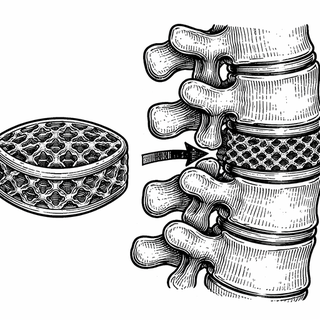
Let me set the scene. Low back pain is the all-star of human misery. It is the number one cause of disability worldwide, and a huge chunk of it traces back to the intervertebral disc - the squishy little cushion sitting between each of your vertebrae. Think of it as a jelly donut wedged between two stacked dinner plates. The donut absorbs shock, lets you twist and bend, and generally keeps your spine from grinding itself into gravel. When that donut starts to dry out and flatten with age, the result is the kind of pain that makes grown adults rethink every decision that led to picking up that one suspiciously heavy box.
The Old Fix Has a Plot Twist
For decades, the gold-standard treatment for a busted disc has been spinal fusion. The surgeon removes the failing disc and welds the two neighboring vertebrae together into one solid block. It works. The pain often improves. But here's the catch that nobody loves to put on the brochure: you have just permanently eliminated motion at that joint.
Your spine, being a team player, compensates. The segments above and below the fusion start picking up the slack, doing extra work they were never designed to do. Over time, those neighbors wear out too. It is called adjacent segment degeneration, and it is basically your spine's version of overworking the one responsible coworker until they also quit.
Enter artificial total disc replacement, the supposed upgrade. Instead of fusing, you swap the bad disc for a synthetic one and keep your mobility. Great idea on paper. The problem is that conventional implants have a tough time mimicking the actual mechanics of a real disc, which is a deceptively complicated little organ. The result has been disappointingly high reoperation rates - and a second spine surgery is nobody's idea of a fun sequel.
So They Asked the Spine What It Wanted
This is where the new study gets interesting. Rather than designing an implant and hoping it behaves, the research team flipped the script. They built a detailed finite element model of the L1-L2 functional spinal unit - essentially a high-resolution digital twin of two vertebrae and the disc between them - and then they put it through its paces.
They applied a 500 newton axial force and a 7.5 newton-meter twisting moment, then mapped how stress travels through a natural disc across seven everyday movements: standing upright, bending forward, leaning back, tilting side to side, and rotating left and right. In other words, they recorded the spine doing all the ordinary things it does between the moment you wake up and the moment you regret your posture.
Armed with that stress roadmap, they designed implants out of gyroid unit cells. A gyroid is a continuous, mathematically smooth lattice structure - imagine a sponge that an architect obsessed over, all flowing curves and interconnected channels with no sharp corners to concentrate stress. They graded the design so different regions had different stiffness, matching the way a real disc is firm in some spots and forgiving in others. The goal was simple to state and fiendishly hard to achieve: build something that moves, absorbs shock, and gets along with living tissue.
Meet G65N, the Overachiever
Several designs were tested, but two rose to the top: G65N and G65Y. Both came impressively close to natural disc mechanics. G65N, though, was the one that quietly aced every category - the kid who studies for the test and still makes it look effortless.
It showed reduced sensitivity to how fast it was loaded, meaning it behaved predictably whether you eased into a stretch or jolted it. It dissipated less irreversible energy, which is engineer-speak for "it doesn't waste your motion as heat and wear." And it held up under cyclic loading, the relentless squeeze-release-squeeze of millions of daily steps.
The numbers back it up. With G65N implanted, the spinal unit handled stress ranges from a whisper of 0.00009 MPa up to 26.6 MPa under compression, and up to 54.09 MPa under flexion. More importantly for the long game, it produced lower endplate contact pressure (2.59 MPa) and less axial displacement (1.86 mm). Translation: a meaningfully reduced risk of the implant sinking into the bone over time, a complication called subsidence that ranks high on the list of reasons these devices fail.
The Biology Showed Up Too
A spinal implant can be a mechanical masterpiece and still flunk the most important exam, which is whether your body tolerates it. Here both designs delivered. In the lab, cells didn't just survive on the implants - they proliferated steadily and politely lined up along the lattice struts, with G65N edging ahead on cell growth. Both designs also showed high permeability, letting fluid and nutrients flow through the structure the way they would through healthy tissue. That permeability matters, because a disc that can't breathe is a disc that's already drafting its own obituary.
Why This Matters Outside the Lab
The headline here isn't just "better disc." It's the method. Designing the implant from the spine's own stress patterns is a fundamentally smarter approach than the traditional "build it, implant it, find out at the follow-up appointment" strategy. If this stress-driven, graded-lattice philosophy holds up through animal studies and eventual clinical trials, it could mean fewer reoperations, preserved motion, and a lower chance that fixing one disc quietly sentences its neighbors.
We are not there yet. This is computer modeling and cell-culture work, which is the promising opening chapter, not the published novel. But for the millions of people whose backs file a daily complaint, a disc replacement that finally acts like the real thing is a story worth following.
This blog post discusses research findings and should not be taken as medical advice. If you have concerns about low back pain or disc degeneration, please consult a healthcare provider. Research discussed here represents ongoing scientific investigation and clinical validation is still in progress.
All images used in this post are decorative illustrations only and do not represent or reflect the accuracy, reality, or correctness of the referenced research.
Primary Source: Stress-driven design of intervertebral disc implants and optimization of mechanical and biological performance. PubMed. 2026. PMID: 42006909