
Here was the puzzle keeping a team of metabolic engineers up at night: they had built strains of E. coli engineered to crank out a valuable industrial chemical, and the bugs were doing their job. Sort of. Production would ramp up, then stall, then sputter, like a factory that mysteriously slows down every afternoon for reasons nobody can name. The chemical was being made. It was leaving the cell. And then, inexplicably, some of it was coming right back in - dragged across the membrane and dumped back into the very cytoplasm the cell was trying to clear out. The researchers eventually identified the culprits, and they turned out to be a handful of overzealous molecular bureaucrats with a fondness for paperwork that nobody asked them to file.
Let me back up, because the chemical itself matters.
What 3-HP is and why anyone cares
The molecule at the center of this story is 3-hydroxypropionic acid, or 3-HP, which sounds like a wifi password but is actually one of the more coveted building-block chemicals in green manufacturing. The U.S. Department of Energy has long listed it among the "top value-added chemicals" you can squeeze out of biomass, because 3-HP is a gateway to acrylic acid, biodegradable plastics, coatings, and a pile of other things currently made from petroleum. Get bacteria to produce it cheaply and you have a renewable feedstock for products that normally start their lives in an oil refinery.
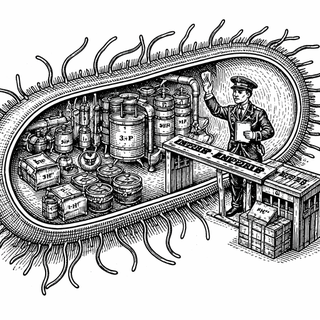
The catch is the one that haunts nearly all microbial production: the cell is both the factory and the worker living inside the factory. When you engineer a microbe to overproduce something, that something tends to pile up. And cells, like the rest of us, do not thrive when surrounded by mounting heaps of their own output. Intracellular accumulation slows growth, drags down productivity, and generally turns an enthusiastic little chemical factory into a stressed-out one.
The obvious fix that nobody could actually do
The intuitive solution is elegant: stop the product from coming back inside. If the chemical leaves the cell and stays out, the internal heap never builds up. The problem is logistical. To stop import, you need to know which genes are running the import operation - which membrane proteins are, in effect, the customs officials waving the product back through the gate. For native compounds the cell evolved to handle, that catalog sometimes exists. For a non-native product like 3-HP, which E. coli never signed up to deal with in the first place, the import machinery was essentially undocumented. You cannot deregulate an industry when you do not have a list of the regulators.
So the team did something I find genuinely clever: instead of guessing gene by gene, they built a system to make the cells confess.
How they found the moles
Their workflow reads like a sting operation. First, they assembled a genome-wide overexpression library - meaning they made a vast population of E. coli, each individual cranking up a different gene from the genome. Somewhere in that crowd were the cells whose boosted gene happened to import more 3-HP. The trick was spotting them.
For that, they installed a 3-HP-responsive fluorescent biosensor: a molecular tattletale that glows brighter the more 3-HP is sitting inside the cell. Then they ran the whole population through flow cytometry, which sorts cells one by one at high speed and plucks out the brightest. The cells lighting up like little beacons were precisely the ones importing extra product. (A rare case where being caught red-handed involves literally emitting light.)
The standout informant was a gene called narQ. Strains overexpressing it shone with a 3-fold higher fluorescence signal - a strong tell that narQ was somehow turning up the import dial. But narQ itself is a sensor protein, more of a middle manager than a frontline gate agent. So the team profiled the whole transcriptome under NarQ overexpression to see who it was bossing around. That revealed a distinct set of membrane-associated genes getting switched on: acrD, mliC, and the pgaABCD cluster. Functional tests confirmed it - overexpressing these genes enhanced 3-HP import, exactly as the fluorescent finger-pointing had implied.
The payoff: fire the importers, boost the output
Here is the part that turns a tidy mechanistic story into something an industrial fermentation manager actually wants to read. When the researchers deleted those import-related genes in actual 3-HP-producing strains, titers climbed by up to 21% compared with the control. Same metabolic engine, same feedstock, but with the molecular customs officials sent home, more product stayed out where it belonged and the cells kept working instead of drowning in their own success.
Twenty-one percent does not sound like a revolution until you remember that industrial bioprocessing lives and dies on the margins. Yield improvements in the low double digits are the difference between a process that pencils out and one that stays a lab curiosity. A 21% bump, achieved not by rebuilding the whole metabolic pathway but by removing a few genes that were quietly working against the goal, is the kind of efficiency gain that gets a process closer to competing with petroleum on cost.
Why the method outlasts the molecule
The genuinely systemic contribution here is not the 21%, satisfying as it is. It is the workflow itself. Until now, hunting for import genes - especially for products the cell never evolved to recognize - was a slow, hypothesis-by-hypothesis grind. This team built a general-purpose procedure that reads import-related genes directly out of genomic DNA: overexpress everything, let a biosensor glow, sort the glowers, trace the regulatory chain, then delete the offenders. Swap in a different biosensor and the same pipeline could, in principle, deregulate the import problem for a whole catalog of other valuable chemicals.
That is the quiet promise. Microbial production platforms have spent decades optimizing how cells make things. This is a reminder that how cells retain things is an equally large lever, and one that has been hiding in plain sight inside membranes nobody had fully mapped. Sometimes the most productive policy reform is not building a new factory - it is auditing the people standing at the loading dock and reassigning the ones who keep carrying the goods back inside.
This blog post discusses research findings and should not be taken as medical or industrial-process advice. If you have questions about biomanufacturing or metabolic engineering applications, please consult a qualified specialist. Research discussed here represents ongoing scientific investigation and further validation is still in progress.
All images used in this post are decorative illustrations only and do not represent or reflect the accuracy, reality, or correctness of the referenced research.
Primary Source: Genome-Scale Engineering Importing Property of Escherichia coli for Improving Production of 3-Hydroxypropionic Acid. PubMed. 2026. https://pubmed.ncbi.nlm.nih.gov/42050378/