
Okay, real talk: most of us only think about laboratory medicine when we are waiting for test results and trying not to refresh the patient portal like it owes us money. But behind every blood test, infection screen, tumor marker, and molecular assay is a constant engineering problem: how do we detect tiny biological signals faster, more accurately, and with less sample, cost, and complexity? A new review on carbon dots suggests that these microscopic glowing particles may become the lab medicine equivalent of R2-D2: small, weirdly versatile, and constantly saving the mission while everyone else is arguing in a control room.
So, What Are Carbon Dots?
Carbon dots, often shortened to CDs, are zero-dimensional carbon-based nanomaterials. “Zero-dimensional” does not mean they live in a physics basement with no personality. It means they are extremely small nanoparticles, usually only a few nanometers across, where quantum-scale effects start to matter.
Their big party trick is photoluminescence. Shine light on them, and they can emit light back. Depending on how they are made and modified, that glow can be tuned for different detection and imaging tasks. In lab medicine, that is a very big deal, because many diagnostic tests depend on seeing a signal that tells us whether a molecule, microbe, cell type, or disease marker is present.
Carbon dots also bring several practical advantages to the bench. They can have high photoluminescence quantum yield, meaning they can glow efficiently. They are generally considered biocompatible, which matters if they are going anywhere near cells, tissues, or biological samples. And their surfaces can be functionalized, which is engineer-speak for “we can decorate them with useful chemical features.” Think of them like tiny LEGO studs with lab coats.
How Do Scientists Make These Tiny Glow Machines?
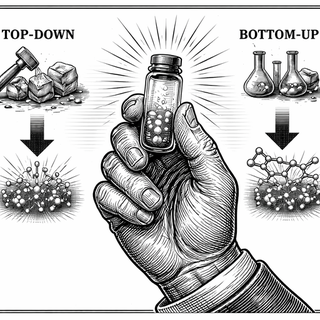
The review describes two major routes: top-down and bottom-up synthesis.
Top-down methods start with larger carbon materials and break them down into nanoscale dots. It is a little like taking a carbon block and saying, “Congratulations, you are now confetti,” except with more controlled chemistry and fewer party hats.
Bottom-up methods build carbon dots from smaller molecular precursors. These approaches can offer more control over composition and surface chemistry, which is helpful when the goal is to make particles that behave predictably in a diagnostic test.
That last word, predictably, is doing a lot of work. In medicine, “it glows beautifully sometimes” is not enough. A diagnostic tool needs to perform reliably across batches, labs, sample types, and real patients. That is where the field still has some work to do.
Why Lab Medicine Is Interested
Laboratory medicine is full of detection challenges. Many clinically useful molecules appear in tiny amounts. Some are hard to distinguish from similar molecules. Others are present in messy biological environments like blood, urine, tissue extracts, or cell cultures, where proteins, salts, enzymes, and cellular debris are all photobombing the experiment.
Carbon dots may help because their optical properties can be paired with chemical selectivity. In principle, they can be engineered to respond to specific biomolecules, such as proteins, nucleic acids, and small biological molecules. If the target is present, the carbon dot signal might brighten, dim, shift, or otherwise change in a measurable way.
That means CDs could support sensitive assays for disease markers. For example, nucleic acid detection matters in infectious disease testing and genetic diagnostics. Protein detection matters for cancer markers, inflammation, cardiac injury, and countless other clinical questions. Small biomolecules can tell us about metabolism, organ function, oxidative stress, and biochemical imbalance.
Basically, carbon dots are being explored as molecular signal translators. Biology whispers; the dot glows louder.
Microbes, Imaging, and Diagnostic Possibilities
The review also highlights microbial identification. That is a major area because faster pathogen detection can influence treatment decisions, infection control, and antibiotic stewardship. A method that helps distinguish microbes quickly could be clinically valuable, especially when time-sensitive infections are involved.
Carbon dots may also be useful for cell and tissue imaging. Because they can glow and can be engineered for biological compatibility, they may help researchers visualize cellular structures, track biological processes, or highlight disease-related changes. This is where the technology starts feeling a little like the scanning visor in a sci-fi medical bay, except the real version requires calibration curves, controls, and someone remembering to label the centrifuge tubes.
The review points to potential roles in diagnosing cancer, infectious diseases, and other disorders. That does not mean carbon dots are about to replace your local clinical lab analyzer next Tuesday. It means they are promising tools in the development pipeline, especially for tests that need to be faster, more sensitive, more portable, or more personalized.
The Engineering Catch: Reproducibility
Now for the part biomedical engineers quietly obsess over while everyone else is admiring the fluorescence images: reproducibility.
Carbon dots can be made in many ways, from many starting materials, using many reaction conditions. That flexibility is exciting, but it also creates a standardization problem. If two labs make “carbon dots” using different precursors, temperatures, purification steps, and surface modifications, are they really making the same thing? Maybe. Maybe not. Welcome to Nanomaterials: The Multiverse Saga.
The review identifies poor reproducibility and lack of standardized protocols as major barriers. This matters because clinical diagnostics demand consistency. A test cannot behave like a moody streaming service: crisp and reliable one day, buffering mysteriously the next.
To move toward real clinical use, researchers will need better control over synthesis, structure, optical behavior, surface chemistry, stability, and batch-to-batch variation. They will also need rigorous validation in clinically relevant samples, not just clean lab solutions where molecules behave politely.
Where This Could Go Next
The future directions are genuinely exciting. The review points toward multifunctional probes, clinical translation, artificial intelligence integration, microfluidics, and single-cell analysis.
Multifunctional probes could combine several capabilities in one carbon dot platform, such as targeting, sensing, imaging, and maybe even therapeutic monitoring. Microfluidics could pair well with CDs because tiny channels and tiny particles are natural collaborators. Imagine a compact diagnostic chip that moves a drop of sample through miniature reaction zones while carbon dots report what they find. Very “lab-on-a-chip,” very “Tony Stark would over-engineer the casing.”
Artificial intelligence could help interpret complex optical signals, optimize synthesis patterns, or classify diagnostic readouts. Single-cell analysis is another powerful direction because many diseases are not uniform. Tumors, immune responses, and infections can vary cell by cell. Tools that help measure those differences could support more personalized medicine.
What This Means for Everyday Patients
If carbon dot-based diagnostics mature, the payoff could be practical: faster tests, smaller samples, better sensitivity, and more personalized information. That could matter in settings ranging from large hospitals to point-of-care clinics, public health screening, and resource-limited environments.
The strongest promise is not that carbon dots are magical diagnostic glitter. It is that they may offer a flexible platform for building better assays. In modern medicine, platforms matter. Once a reliable platform exists, scientists can adapt it for many targets, from cancer biomarkers to microbial signatures to nucleic acid sequences.
There is still a gap between a promising nanomaterial and an approved clinical test. But this review makes a clear case that carbon dots deserve attention. They are bright, tunable, relatively biocompatible, and chemically adaptable. For particles that are almost comically small, they are carrying a surprisingly large diagnostic backpack.
This blog post discusses research findings and should not be taken as medical advice. If you have concerns about laboratory test results, cancer, infectious diseases, or any other medical condition, please consult a healthcare provider. Research discussed here represents ongoing scientific investigation and clinical validation is still in progress.
All images used in this post are decorative illustrations only and do not represent or reflect the accuracy, reality, or correctness of the referenced research.
Primary Source: Carbon dots in laboratory medicine: synthesis, properties, and applications. PubMed Record ID 42065543. PubMed: https://pubmed.ncbi.nlm.nih.gov/42065543/