
They said it could not really be done cleanly: make a small fluorescent probe that lights up deep red, resists photobleaching, gets into cells efficiently, and labels both lipid droplets and lysosomes without wandering around the cytoplasm like a tourist looking for the buffet. In cellular imaging, that is not a small ask. It is more like requesting a single kitchen gadget that can julienne carrots, sous-vide salmon, and also explain hospital reimbursement codes without sighing.
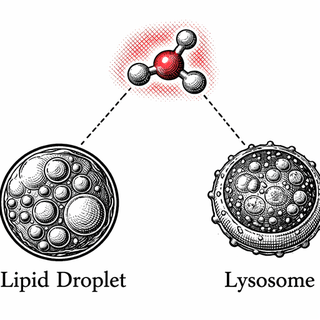
The research behind PubMed record 42065489 tackles exactly that problem with three newly designed 2,1,3-benzothiadiazole-based aggregation-induced emission luminogens, or AIEgens: MBM, DBD, and TBT. These are symmetric D-pi-A-pi-D molecules engineered to emit in the deep red range and concurrently stain lipid droplets, lysosomes, and even autophagosomes.
For anyone who has spent time around bioimaging tools, this is the sort of paper that makes you lean forward a little. Not because it instantly becomes a product, but because it addresses several familiar failure points at once: brightness, specificity, photostability, tissue-friendly emission, and practical synthesis.
Why Deep Red Matters
Fluorescent probes are workhorses in biology, diagnostics, and drug discovery. They let researchers watch cellular structures and processes that would otherwise be invisible. The catch is that not all light is equally useful.
Deep red emission, here reported around 630 to 740 nm, is valuable because longer wavelengths generally penetrate biological tissue better and produce less background noise from autofluorescence. In plain English, the signal is easier to see through the biological soup. That matters for imaging, especially when the goal is higher contrast, better photostability, and less interference from everything else in the sample trying to photobomb the experiment.
Traditional fluorophores have a long-standing nuisance: aggregation-caused quenching. Many dyes shine nicely when dispersed, then get dim when they cluster. Cells, however, are crowded, messy places. Molecules aggregate. Membranes accumulate dyes. Organelles are not polite little glass vials.
AIEgens flip that behavior. They become more emissive when aggregated. From an engineering standpoint, that is pleasingly backwards in the way only useful chemistry can be. It turns a common liability into a feature, like discovering your smoke alarm also makes excellent toast. Please do not test that at home.
The Target: Lipid Droplets and Lysosomes
Lipid droplets are cellular fat storage structures, but calling them “fat blobs” undersells them badly. They are active organelles involved in metabolism, stress responses, and disease biology, including cancer. Lysosomes, meanwhile, are acidic recycling centers that break down cellular materials.
The relationship between lipid droplets and lysosomes is especially interesting because of lipophagy, a process where lipid droplets are degraded through lysosomal pathways. When cells need to manage energy balance or metabolic stress, this interaction becomes part of the operating system.
For researchers, imaging both structures at the same time is useful because it can show how lipid metabolism and cellular recycling interact in real time. The problem is that many small-molecule dyes are not great multitaskers. Some diffuse through the cytoplasm before settling down. Others target one organelle but miss the paired biology. Some bleach under light exposure faster than a cheap patio umbrella in July.
This study reports probes that can label lipid droplets and lysosomes concurrently, with colocalization experiments supporting dual targeting. The probes also stained autophagosomes, which adds another layer because autophagy is closely tied to cellular cleanup, stress handling, and disease mechanisms.
The Engineering Angle: Balance, Not Magic
The useful part of this work is not just “new dyes are red.” The more interesting part is molecular balance.
MBM, DBD, and TBT were designed around a 2,1,3-benzothiadiazole core in a symmetric donor-pi-acceptor-pi-donor structure. That architecture supports deep red emission and AIE behavior. But organelle targeting is not only about brightness. The molecules also need the right hydrophobic and hydrophilic balance.
Too hydrophobic, and a probe may bury itself in lipid-rich structures or behave like oil in a salad dressing. Too hydrophilic, and it may float around in aqueous compartments or fail to cross membranes efficiently. The trick is getting enough compatibility with multiple cellular environments without turning the dye into a fluorescent free agent.
The study suggests these probes hit that balance well enough to show organelle specificity, efficient uptake, photostability, and tunable cytotoxicity. That last phrase deserves attention. In a research setting, tunable cytotoxicity can be useful because some probes may support imaging alone, while others may be explored for therapeutic or theranostic applications. In a commercial development setting, it also means the toxicology team gets invited early, which is always a festive meeting.
Why This Could Matter for Diagnostics and Drug Development
This is still preclinical chemical biology, not a device cleared for clinical use. But medical device and diagnostics companies should pay attention to enabling technologies like this because better probes can improve the whole imaging stack.
A fluorescent probe is not a finished diagnostic platform. It is one ingredient. But ingredients matter. A good sauce will not save bad pasta, but bad sauce can absolutely ruin good pasta. In bioimaging, the probe, optics, detector, software, sample preparation, and workflow all have to cooperate.
If deep red AIEgens like MBM, DBD, and TBT continue to perform well, they could support:
- Better live-cell imaging of lipid metabolism and autophagy
- Cancer biology research focused on metabolic reprogramming
- Screening assays for drugs that affect lipid droplets, lysosomes, or autophagic pathways
- Higher-contrast imaging where conventional dyes struggle
- Possible future theranostic designs that combine imaging and treatment functions
The comparison with Nile Red is especially relevant. Nile Red is widely used for lipid staining, but conventional dyes can suffer from photobleaching, background signal, or limited functional flexibility. The reported low photobleaching, large Stokes shifts, and strong AIE behavior make these new probes attractive on paper.
That phrase, “on paper,” is doing work. Papers are where promising technologies wear their best suit. Product development is where they are asked to commute, pay rent, and survive procurement.
The Business Reality Check
From a medical device industry perspective, the road from elegant fluorescent molecule to practical imaging tool is not automatic.
First, synthesis needs to be scalable and reproducible. The title emphasizes “easy access,” which is encouraging, because exotic chemistry that requires heroic purification steps tends to make operations teams reach for antacids.
Second, biological validation has to broaden. Cell studies are valuable, but a commercial imaging reagent or diagnostic-enabling probe must show consistency across cell types, disease models, sample handling conditions, and instrument platforms.
Third, regulatory and safety considerations depend heavily on intended use. A research-use-only imaging dye is one business model. A clinical diagnostic reagent is another. A therapeutic or theranostic agent is a much larger climb. Each path has different evidence requirements, quality systems, manufacturing expectations, and timelines.
Fourth, integration matters. If a probe requires special handling, unusual excitation settings, custom filters, or fragile workflows, adoption slows. Scientists may tolerate fiddly protocols. Clinical labs usually do not. They have schedules, budgets, and centrifuges with mysterious personalities.
What Makes the Study Intriguing
The paper is interesting because it does not chase only one performance metric. It combines deep red emission, aggregation-induced fluorescence, dual organelle targeting, autophagosome staining, photostability, and favorable uptake behavior. That combination is the point.
In a crowded field of fluorescent probes, incremental brightness is nice. Multipurpose performance is better. The ability to visualize lipid droplets and lysosomes together could help researchers study lipophagy and metabolic regulation with fewer compromises.
The therapeutic angle is also worth watching, though cautiously. Deep red AIEgens have been explored for bioimaging and therapy because they can offer strong signal, high contrast, and photostability. Whether these specific probes become therapeutic candidates will depend on much more data, including safety, selectivity, dose behavior, clearance, and in vivo performance.
Still, as a platform idea, it is attractive. A probe that can image relevant organelles, survive illumination, and possibly support downstream therapeutic strategies is the kind of multifunctional tool that gets translational teams interested. Then the spreadsheets arrive, because science is beautiful and budgets are legally binding.
The Takeaway
This research presents three benzothiadiazole-based symmetric deep red AIEgens that appear to solve a real imaging problem: concurrent staining of lipid droplets and lysosomes, with additional staining of autophagosomes. The reported properties, including red emission from 630 to 740 nm, strong AIE behavior, photostability, efficient uptake, and improved performance compared with conventional dyes like Nile Red, make the work notable.
The practical value will depend on what happens next: broader validation, biological reproducibility, manufacturing feasibility, safety profiling, and fit with real imaging workflows. But the core idea is solid. If you can make cellular structures light up where biology is actually happening, without the signal collapsing or the probe wandering off like it forgot its table number, you have something worth watching.
This blog post discusses research findings and should not be taken as medical advice. If you have concerns about cancer, metabolic disease, or any related condition, please consult a healthcare provider. Research discussed here represents ongoing scientific investigation and clinical validation is still in progress.
All images used in this post are decorative illustrations only and do not represent or reflect the accuracy, reality, or correctness of the referenced research.
Primary Source: Easy access to 2,1,3-benzothiadiazole-based symmetric deep red-AIEgens for concurrent staining of lipid droplets and lysosomes. PubMed Record 42065489. https://pubmed.ncbi.nlm.nih.gov/42065489/