
A while back, I sat with an older adult who had been carrying a bag full of pill bottles, appointment notes, and a look that said, with complete accuracy, "I am tired of explaining this story from the beginning." Nothing about the moment was dramatic in the television sense. It was just messy, slow, and deeply human. Symptoms did not line up neatly. Medications blurred the picture. Family members had pieces of the puzzle. It felt a bit like trying to solve a crossword where half the clues were written in disappearing ink.
That is why the clinical trial NCT07553559, titled Advancing Diagnostic Excellence For Older Adults Through Collective Intelligence And Imitation Learning, caught my attention. The study is testing whether an artificial intelligence clinical decision support system, or AI CDSS, is acceptable and feasible for use during primary care visits with older adults. In plain English, this is an effort to see whether technology can help clinicians, patients, and caregivers think more clearly together and reach the right diagnosis sooner.
Why diagnosis can be especially hard in older adults
Older adults are more likely to live with multiple health conditions at once. They may also be dealing with frailty, memory changes, or symptoms that do not present in textbook fashion. A urinary tract infection might show up as confusion. Heart problems may look like fatigue. Medication side effects can masquerade as brand-new illnesses, which is rude but unfortunately common.
All of that raises the risk of diagnostic error, meaning a diagnosis is missed, delayed, or incorrect. When that happens, the fallout is not only medical. It can mean extra appointments, more costs, more stress for family caregivers, and another round of repeating the same story under fluorescent lights.
For underserved communities, the stakes are even higher. Older adults who face barriers related to transportation, language access, disability, lower income, or fragmented care often have less room for error in the system. If a promising tool can help make diagnostic conversations more accurate and more inclusive, that matters.
What this trial is actually testing
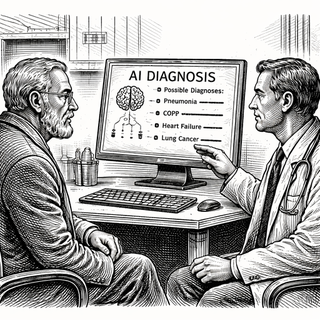
Based on the study summary, participants will use a new AI clinical decision support system during a primary care visit. The system offers suggestions for possible diagnoses and tests. After the visit, participants give feedback through a survey and interview about what it was like to use the tool.
That means this trial is not asking, "Can AI replace doctors?" Thankfully, no. It is asking a more grounded and useful question: Can AI help support better diagnosis and better communication in real clinic visits?
I appreciate that focus. In public health, feasibility and acceptability are not glamorous words, but they do a lot of heavy lifting. A tool can be clever on paper and still flop in the exam room if it is confusing, slows things down, or makes patients feel like they are competing with a laptop for eye contact.
The intriguing part: collective intelligence, not solo genius
The title includes two phrases worth unpacking: collective intelligence and imitation learning.
Collective intelligence suggests that better decisions can come from combining perspectives rather than relying on one person, one note, or one hurried impression. In this context, that likely means drawing together patient symptoms, clinician judgment, caregiver observations, and AI-supported suggestions. Good diagnosis is often less like a dramatic medical epiphany and more like a careful group project, just with fewer poster boards.
Imitation learning usually refers to training systems to learn from expert behavior. In healthcare, that points toward an AI system shaped by how skilled clinicians reason through complex cases. That does not make the tool magical. It makes it potentially useful, which is a much better goal anyway.
Why this matters beyond the clinic
If this approach works, the real-world impact could be substantial.
First, it could help catch problems earlier. Timely diagnosis can reduce avoidable harm, especially for older adults whose health can decline quickly when something is missed.
Second, it could improve communication among patients, doctors, and caregivers. That piece should not be treated as a side benefit. Diagnostic accuracy is not just about what a clinician knows. It is also about whether the right information gets surfaced at the right time. Families often notice subtle changes first. Patients know when "something is off" even if they do not have the medical vocabulary for it. A good support tool should make those voices easier to use, not easier to ignore.
Third, it could help address health equity gaps if designed and implemented thoughtfully. Communities that are already navigating uneven access to care deserve diagnostic tools that reduce confusion rather than deepen it. An AI system that supports clearer conversations and more consistent thinking in primary care could be especially valuable where specialist access is limited.
The challenges are real, and they should stay in the conversation
Now for the realistic part. AI in healthcare has a talent for attracting both breathless hype and dramatic panic, neither of which is especially helpful.
A diagnostic support tool for older adults has to work in the real world, where visits are short, symptoms are tangled, and not every patient arrives with a neatly organized timeline and a charged phone. It also needs to be understandable to people with different levels of health literacy and different relationships to technology. If the tool is too complex, too opaque, or too disruptive, it will become one more thing in the room asking for attention.
There is also the question of trust. Patients need to know whether the system is helping the conversation or quietly hijacking it. Clinicians need confidence that suggestions are useful rather than a random blizzard of possibilities. Nobody needs more tabs open in their brain.
That is why this study's design matters. Asking participants directly about their experience is not a formality. It is how we learn whether a promising idea can survive contact with everyday care.
What I will be watching
I am especially interested in whether the tool helps people feel more heard. For older adults, diagnostic quality is not only about producing a correct label. It is also about making sense of symptoms in a way that respects the person's lived experience, cognitive needs, and support network.
I will also be watching for signs that this approach could reduce the burden on patients who are too often expected to act as their own medical archivists, detectives, and project managers. If a tool can lighten that load even a little, that is no small thing.
The trial summary describes a modest but meaningful step: use the AI tool during a visit, review suggested diagnoses and tests, then ask people what worked and what did not. Sensible. Practical. Not flashy. Public health loves a fancy breakthrough now and then, but it also loves interventions that people can actually use on a Tuesday morning.
Where to learn more
Primary study page: https://clinicaltrials.gov/study/NCT07553559
Table view: https://clinicaltrials.gov/study/NCT07553559?tab=table
Disclaimer: This post is for educational purposes only and is not medical advice. The discussion here is based on the study summary provided for clinical trial NCT07553559 and should not be used to make personal healthcare decisions.
Citation: ClinicalTrials.gov. Advancing Diagnostic Excellence For Older Adults Through Collective Intelligence And Imitation Learning (NCT07553559). https://clinicaltrials.gov/study/NCT07553559