
In Mission: Impossible, the whole trick is getting the right thing to the right place without tripping every alarm in the building. Drug delivery has the same plot, just with fewer exploding gum gadgets and more lipid chemistry. A recent PubMed-indexed paper on testosterone-modified liposomes for male infertility takes that problem head-on by trying to smuggle an anti-inflammatory, antioxidant payload directly to the testis. That is the sort of engineering move medical device and drug delivery people notice immediately, because targeting is where many elegant ideas go to die.
Why this paper is interesting
Male infertility is a big umbrella, and not all of it is fixable with a more clever vehicle. But inflammation of the testes, or orchitis, is one of the more tangible biological problems in the stack. If inflammation and oxidative stress are damaging sperm production, then a treatment that reaches the site, cools the inflammatory fire, and limits oxidative injury has a rational shot at helping.
That is the lane this study occupies.
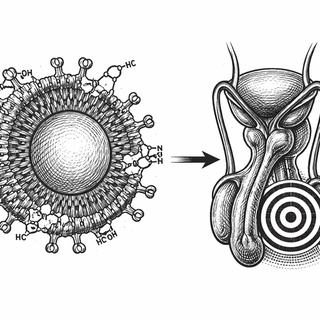
The researchers describe a testis-targeted nanodrug system built from liposomes modified with testosterone and loaded with an epigallocatechin gallate-zinc complex, abbreviated as EGCG-Zn@T-Lipo. Strip away the alphabet soup and the concept is pretty clean: take a known antioxidant compound from green tea chemistry, coordinate it with zinc, package it in a lipid carrier, then decorate the surface with testosterone to improve targeting to male reproductive tissue.
From an engineering standpoint, this is not just "drug in a bag." It is more like trying to get a delicate sauce through a crowded kitchen pass without it separating, spilling, or landing on the wrong plate. The payload matters, but the plating matters too.
The biological problem it is trying to solve
Orchitis can impair fertility by disrupting the local environment needed for sperm production. Inflammation brings immune activity, tissue stress, and a rise in reactive oxygen species. Those oxygen-related molecules are useful in tiny, controlled amounts, but in excess they behave like line cooks with too much caffeine and no supervision. Membranes, proteins, and DNA can all take hits.
That matters in the testis because spermatogenesis is a tightly controlled manufacturing process. There is not much tolerance for heat, immune chaos, or oxidative wear and tear. When the system gets inflamed, output quality suffers. In plain language, the factory starts making defective product.
This is why antioxidant and anti-inflammatory strategies keep showing up in fertility research. The challenge has never been inventing compounds with theoretical benefit. The challenge is getting enough of them to the right tissue, in the right form, without creating a new mess somewhere else.
Why testosterone on the surface is the clever part
Liposomes are old friends in drug delivery. They are lipid vesicles that can carry active ingredients and alter how those ingredients circulate, release, and accumulate in tissue. On their own, though, liposomes are not magic. They still need a reason to home in on the tissue you care about.
That is where testosterone modification enters the frame.
The paper positions testosterone as a targeting mechanism for the testis. In other words, the hormone is being used less like a therapeutic hammer and more like an address label. That is a smart distinction. If it works as intended, the testosterone-modified surface may help the liposomes interact more effectively with androgen-responsive or testis-associated biological pathways, improving local delivery.
In medtech terms, this is the difference between building a better package and building a better package with routing information. Plenty of products fail because they are excellent boxes with no shipping label.
Why EGCG and zinc make sense together
The payload choice is also worth a look. EGCG, a polyphenol associated with green tea, is widely studied for antioxidant and anti-inflammatory effects. Zinc is deeply relevant to reproductive biology and cellular function. Coordinating EGCG with zinc suggests the authors were not simply piling in ingredients from the supplement aisle and hoping for a miracle. They were trying to create a functional complex with combined biological utility and a more stable delivery format.
That matters because free bioactive compounds often look terrific in concept slides and much less terrific in actual biology. They degrade, disperse, bind the wrong thing, clear too quickly, or arrive at such low local concentrations that the effect is mostly decorative. Anyone who has sat through enough platform pitches develops a healthy respect for this graveyard.
Packaging the EGCG-zinc complex in a testosterone-modified liposome is an attempt to solve several of those problems at once: stability, localization, uptake, and pharmacologic relevance.
The real-world promise, if this keeps working
If follow-up development succeeds, the appeal is obvious. Male infertility is often discussed as if it were a black box, with diagnostics and interventions lagging behind the need. A targeted therapy for inflammation-related fertility impairment could add something the field badly needs: specificity.
Not every patient with infertility needs hormonal manipulation. Not every patient needs surgery. Not every patient benefits from broad systemic treatment. A localized or tissue-biased anti-inflammatory nanotherapy could, in principle, become part of a more stratified treatment approach.
From a business angle, that matters too. Therapies that can be matched to a defined biological mechanism tend to have a clearer value story than vague wellness-adjacent interventions. If a platform can show targeted delivery, measurable biomarker change, and improved reproductive outcomes, that is a pathway investors, partners, and regulators can at least discuss with straight faces.
What still needs to be proved
Now for the cold water, because every early-stage paper needs some.
First, this appears to be a preclinical delivery concept, not a clinic-ready product. That is a long distance. Many nanomedicine ideas perform well in controlled experimental settings and then discover that scale-up, reproducibility, biodistribution, manufacturing cost, and regulatory scrutiny are not optional side quests.
Second, targeting the testis is biologically attractive precisely because it is biologically difficult. The tissue environment is selective for good reasons. If a platform claims efficient and meaningful targeting, the next questions are predictable: How much actually gets there? How consistently? For how long? At what safety cost? And does improved tissue delivery translate into better fertility outcomes, not just prettier mechanistic graphs?
Third, testosterone as a targeting element is clever, but it also raises practical development questions. Hormone-associated strategies can invite concerns about off-target effects, endocrine signaling, dosing complexity, and patient selection. None of those are fatal flaws, but they are the sort of details that turn elegant bench work into slow committee meetings. Science is glamorous that way.
Why this paper still deserves attention
Even with those caveats, I think this study is worth watching because it treats male infertility as a delivery and microenvironment problem, not just a hormonal slogan. That is a more mature framing. It recognizes that biology is often less like flipping a switch and more like restoring a damaged kitchen so the staff can cook again.
The deeper value here may be platform logic. If testosterone-modified liposomes can reliably steer useful cargo toward inflamed testicular tissue, that could open doors beyond this specific EGCG-zinc combination. The first recipe is rarely the whole restaurant.
For now, this work is best viewed as a technically interesting early step: a targeted nanomedicine strategy aimed at testicular inflammation, with a plausible mechanism and the right kind of skepticism attached. In this business, that already puts it ahead of a surprising amount of PowerPoint.
This blog post discusses research findings and should not be taken as medical advice. If you have concerns about male infertility or orchitis, please consult a healthcare provider. Research discussed here represents ongoing scientific investigation and clinical validation is still in progress.
All images used in this post are decorative illustrations only and do not represent or reflect the accuracy, reality, or correctness of the referenced research.
Primary Source: Testosterone-Modified Liposomes Loaded with the Zn-Polyphenol Complex for Treatment of Male Infertility. PubMed Record 41985533. https://pubmed.ncbi.nlm.nih.gov/41985533/