
Somewhere right now, a patient is sitting on an exam table, breathing in and out on command while a clinician listens through a stethoscope and tries to separate signal from bodily jazz. Lungs crackle. Hearts murmur. Breath sounds whisper, wheeze, or vanish like a sock in a dryer. For students learning the art of auscultation, this can feel less like medicine and more like trying to identify a bird by hearing one feather move.
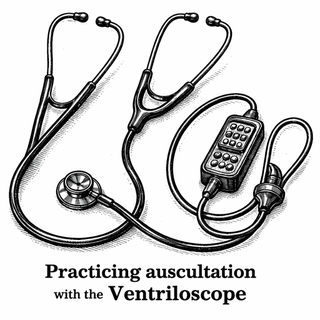
That is the very human problem behind clinical trial NCT07559422, titled The Effect of Ventriloscope Simulation Stethoscope Training on Auscultation Knowledge, Skill, and Confidence in Physical Therapy and Athletic Training Students: A Longitudinal Within-Subjects Study. The table view is available at ClinicalTrials.gov.
The study asks a practical question: can a simulation stethoscope called the Ventriloscope help physical therapy and athletic training students get better at recognizing clinical sounds after they have already received traditional auscultation instruction?
Why Listening Is Harder Than It Looks
The stethoscope has excellent branding. It hangs around necks in television dramas. It signals competence, urgency, and a certain willingness to own many pens.
But using it well is not automatic.
Auscultation means listening to internal body sounds, usually from the heart, lungs, or blood vessels. Clinicians use these sounds to detect findings such as wheezing, crackles, murmurs, diminished breath sounds, or abnormal rhythms. These clues can matter in cardiopulmonary screening, rehabilitation, emergency evaluation, athletic sideline care, and routine clinical decision-making.
The catch is that real patients do not produce textbook audio clips. A wheeze may be faint. A murmur may be subtle. A room may be noisy. A student may be nervous. The patient may be wearing three layers of winter clothing and a heroic amount of static electricity.
Traditional teaching often relies on lectures, diagrams, audio recordings, and supervised practice. Those are useful. But they may not give every student enough repeated, realistic exposure to abnormal sounds. Simulation can help fill that gap by letting learners hear specific findings on demand, in a controlled setting, without waiting for the perfect patient encounter to stroll through the door.
Enter the Ventriloscope
The intervention in this trial is Ventriloscope simulation stethoscope training, delivered after traditional auscultation instruction. The device is designed to let educators simulate clinical sounds through a stethoscope during training. In plain English, it lets students practice listening to clinically meaningful sounds in a way that feels closer to an exam than simply clicking an audio file on a laptop.
The study uses a longitudinal, single-cohort, within-subjects design. That means all participating students receive both training experiences in sequence, and each student is compared with themselves over time. It is less “Team A versus Team B” and more “Did this person improve after the added simulation training, and did that improvement stick?”
The participants are physical therapy and athletic training students. Their auscultation knowledge, clinical sound recognition skill, and self-reported confidence are measured at five timepoints, labeled T1 through T5, across about five months. The trial also includes a qualitative component, asking students what they thought of the training methods.
That last piece matters. Educational tools can look terrific on paper and still make students want to quietly become accountants. Perception, usability, and confidence can shape whether a teaching method actually gets adopted.
What the Trial Is Measuring
The main outcomes are straightforward and nicely grounded in the real world:
Knowledge: Do students understand auscultation concepts better after training?
Skill: Can they recognize clinical sounds more accurately?
Confidence: Do they feel more prepared to use auscultation in practice?
Retention: Are any gains still present two months after training?
That retention question is the sleeper hit. Lots of training works beautifully for 48 hours, which is also how long many people remember a hotel Wi-Fi password. The more meaningful test is whether students still carry the skill after time has passed, after exams, after other coursework, after the general blender of professional education has done its work.
Why This Is Interesting
This trial sits in a useful corner of medical education research: not flashy, not sci-fi, but potentially quite valuable.
Physical therapists and athletic trainers are not replacing cardiologists or pulmonologists. That is not the point. But these clinicians often work with patients who have cardiopulmonary conditions, exercise intolerance, post-surgical limitations, respiratory symptoms, or acute changes during rehabilitation or sport. Better auscultation skills could support earlier recognition of concerning findings and more confident referral or escalation.
In training programs, students need repeated practice before they meet high-stakes clinical situations. Simulation offers a way to practice without depending entirely on chance. No one wants a curriculum built around “hopefully someone with exactly the right abnormal breath sound appears between 2:00 and 3:15 p.m.”
Recent medical education literature has continued to support simulation, deliberate practice, and technology-assisted learning as ways to improve clinical skill acquisition. Reviews of simulation-based education have found that structured practice, feedback, and repeated exposure can improve learner performance, especially when the training is tied to clear outcomes rather than gadget enthusiasm in a lab coat. Relevant background includes work on simulation-based health professions education and clinical skills learning, including studies and reviews such as https://doi.org/10.1097/ACM.0000000000003750, https://doi.org/10.1136/bmjopen-2020-040551, and https://doi.org/10.1016/j.nedt.2021.104868.
The Challenge: Turning Sound Into Skill
Auscultation education has a peculiar problem: students can know the words without recognizing the sound.
They may memorize that crackles can occur in certain lung conditions. They may define wheezing correctly. They may explain where to place the stethoscope. Then the moment arrives, the sound is faint, the patient coughs, the room hums, and the student’s brain opens seventeen browser tabs at once.
Simulation training can help by offering repetition. Hear the sound. Identify it. Get feedback. Hear it again. Compare it with normal. Repeat until the brain stops treating every abnormal sound like a cryptic podcast.
The Ventriloscope approach is intriguing because it may preserve the embodied part of the skill. Students still use a stethoscope. They still place it on a body or training surface. They still connect hand position, listening technique, and sound recognition. That physical context may matter, because clinical skills are rarely just facts. They are facts wearing shoes.
What Success Could Mean
If the trial shows that Ventriloscope training improves knowledge, skill, confidence, and retention, the impact could be practical and fairly immediate.
Programs training physical therapy and athletic training students could add simulation stethoscope sessions after traditional instruction. Educators could standardize exposure to key sounds. Students could practice rare or subtle findings without waiting for clinical placements to supply them. Assessment could become more consistent.
For patients, the benefit would be indirect but meaningful. A better-trained clinician may notice abnormal respiratory or cardiac findings sooner. They may feel more comfortable screening during rehabilitation or athletic care. They may know when something sounds off and deserves medical follow-up.
That does not mean every student becomes a walking echocardiogram. It means the stethoscope becomes a little less mysterious and a little more useful.
A Sensible Study for a Noisy Skill
This trial is not trying to cure disease with a moonshot molecule. It is trying to improve how future clinicians learn a difficult sensory skill. That may sound modest, but medicine is built from thousands of such moments: listen carefully, notice the clue, act wisely.
The design is especially appealing because it follows students over about five months and checks whether learning lasts. It also asks students how the training felt from the learner side. That is wise. In education, the human interface is not optional. It is the whole machine.
The stethoscope may be old technology, but learning to use it well remains stubbornly modern. A tool like the Ventriloscope could help bridge the gap between classroom knowledge and clinical listening. And if it makes students less likely to stare into the middle distance while wondering whether that was a wheeze or the HVAC system, that seems like progress worth hearing.
Disclaimer: This article is for educational purposes only and does not provide medical advice. Clinical care decisions should be made with qualified health professionals. Trial information cited from ClinicalTrials.gov record NCT07559422.