
Fun fact: your immune system makes game-time decisions faster than most people pick a streaming show. The hard part in cancer care is not whether immune cells can react. It is figuring out, early enough, whether they are reacting in a way that actually helps the patient. A new study on hepatocellular carcinoma, the most common type of liver cancer, explores a surprisingly elegant tool for that job: an organic electrochemical transistor, or OECT. Yes, a transistor. The same broad family of components that helped build modern electronics is now being drafted into the oncology lineup.
Why this matters in plain English
Patients with advanced liver cancer may be treated with a combination of atezolizumab and bevacizumab. Atezolizumab helps take the brakes off the immune response by targeting PD-L1. Bevacizumab targets VEGF, a signal involved in blood vessel growth that tumors like to exploit. Together, the pair is meant to make life harder for the cancer and easier for the immune system.
But here is the problem: not every patient responds.
From the old paramedic side of my brain, this is the part that always feels painfully familiar. You can give the right treatment, for the right condition, at the right time, and biology still decides to be biology. Cancer does not read the protocol. So clinicians need ways to tell, sooner rather than later, whether a treatment is actually kicking off a useful immune response.
That is where this study gets interesting.
The device is tiny, but the question is huge
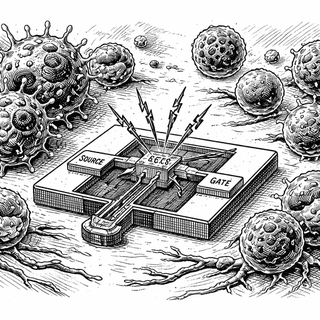
The researchers used a PEDOT:PSS-based organic electrochemical transistor. That sounds like something assembled by a graduate student who has not seen daylight in three weeks, but the idea is more intuitive than the name suggests.
This transistor is biocompatible and chemically stable in cell media, which means it can sit there with living cells and measure electrical changes over time without throwing a fit. In this study, liver cancer cell lines were grown directly onto the device. Then the team added peripheral blood mononuclear cells, or PBMCs, from different people.
PBMCs are a mixed group of immune cells found in blood. Think of them as a grab bag of immune system regulars, including lymphocytes and monocytes. If these cells get activated against the cancer cells, the transistor can pick up the resulting electrical changes in real time.
That is the clever part. Instead of waiting for later clinical clues, the setup aims to catch the immune system warming up almost right out of the tunnel.
What the researchers actually tested
The study looked at PBMCs from patients with advanced hepatocellular carcinoma who either responded or did not respond to atezolizumab-bevacizumab treatment. Those immune cells were cocultured with liver cancer cell lines called Huh7 and SNU449, which were grown directly on the OECT platform.
The researchers then compared the transistor's electrical readings with more familiar lab measures, including cell growth, cell death assays, and IL-6 levels. IL-6 is a signaling molecule involved in inflammation and immune activity. It is not some magical single-answer biomarker, but it can still offer clues about what immune cells are up to.
What they found was encouraging: the OECT signal strongly correlated with those standard measures. In other words, when the immune cells were showing signs of activation or impact, the transistor seemed to notice too.
They also checked the system using positive and negative controls. PBMCs from healthy controls behaved in a way that supported the device's sensitivity, while PBMCs from patients on immunosuppressive drugs helped demonstrate the low-activity end of the spectrum. That matters because any shiny new biosensor can look smart when everything is obvious. The real test is whether it can separate signal from noise when the biology gets messy.
Why an electrical readout is a big deal
Cancer care already has blood tests, imaging, pathology, and enough acronyms to make your coffee nervous. So why add a transistor?
Because speed and practicality matter.
An electrical sensor that can monitor immune-cell behavior in vitro, in real time, opens the door to earlier treatment guidance. If future work confirms this approach, doctors may be able to identify likely nonresponders sooner and consider alternative options before precious time slips away.
That is not a small thing in advanced liver cancer. Hepatocellular carcinoma is a tough diagnosis, and treatment windows can be narrow. If a low-cost, scalable device can give an early read on whether the immune system is actually engaging under a given therapy, that could help make treatment decisions more personalized and less guess-and-hope.
And I do mean low-cost and scalable in a good way, not in the “some assembly required and two screws are missing” way. OECTs have been attractive for biosensing partly because they can be made more affordably than many high-end lab platforms.
What makes this study especially intriguing
A lot of cancer-tech headlines boil down to “researchers found a thing that might someday maybe help.” This paper still lives in research territory, but it earns extra attention because it ties the device output to biologically meaningful lab results instead of waving its hands and asking us to trust the vibes.
It is also aimed at a practical bottleneck in immunotherapy: early response detection.
Immune checkpoint inhibitor treatments can be powerful, but they are not universal winners. Some patients respond beautifully. Others do not. Being able to test a patient's immune cells against tumor cells on a sensing platform like this could eventually support a more tailored treatment path. That is the sort of bench-to-bedside idea that clinicians actually care about, because it speaks the language of timing, selection, and action.
There is also a broader angle here. The authors note that this approach could matter beyond liver cancer, especially in other cancers treated with immune checkpoint inhibitors. If the core principle holds up, the same kind of platform might become a useful companion tool across multiple tumor types.
The catch, because there is always a catch
This is not a plug-it-into-the-clinic-next-week story.
The work is in vitro, which means it was done outside the body in a controlled lab setting. That is a necessary step, but the human body is a far more chaotic stadium. Tumors interact with blood vessels, surrounding tissue, metabolism, inflammation, and a whole cast of molecular troublemakers. A cell coculture system captures some of that story, not all of it.
The study is best seen as a promising early platform validation, not a finished clinical test. Larger studies, real-world validation, and proof that this method improves decision-making for actual patients still need to happen.
Still, that does not make it small. Early tools often matter precisely because they solve one stubborn piece of the puzzle. This one tackles a question oncologists and patients care about a lot: is the immune system waking up, and is it waking up in time?
The bottom line
This research points to a smart, noninvasive, automated way to monitor early immune activation during atezolizumab-bevacizumab treatment for advanced hepatocellular carcinoma. By using an organic electrochemical transistor to track how patient immune cells behave around liver cancer cells, the team showed that electrical signals can line up with standard biological markers of response.
That is not a cure, and it is not a final answer. But it may be a better early scoreboard. In cancer care, that can make all the difference.
This blog post discusses research findings and should not be taken as medical advice. If you have concerns about liver cancer or cancer treatment options, please consult a healthcare provider. Research discussed here represents ongoing scientific investigation and clinical validation is still in progress.
All images used in this post are decorative illustrations only and do not represent or reflect the accuracy, reality, or correctness of the referenced research.
Primary Source: Organic Electrochemical Transistors for Real-Time Detection of Immune System Early Activation during Atezolizumab-Bevacizumab Treatment in Hepatocellular Carcinoma. PubMed Record 42054571. https://pubmed.ncbi.nlm.nih.gov/42054571/