
Here's the thing about pork preservation that nobody tells you: the packaging is doing a lot more than just sitting there looking shiny under grocery store lights. It is the quiet defensive lineman between your dinner plans and a microbial free-for-all. And like any good defensive lineman, the best packaging does its job without asking for applause, endorsement deals, or a post-game interview.
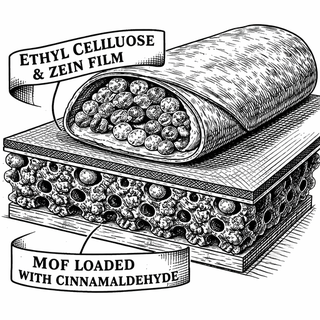
A new study indexed in PubMed looked at a biodegradable composite film made from ethyl cellulose and zein, then upgraded it with a tiny active ingredient delivery system: cinnamaldehyde-loaded magnesium-gallic acid metal-organic frameworks. That is a mouthful, and not the good kind of mouthful involving pulled pork. The short version: researchers built a plant-based food wrap designed to be stronger, greener, and better at slowing pork spoilage.
Why Pork Packaging Needs an Upgrade
Fresh pork is high in moisture, rich in nutrients, and therefore very attractive to bacteria. If you ever worked EMS, you learned quickly that warm, wet, protein-rich environments are where biology starts making decisions without consulting anyone. Food spoilage is the same basic party, just in a supermarket tray instead of a trauma bag.
Traditional plastic packaging helps by creating a barrier against air, moisture, and contamination. The problem is that most petroleum-based plastics stick around in the environment far longer than your appetite for leftovers. That has pushed researchers toward biodegradable films made from natural materials such as polysaccharides and proteins.
But there is a catch. Natural films can be fragile, too permeable to moisture, or not active enough against microbes and oxidation. In sports terms, some eco-friendly films have good intentions but no upper-body strength. They show up to the gym, but the bench press is still judging them.
Meet the Main Ingredients
This study combined ethyl cellulose and zein as the base film.
Ethyl cellulose is a cellulose-derived material with useful film-forming properties. Zein is a corn protein that can also form films and has attracted attention in food packaging because it is biodegradable and renewable. Together, they can form a composite matrix, which is research-speak for “a structured material where the ingredients hopefully make each other better.”
Then the team added something more interesting: cinnamaldehyde loaded into a magnesium-gallic acid metal-organic framework, abbreviated as CA@Mg-GA-MOF.
Cinnamaldehyde is the compound that gives cinnamon its characteristic aroma. It is also known for antimicrobial and antioxidant activity. The challenge is that active plant compounds can be volatile, unstable, or difficult to release in a controlled way. Dumping cinnamaldehyde into a package without a delivery system would be a bit like trying to pace yourself at a buffet. The concept is simple, the execution is where things get messy.
That is where the MOF comes in.
What Is a MOF, Without the Lab-Coat Fog Machine?
A metal-organic framework, or MOF, is a porous material made from metal ions connected by organic molecules. Think of it like a microscopic storage rack. Instead of holding sports drinks and old holiday decorations, it can hold active compounds and release them more gradually.
In this study, the MOF was built from magnesium and gallic acid. Gallic acid is a naturally occurring phenolic compound found in many plants, and magnesium is familiar from nutrition labels and antacid commercials. The researchers used this Mg-GA-MOF structure to encapsulate cinnamaldehyde, then blended it into the ethyl cellulose and zein film.
The goal was not just to make a wrap that covers pork. The goal was to make a wrap that participates.
The Film Had Real Mechanical Muscle
The optimized film, described as CA@Mg-GA-MOF/EC/Zein-4%, had a thickness of 0.14 mm. That is thin enough to act like a packaging film but still showed solid mechanical performance.
The reported tensile strength was 55.75 MPa, with elongation at break of 5.46%. Tensile strength tells you how much pulling force the material can handle before breaking. Elongation tells you how much it stretches before giving up. If tensile strength is the “can it take a hit?” metric, elongation is the “can it bend without acting dramatic?” metric.
For food packaging, both matter. A film that tears too easily is useless. A film that is strong but brittle can also fail during handling, transport, sealing, or the glorious chaos of someone stuffing groceries into a trunk around a soccer bag and a half-empty coffee.
The study also reported low water vapor permeability, measured at 5.87 x 10, although the provided abstract text cuts off the full unit and exponent. Even with that truncation, the takeaway is clear: the researchers were targeting moisture control, which is a big deal for fresh meat preservation.
Why Moisture and Oxygen Matter So Much
Food spoilage is not just one villain twirling a mustache. It is a whole bench of troublemakers: bacteria, oxidation, moisture migration, and enzymatic changes.
Moisture control helps because too much water movement can change food texture and support microbial growth. Oxygen control matters because oxidation can affect color, flavor, odor, and fat stability. Anyone who has opened questionable meat knows oxidation and microbial activity do not send subtle warning emails. They kick the door open.
Active packaging tries to go beyond passive protection. Instead of merely blocking the outside world, it can release antimicrobial or antioxidant compounds, absorb unwanted molecules, or respond to food conditions.
That is why the cinnamaldehyde-loaded MOF is interesting. It suggests a route toward packaging that can slowly deliver protective bioactive compounds while still being built from more sustainable materials.
The Sustainability Angle Is Not Just Window Dressing
Plastic waste is a major environmental problem, and food packaging is a large part of that conversation. Meat packaging is especially tricky because it has to meet high performance standards. You cannot simply swap in a compostable-looking film and hope for the best. Food safety does not run on vibes.
Natural protein-polysaccharide films are appealing because they may reduce reliance on petroleum-based plastics. But to compete in the real world, they need strength, barrier performance, manufacturability, and safety. They also need to survive the supply chain, which is basically an obstacle course designed by people who have never gently handled a package in their lives.
This study fits into a growing research push: make biodegradable packaging that behaves less like a fragile science fair project and more like something a food company could eventually use.
What Makes This Study Intriguing?
The clever part is the combination of multiple functions in one film.
The ethyl cellulose and zein provide the packaging structure. The Mg-GA-MOF acts as a carrier. The cinnamaldehyde brings antimicrobial and antioxidant potential. Together, the film is designed to be mechanically useful, moisture-resistant, and bioactive.
That matters because single-purpose materials often fall short. A wrap that is biodegradable but weak will not make it far. A strong wrap that cannot help preserve food is only doing half the job. A powerful antimicrobial additive that evaporates too fast is like a rookie sprinting the first quarter and needing a nap by halftime.
Controlled release is the grown-up version of that strategy.
What Still Needs to Happen?
This is promising materials research, not a signal that cinnamon-powered pork wrap will appear at the grocery store next Tuesday.
Follow-up work would need to answer practical questions. How does the film perform across different storage temperatures? How consistent is the release of cinnamaldehyde over time? Does it affect flavor or aroma in ways consumers notice? Is it safe and acceptable under food-contact regulations? Can it be produced at scale without turning the price of pork chops into a luxury car payment?
Those are not small details. In food packaging, a material has to satisfy science, safety, manufacturing, cost, shelf life, consumer expectations, and regulatory review. That is a lot of referees on the field.
Still, this kind of study is valuable because it shows how active biodegradable packaging could move from concept toward practical use.
The Real-World Payoff
If this type of technology succeeds, the impact could be meaningful.
Better active packaging could help extend shelf life, reduce food waste, and lower dependence on petroleum-based plastics. For consumers, that could mean fresher meat and fewer “is this still okay?” fridge debates. For retailers, it could mean less spoilage loss. For the environment, it could mean packaging that does not linger for decades after the pork has long since become dinner.
As someone who has seen how quickly small failures can become big problems, I appreciate quiet prevention. In medicine, the best save is often the one nobody notices. Food packaging works the same way. If it is doing its job, dinner just stays dinner.
This ethyl cellulose/zein composite film is not the final answer yet, but it is a smart step: greener materials, active preservation, and a delivery system that treats cinnamaldehyde less like a loose cannon and more like a controlled-release teammate.
This blog post discusses research findings and should not be taken as medical advice. If you have concerns about food safety, foodborne illness, or proper meat storage, please consult a qualified food safety professional or healthcare provider. Research discussed here represents ongoing scientific investigation and practical validation is still in progress.
All images used in this post are decorative illustrations only and do not represent or reflect the accuracy, reality, or correctness of the referenced research.
Primary Source: Fabrication and characterization of ethyl cellulose/Zein-based multifunctional composite film integrated with cinnamaldehyde-loaded Mg-gallic acid-MOF for pork preservation. PubMed Record ID: 41794537. PubMed