
A wearable sensor is trying to read faint biological signals without draining its battery. A lab-on-a-chip device is being asked to do more computing in less space. An engineer stares at a fabrication workflow that has somehow acquired the administrative elegance of a 14-step parking permit application. That is the neighborhood this paper lives in.
The study behind PubMed record 42047009 is not about a drug, a surgery, or a shiny robot rolling into a hospital lobby. It is about transistor materials - specifically organic electrochemical transistors, or OECTs - and a clever way to make them handle both positive and negative charge transport in the same device. That sounds niche because it is niche. But it is the kind of niche that can quietly determine whether future medical electronics become smaller, cheaper, and easier to build, or remain stuck in the engineering equivalent of a forms backlog.
Why anyone outside a semiconductor lab should care
OECTs are attractive for bioelectronics because they work well in wet, ion-rich environments. That matters because biology is, in technical terms, extremely damp. These devices can interact with ions and electrons at the same time, which makes them useful candidates for sensors, neural interfaces, and other electronics meant to operate near or inside biological systems.
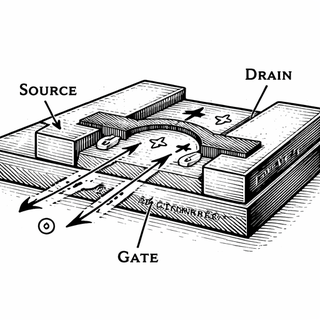
The catch is that building more sophisticated circuits often requires both p-type and n-type behavior. In plain English, you want one component that is good at carrying positive charge and another that is good at carrying negative charge, so you can make complementary logic circuits. Those circuits are a big deal because they can improve efficiency and packing density while lowering design complexity.
In theory, that is elegant. In practice, the field has had a problem: ambipolar materials, meaning single materials that can do both jobs, have been hard to develop well. And when your design rules are still fuzzy, progress tends to move at the speed of a committee revising a parking ordinance.
What this paper actually did
The researchers designed a new electron-deficient building block called BITBII and used it to create two polymers by pairing it with different electron-donating units. Those polymers were named PBITBII-2FT and PBITBII-F2T.
That choice of chemistry mattered. By changing the donor unit attached to the same core building block, the team was able to shift the transistor behavior. One polymer in particular, PBITBII-F2T, showed strong ambipolar performance in single-component OECTs. That means the same material supported both p-type and n-type operation in a meaningful way.
This is the heart of the paper. The researchers were not merely reporting that they made another experimental polymer with a wonderfully unmemorable name. They were showing that donor engineering can switch device behavior from mostly n-type toward ambipolar operation. That is a useful design principle, and design principles are what move a field from artisanal chemistry to something more reproducible and scalable.
Why ambipolar OECTs are a big engineering deal
Single-component ambipolar OECTs could reduce fabrication complexity. That phrase may sound modest, but in manufacturing and device design, reducing complexity is often where the real action is. Fewer distinct materials can mean fewer processing headaches, fewer compatibility problems, and potentially lower cost.
For medical and health-adjacent electronics, that matters because the path from clever prototype to usable product is already cluttered with enough obstacles. Materials that simplify circuit integration are valuable not because they make for better conference posters, though they do, but because they may help real devices become practical.
Think of it this way: if complementary logic today often asks engineers to coordinate multiple specialized materials, a good ambipolar material is like hiring a civil servant who can process both reimbursement claims and licensing forms without sending everyone to a different window. Not glamorous, but suddenly the whole office moves faster.
The bioelectronics angle
This paper is basic materials science, not a clinical study. Nobody should read it and assume a next-generation implant is arriving by Thursday. Still, the implications for bioelectronics are easy to see.
OECTs are already interesting for biosensing because they can amplify signals while interfacing with ionic biological environments. If researchers can build denser, lower-complexity complementary circuits using ambipolar organic mixed ionic-electronic conductors, that could help future devices become more compact and more efficient.
That matters for several possible applications:
- Wearable sensors that need low-power signal handling
- Implantable or near-tissue electronics that must function in wet environments
- Flexible diagnostic platforms where traditional silicon approaches are not always ideal
- High-density integrated bioelectronic circuits that need more logic without more fabrication drama
The policy-minded takeaway is simple: platform technologies matter. We often focus public attention on the end product, the diagnostic, the monitor, the smart patch. But whether those tools become affordable and manufacturable often depends on less glamorous upstream advances like this one.
What problem this research is trying to fix
The field has lagged because ambipolar single-component OMIECs, organic mixed ionic-electronic conductors, are underdeveloped. Researchers have known these materials could be useful, but the design logic has not been mature enough to make progress predictable.
This study chips away at that bottleneck by showing that molecular design choices can tune charge transport behavior in a practical direction. That is the kind of result researchers need if they are going to stop relying on a mixture of intuition, luck, and caffeine.
And yes, this is one of those moments where a materials paper starts sounding suspiciously like health systems reform. Better performance matters. Clearer design rules matter more. The latter is how you get a field that scales.
What to keep in perspective
There are limits here, and they are worth stating plainly.
First, this is not a human study and not a medical device trial. It is an early-stage materials advance. The road from transistor paper to approved healthcare product is long, winding, and well furnished with validation requirements.
Second, "excellent ambipolar performance" in a research setting does not automatically translate into commercial reliability, manufacturability, long-term stability, or biocompatibility in real-world use. Those questions tend to arrive later, usually carrying clipboards.
Third, the medical relevance is indirect for now. The paper strengthens the foundation for future bioelectronics, but it does not demonstrate a clinical outcome. That distinction matters, especially in a world that likes to market every promising chip, polymer, and nanoparticle as a revolution before lunch.
Why this paper is still intriguing
Even with those caveats, this is a compelling result because it addresses a stubborn systems problem rather than chasing a flashy single metric. The authors are working on the material logic that could make complementary organic electrochemical circuits easier to integrate. That may sound like plumbing, but high-functioning systems usually depend on good plumbing.
And for healthcare technology, simplification is not a side benefit. It is often the difference between a device category that stays expensive and specialized, and one that becomes deployable at scale. Regulators, manufacturers, and procurement teams may not write sonnets about ambipolar polymers, but they do tend to appreciate technologies that reduce complexity instead of multiplying it.
Which, frankly, is more than can be said for some federal reporting portals.
The bottom line
This paper shows that donor engineering around a new BITBII building block can shift OECT behavior toward strong ambipolar performance, especially in the polymer PBITBII-F2T. That is a meaningful advance for the design of single-component organic electrochemical transistors.
For most readers, the headline is not "new polymer exists." It is "a key building block for future bioelectronic circuits may be getting smarter and simpler." If that trend holds up in follow-up work, it could support more compact and efficient sensor and interface technologies down the line.
That is how a lot of real progress happens in medicine and medical technology. Not with one dramatic leap, but with a quiet fix to a structural bottleneck that everyone in the field has been tripping over for years.
This blog post discusses research findings and should not be taken as medical advice. If you have concerns about medical devices, wearable sensors, or bioelectronic health technologies, please consult a qualified healthcare provider or relevant specialist. Research discussed here represents ongoing scientific investigation and clinical validation is still in progress.
All images used in this post are decorative illustrations only and do not represent or reflect the accuracy, reality, or correctness of the referenced research.
Primary Source: PubMed record 42047009. Switching N-Type to Ambipolar Organic Electrochemical Transistors by Donor Engineering of Polymeric Mixed Conductors Based on a Novel Electron-Deficient BITBII Building Block. Available at: https://pubmed.ncbi.nlm.nih.gov/42047009/