
This research paper is about to be the most shared study in diagnostics circles. Not because it has a catchy name - "shell-thickness-modulated electrochemiluminescence of colloidal quantum dots" is not exactly the title of a summer blockbuster - but because it takes a very real problem in medical testing and attacks it with something surprisingly elegant: tiny glowing particles engineered with the precision of a parent trimming a sandwich crust to avoid a full lunch-table uprising.
As a parent, when I read a paper like this, my first question is simple: will this help somebody get a better answer, sooner, with less mess and less uncertainty? That is the real test. Fancy physics is nice. Better care is nicer.
What the study is actually about
This paper focuses on detecting PSA, or prostate-specific antigen. PSA is a blood marker often used in screening and monitoring prostate disease, including prostate cancer. It is not a perfect marker. High PSA does not automatically mean cancer, and a normal-seeming number does not settle everything either. Still, it is widely used, and better PSA testing could make a difference in how quickly doctors spot changes or follow treatment.
The researchers built a highly sensitive biosensor using quantum dots. These are tiny semiconductor particles that can emit light under the right conditions. In this case, the light is generated through electrochemiluminescence, or ECL. That just means the sensor lights up as part of an electrochemical reaction. No fireworks, sadly, but scientifically very useful.
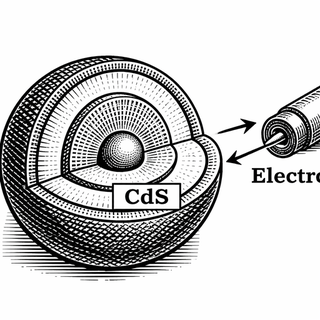
The key idea in this study is that the structure of the quantum dot matters. A lot. The team used a layered quantum dot made of CdSe/CdS/ZnS and changed the thickness of one shell layer, the CdS middle shell, to see how that affected performance.
Why shell thickness matters
This is where the paper gets interesting instead of merely "very smart people did very smart people things."
The shell around the quantum dot does two jobs that tug in opposite directions. A thicker shell protects the glowing center from damage. That is good, especially in real biological samples like serum, which are not known for being gentle and cooperative. But a thicker shell also makes it harder for the quantum dot to interact with the electrode and the surrounding chemicals needed to produce a bright signal. That is bad.
So the problem becomes: how thick is thick enough to protect the sensor, but thin enough to let it do its job?
The answer here was five monolayers of CdS.
That was the sweet spot. Thicker shells improved stability but dulled the signal. Thinner shells gave less protection. Five layers hit the balance between durability and brightness, which is exactly the kind of engineering choice that matters if you ever want a lab trick to survive contact with actual clinical samples.
Why that could matter in the real world
A good medical test has to do more than work beautifully in a pristine lab setup. It has to keep working when faced with the biological equivalent of a toddler helping bake cookies. Real samples are messy. Proteins, salts, interfering molecules - they all show up uninvited.
According to the study, the optimized sensor detected PSA across a wide range, from 1.0 pg/mL to 10 ng/mL, with a detection limit of 0.51 pg/mL. That is a very low level. In plain English, the system can pick up tiny amounts of PSA.
Why do we care about that? Because lower detection limits can help when doctors need to notice small changes early, or track subtle shifts over time. For someone being monitored after treatment, or for someone whose lab trends are being watched closely, sensitivity is not just a nice spec sheet number. It can shape real decisions.
The sensor also performed reliably in clinical serum samples, which matters even more than the headline number. A lot of experimental tests look dazzling right up until they meet real human biology and promptly fall apart like a bargain stroller wheel.
The clever extra trick
The researchers did not stop at optimizing the quantum dots. They also built a "signal-on" aptasensor using resonance energy transfer with gold nanorods as energy acceptors.
That sounds like a sentence designed to punish tired parents reading after 10 p.m., so here is the short version: they created a system that changes its light signal when PSA is present, using a biological recognition element and a nanoscale energy-transfer setup. The result is a sensor that becomes a practical PSA detector, not just a materials science demo.
That matters because plenty of papers are content to stop at "look, we made a cool particle." This one goes further and shows how the particle can be used in a diagnostic platform.
What I find genuinely promising
What I like about this study is that it deals with a bottleneck that often gets ignored. In diagnostics, people love talking about sensitivity. Less glamorous, but just as necessary, is stability. If a sensor is incredibly sensitive but degrades easily, that is not a future medical tool. That is a very expensive mood.
This paper treats stability and signal strength as a balancing act and tries to solve both at once. That is the kind of practical thinking that moves technology closer to use in clinics.
I also appreciate that the work offers a design strategy, not just a one-off result. The broader message is that tuning quantum dot architecture can systematically improve biosensors. If that idea holds up in follow-up studies, it could influence more than PSA testing.
What this does not mean yet
This is not a new home test. It is not a replacement for current screening guidelines. It is not proof that every patient will get better cancer care next year because of glowing nanoparticles.
It means researchers may have found a smarter way to build a sensitive and stable biosensor for PSA detection. That is valuable, but it is an early-stage kind of valuable. Before anything like this becomes widely used, it would need more validation, more comparison with existing methods, and the kind of scaling work that tends to be less glamorous than journal covers.
There is also the bigger issue that better PSA detection does not solve every problem around PSA interpretation. A more sensitive test can give more information, but doctors still need to decide what that information means for a person sitting in front of them.
The parent verdict
From the "will this help my kid?" angle, this paper is not directly about children, and PSA is a prostate marker, so the answer is obviously not in the straightforward way. But I still think this kind of research matters for families because better diagnostics ripple outward. Every household eventually runs into blood tests, repeat monitoring, uncertain results, or the nerve-racking wait for clearer answers.
If follow-up development succeeds, this work points toward lab tests that are more precise, more stable, and more dependable in real samples. That is not flashy in a movie-trailer sense, but in medicine, dependable is often the hero.
And honestly, a paper that figures out the exact shell thickness needed to make tiny particles glow usefully without burning out deserves some respect. Parenting has taught me that "just enough protection, not so much that nothing works" is a principle with unusually broad application.
This blog post discusses research findings and should not be taken as medical advice. If you have concerns about prostate health, prostate cancer screening, or PSA testing, please consult a healthcare provider. Research discussed here represents ongoing scientific investigation and clinical validation is still in progress.
All images used in this post are decorative illustrations only and do not represent or reflect the accuracy, reality, or correctness of the referenced research.
Primary Source: Shell-thickness-modulated electrochemiluminescence of colloidal quantum dots for ultrasensitive PSA detection. PubMed. https://pubmed.ncbi.nlm.nih.gov/42054862/