
Most breakthrough hardware stories are a little overdressed. This one may actually be underdressed - because a paper about atomically thin sliding ferroelectricity sounds obscure enough to empty a room, yet it could matter enormously for the future of medical sensors, implants, and flexible electronics that do not quit after repeated use.
As someone who spends a lot of time thinking about how ideas migrate from benchtop to bedside, I find this kind of work unusually interesting. Not because it is ready for clinic tomorrow. It is not. But because it targets a stubborn engineering bottleneck that quietly limits what our next generation of health technology can become. Tiny materials problems have a habit of becoming very large practical problems later, a bit like discovering the elevator cable was "mostly fine."
So what did this study actually do?
The paper reports room-temperature sliding ferroelectricity in a lattice-mismatched semiconducting MoS material. That is the key point.
Ferroelectric materials are useful because they can maintain an internal electrical polarization that can be switched between states. In plain English, they can behave a bit like tiny electrical memory elements. That matters for electronics that need stable, low-power switching and reconfiguration.
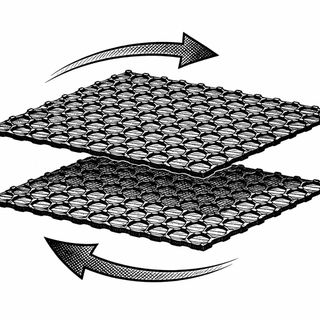
The twist here is sliding ferroelectricity in a two-dimensional, ultrathin material system. Instead of relying only on classic bulk crystal behavior, the electrical state can be influenced by how atomically thin layers slide relative to one another. Think of two decks of cards shifted by a hair - same cards, very different alignment. At this scale, that tiny rearrangement can change the material's electrical behavior in a meaningful way.
Why is that exciting? Because the authors say this approach may offer an ultrathin, fatigue-free platform for reconfigurable electronics. In other words, devices built from such materials might switch states repeatedly without wearing down in the usual way. For medicine, that phrase "fatigue-free" is not trivia. It is the sort of phrase that makes every device engineer sit up a little straighter.
Why the field was stuck
The abstract points to a major limitation: earlier work in 2D sliding ferroelectrics had a strict requirement for lattice matching.
Lattice matching refers to how neatly the atomic structures of layered materials line up. If only perfectly matched materials can do the trick, your design menu gets painfully small. You may get elegant physics, but not much freedom to build useful devices around it.
That is where this study appears to push the field forward. The authors report sliding ferroelectricity in a lattice-mismatched semiconducting material, and they do it at room temperature. That combination matters. It suggests the phenomenon may be less fragile, less picky, and more compatible with real-world device design than previously assumed.
In engineering, removing a "must be perfectly aligned or nothing works" rule is a big deal. It is the difference between a concept that lives in a presentation slide and one that might eventually survive manufacturing.
Why should anyone in healthcare care?
Fair question. Nobody is prescribing sliding ferroelectricity in clinic next week.
But medicine increasingly depends on electronics that are expected to be all of the following at once: thin, flexible, reliable, low-power, stable over time, and ideally capable of local data handling. That is a demanding wish list. Wearable monitors, skin-like biosensors, soft neural interfaces, implantable stimulators, and compact diagnostic chips all run into some version of the same challenge: how do we make the electronics smarter and smaller without making them more fragile?
Materials like these could someday help.
If this line of research matures, it may support devices that can be:
- Ultrathin, which is useful for conforming to skin or soft tissue
- Low-power, which matters for portable and implantable systems
- Reconfigurable, allowing device function to be tuned or switched
- More durable under repeated operation, which is exactly what long-term monitoring systems need
From a patient-impact perspective, the dream is straightforward. Better materials can enable better hardware, and better hardware can mean less bulky wearables, longer-lasting implants, and more comfortable monitoring. Patients usually do not care whether a sensor contains elegant condensed-matter physics. They care whether it is accurate, unobtrusive, and does not behave like a needy houseplant.
The quietly important phrase: room temperature
Room-temperature performance deserves its own applause.
A lot of beautiful materials science works under conditions that are, let us say, not ideal for everyday healthcare. If your miracle effect requires extreme cooling, heroic isolation, or a laboratory that looks like it could summon thunderstorms, bedside translation becomes unlikely.
Room-temperature behavior means this phenomenon shows up where actual devices live. That does not guarantee commercial success, but it moves the work from "scientifically charming" toward "possibly useful."
For biomedical technology, that matters because every extra requirement in device operation multiplies cost, complexity, failure points, and regulatory headaches. Clinical translation is not kind to delicate systems.
What problems does this address?
The paper tackles two broad problems at once.
First, it addresses a materials-choice bottleneck. If sliding ferroelectricity can occur in lattice-mismatched systems, researchers may have a wider palette of semiconducting materials to work with. More options usually mean better odds of finding materials with the right balance of flexibility, conductivity, manufacturability, and device compatibility.
Second, it addresses functional durability. The abstract frames 2D sliding ferroelectrics as a potential fatigue-free platform. In medical technology, fatigue is not just a mechanical word. Repeated switching, repeated sensing, repeated stimulation - these are daily realities. A material that keeps doing its job without performance fading earns attention.
That does not mean the fatigue problem is solved for final devices. It means the foundation looks more promising.
What this does not mean, at least not yet
This is still early-stage research. It is materials and device physics, not a clinical trial, not a prototype patch for patients, and not evidence of improved health outcomes.
Several steps still sit between this result and anything a patient would recognize:
- Device engineering
- Large-scale fabrication
- Stability testing in real conditions
- Integration with circuits and packaging
- Safety and reliability validation for biomedical use
That is the long road, and it is long for a reason.
Still, I would rather see an early paper solve a real platform constraint than promise a magical end product. This study seems to do the former. It makes the toolbox less narrow. In translational science, that is often how progress actually happens: not with a trumpet blast, but with one less annoying limitation.
Why I think this paper is worth watching
The most compelling part of this work is not just that the authors observed an interesting effect. It is that they appear to have relaxed a rule that was holding the field back.
When a technology depends on perfect matching, perfect conditions, and perfect luck, it rarely becomes practical. When it starts working under looser, more realistic constraints, people can build with it. That is when medicine should start paying attention, even if quietly.
Will patients ever hear the phrase "sliding ferroelectricity"? I hope not. The best medical technologies usually hide their complexity well. But if future wearables become thinner, smarter, and less power-hungry because of advances like this, the impact will be real even if the jargon stays mercifully out of the clinic.
And honestly, that is the goal. Patients do not need prettier physics. They need devices that work.
This blog post discusses research findings and should not be taken as medical advice. If you have concerns about wearable monitoring devices, implantable electronics, or other health technologies, please consult a healthcare provider. Research discussed here represents ongoing scientific investigation and clinical validation is still in progress.
All images used in this post are decorative illustrations only and do not represent or reflect the accuracy, reality, or correctness of the referenced research.
Primary Source: Sliding Ferroelectricity in MoS. PubMed Record 42055543. PubMed link