
You won't believe what researchers are doing with tiny robot grippers. They are basically building a microscopic claw machine for living cell clusters, except instead of winning a stuffed bear and a stale lollipop, the goal is to build future tissues without squashing the goods.
As a parent, this kind of research lands in my brain in one very specific way: could this someday help a real kid with a real medical problem? Not in a glossy brochure sense. Not in a "the future is amazing" sense. I mean help help. The paper behind this idea, titled Force-sensing mobile microrobotic grippers for gentle and precise bioassembly of cell spheroids, is early-stage engineering work. But it is the sort of early-stage work that solves a very real bottleneck. And sometimes the bottlenecks are where the future gets stuck.
What are they actually building?
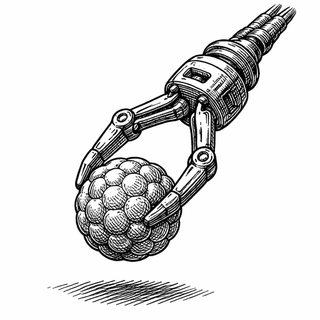
The researchers describe a wireless, mobile microrobot gripper designed to pick up and place cell spheroids.
If "cell spheroid" sounds like a phrase invented to keep parents from asking follow-up questions, here is the plain-English version: these are tiny ball-shaped clusters of living cells. Scientists use them because they behave more like real tissue than single cells spread flat in a dish. That makes them useful for tissue engineering, disease modeling, and drug testing.
The problem is that these little clusters are delicate. You cannot just grab them with brute force and hope for the best. Living tissue does not appreciate being treated like a Lego brick. If a tool squeezes too hard, the cells can be damaged. If it is too clumsy, the structure you are trying to build ends up sloppy or unusable.
So this team made a very small untethered gripper that can move around and, most interestingly, sense force in real time. That means it is not just grabbing blindly. It can tell how much pressure it is applying while handling these tiny cell clusters.
That sounds technical, because it is. But the practical value is simple: when you are assembling living material, gentle matters.
Why force sensing is the big deal
A lot of futuristic biomedical stories sound impressive right up until you ask one annoying question: "Yes, but can it do the thing without breaking the thing?"
That is what force sensing addresses here.
The gripper is meant for "pick-and-place bioassembly," which is exactly what it sounds like. The robot picks up one cell spheroid, moves it, and places it where it belongs as part of a bigger tissue-like structure. The challenge is that the material being handled is soft, variable, and alive. This is not a factory arm installing a windshield. This is more like trying to stack wet jelly donuts with chopsticks while wearing mittens.
By adding real-time force sensing, the system gives itself feedback during handling. That feedback helps the robot avoid crushing the spheroids while still moving them accurately. According to the summary, the researchers showed that the platform could create precise, mixed arrangements of multiple spheroids while keeping cell viability high.
That last part matters a lot. Precision is nice. Precision plus living cells that stay alive is the whole ballgame.
Why should families care?
Right now, this is not a treatment your child is going to get next Tuesday. It is a platform technology. That usually means one step removed from direct patient care, and sometimes several steps removed. Fair enough.
But platform technologies can quietly shape what becomes possible later.
If scientists get better at building organized tissue models from living cell clusters, that can improve several parts of biomedical research. It could help create more realistic lab-grown tissues for studying disease. It could improve drug testing by giving researchers models that behave more like actual human tissue. Over time, it might support regenerative medicine efforts where building complex tissue structures accurately is the whole challenge.
For parents, the hopeful version of this story is not "tiny robot cures everything." The hopeful version is more grounded: better tools for building and studying tissue can lead to better models of childhood diseases, better testing of therapies, and maybe eventually better repair strategies when tissues are damaged or malformed.
That is less flashy than a miracle headline. It is also how progress usually works.
What problem does this solve?
The paper focuses on a barrier in biofabrication. Researchers can make cell spheroids, but arranging them into larger, more complex structures is hard when the handling process itself risks damage.
You need at least three things at once:
- Gentle handling so the cells survive.
- Precise placement so the structure is not a biological finger painting.
- Maneuverability so you can build more complicated patterns.
This microrobotic system is aiming at all three. The untethered design helps with mobility. The gripper format allows pick-and-place assembly. The force sensing provides control during contact. Put those together, and you get a tool that may be better suited for building complex tissue models from fragile living parts.
That does not mean the problem is solved forever. It means one annoying, very technical obstacle just got a more believable answer.
What makes this paper interesting?
For me, it is the combination of precision and restraint.
A lot of medical engineering celebrates what machines can do faster, harder, or at larger scale. This one is about doing less damage while still doing something complicated. There is something deeply reassuring about a medical technology whose superpower is basically "has learned not to squeeze too hard."
The paper also highlights heterogeneous patterning, meaning the system can arrange different kinds of spheroids into intentional structures. That matters because real tissues are not made of one identical blob repeated forever. They are organized mixtures. If researchers want to build models that actually resemble real biology, they need tools that can place different components where they belong.
That is where this stops sounding like a neat gadget and starts sounding like serious infrastructure for tissue engineering.
What are the limits?
Plenty.
First, this is still research-stage work. A clever tool in a controlled experimental setup is not the same as a clinical product. There is a long road between "works in the lab" and "helps patients in routine care."
Second, even if the gripper handles spheroids well, building functional tissue is still hard. Living tissue needs the right structure, the right cell types, the right environment, and usually the right blood supply and signaling conditions. Biology remains stubbornly uninterested in our timelines.
Third, the summary tells us this platform maintained high cell viability and achieved precise assembly, which is encouraging, but it does not mean every downstream challenge has been solved. It means the handling step got smarter. That is valuable. It is not the same as full organ engineering suddenly being around the corner.
The parent take
If my kid had a condition that might someday benefit from tissue engineering or better lab-grown disease models, this is the kind of paper I would file under "worth watching."
Not because it promises a cure. It does not.
Not because it is instantly relatable. Tiny wireless force-sensing microrobotic grippers are not exactly dinner-table material unless your dinner table is extremely niche.
But because it tackles a real problem with a practical solution. When researchers want to build living structures, they need tools that can move fragile cell clusters without wrecking them. This paper says: here is one way to do that, with finesse instead of force.
And honestly, in medicine as in parenting, a lot of progress comes down to learning how to handle delicate things carefully.
This blog post discusses research findings and should not be taken as medical advice. If you have concerns about tissue engineering, regenerative medicine, or related health conditions, please consult a healthcare provider. Research discussed here represents ongoing scientific investigation and clinical validation is still in progress.
All images used in this post are decorative illustrations only and do not represent or reflect the accuracy, reality, or correctness of the referenced research.
Primary Source: Force-sensing mobile microrobotic grippers for gentle and precise bioassembly of cell spheroids. PubMed record 42058554. PubMed: https://pubmed.ncbi.nlm.nih.gov/42058554/