
Here's the thing about microfluidics that nobody tells you: a lot of modern bioanalysis depends on moving unbelievably tiny targets around with ridiculous precision, and that turns out to be much harder than it sounds. We are talking about cells, particles, and other microscopic hitchhikers floating through narrow fluid channels where one sloppy nudge can throw off the whole test. In the ambulance world, organizing chaos usually meant getting the right patient to the right place fast. In the lab, it can mean getting the right cell to the right spot without touching it at all. Same pressure, smaller traffic cones.
A new paper on a tunable 50 MHz acoustic vortex tweezer takes aim at that problem with a tool that uses ultrasound to manipulate microscopic targets in fluid. The headline idea is simple enough to say out loud without spraining anything: use tightly controlled sound waves to grab, guide, and concentrate tiny biological materials, potentially with more flexibility than older systems. The interesting part is how the researchers try to solve some persistent engineering headaches that have kept high-frequency acoustic manipulation from being more adaptable.
Why tiny sample handling matters so much
When people hear about medical testing or bioanalysis, they usually picture the final result: the lab value, the pathology read, the yes-or-no answer. What gets less attention is the prep work. Before a test can identify rare cells or analyze a tiny biological sample, the system often needs to isolate, enrich, or concentrate the target first.
That step can be a bottleneck. If the cells or particles you care about are sparse, mixed into a messy sample, or easily damaged, your analysis can struggle before it even starts. The whole process is a little like trying to find one specific running back in a stadium parking lot after the game, except everybody is microscopic and suspended in fluid.
This is where acoustic methods have real appeal. Ultrasound can move particles without direct contact. That matters because physical grabbing, filtering, or pushing can be rough on delicate samples. Non-contact handling is often a better fit for living cells or finely tuned assays.
What makes this device different
According to the paper summary, high-frequency ultrasound above 50 MHz can offer resolution on the scale of tens of micrometers. That level of precision is attractive for microfluidic systems, where the targets are tiny and the margins are unforgiving. But older approaches have some stubborn limitations.
The paper points to three big ones:
- Fixed focal points
- Single manipulation modes
- High acoustic attenuation during field regulation
Put more plainly, a lot of existing systems are good at doing one trick in one place, and they lose efficiency when you try to get fancy. That is not ideal if your goal is selective manipulation in a complex sample. You want something more like a skilled point guard than a vending machine.
The researchers describe a tunable acoustic vortex tweezer built on a low-attenuation silicon metasurface. That matters because attenuation is basically energy loss. If too much of the sound energy fades away while you are trying to shape and control the field, performance takes a hit. At high frequencies, that problem gets especially annoying, like trying to shout instructions through three closed doors and a leaf blower.
The other notable feature is the shift away from traditional fixed-focus transducers. Instead, this device uses topological charge modulation, which is a phrase that sounds like it belongs in a superhero origin story but here refers to changing the structure of the acoustic vortex field. In practical terms, the team is trying to make the tweezer more adaptable, so it can manipulate targets with greater control rather than being locked into one static operating pattern.
What is an acoustic vortex tweezer, exactly?
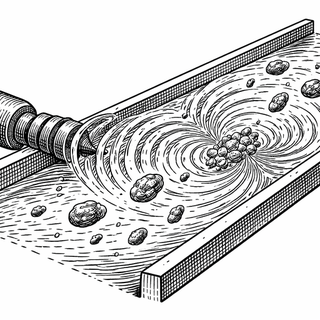
The short version: it is a device that uses patterned ultrasound waves to trap or move microscopic objects. The “vortex” part refers to the shaped acoustic field, which can create forces that guide particles in specific ways.
If you have ever watched leaves swirl into a little spiral in a parking lot on a windy day, you already have the right mental image. Replace the leaves with cells or microparticles, replace the wind with precisely engineered ultrasound, and replace the parking lot with a microfluidic device worth more than my first car.
That ability to sort or concentrate targets by size is especially interesting. A size-selective tool could help enrich the particles or cells you want while leaving others behind. In lab workflows, pre-concentration can improve downstream detection by making the signal stronger and the sample cleaner.
Why pre-concentration is such a big deal
Pre-concentration sounds dry until you remember what it can unlock. In many biological samples, the thing you care about may be present in tiny numbers. If you can gather more of it into one spot before analysis, you may improve sensitivity and make the next testing step more effective.
That does not mean this device is ready to roll into hospitals tomorrow with theme music. It does mean the underlying approach could help tackle a common problem in diagnostics and lab-on-a-chip systems: too much noise, not enough target.
That has potential relevance for areas like cell sorting, sample prep, and microscale bioanalysis. The non-contact nature is a plus, and the tunability could make the tool more versatile than fixed systems that only behave well under narrow conditions.
The real-world promise, and the real-world caution
What makes this paper intriguing is not just that it pushes ultrasound into a highly precise regime. It is that it tries to combine precision, flexibility, and reduced attenuation in one platform. That combination is where things get practical.
If follow-up work goes well, tools like this could fit into next-generation microfluidic devices that prepare samples more efficiently before analysis. Better target handling upstream can improve what happens downstream, whether that is detection, characterization, or sorting.
Still, this is engineering research, not a finished clinical product. There is a long distance between “works in a controlled research setup” and “reliably improves routine medical testing.” Device robustness, reproducibility, manufacturing, compatibility with different sample types, and validation in realistic workflows all matter. Lab innovation has a habit of looking like the future right up until it meets the paperwork, the budget, and a cranky real-world sample.
Why this one is worth watching
I like this study because it goes after a problem that tends to hide in plain sight. Everyone gets excited about the final diagnostic breakthrough, but fewer people talk about the tiny choreography needed to get a sample ready for that moment. This paper focuses on the backstage crew, and in medicine, the backstage crew often decides whether the show works.
A tunable 50 MHz acoustic vortex tweezer will never sound like a household item, and that is probably for the best. But as a concept, it is compelling: use highly controlled sound waves to sort and concentrate microscopic biological targets without touching them, and do it with more flexibility than older high-frequency systems allowed.
That is the kind of advance that may not grab headlines outside engineering circles, yet it could quietly improve the plumbing behind better diagnostics and bioanalysis. Sometimes progress is not a dramatic cure or a miracle drug. Sometimes it is a smarter way to move tiny things around in tiny channels, which, fair warning, is how a surprising amount of modern medicine gets done.
This blog post discusses research findings and should not be taken as medical advice. If you have concerns about diagnostic testing, laboratory results, or related health conditions, please consult a healthcare provider. Research discussed here represents ongoing scientific investigation and clinical validation is still in progress.
All images used in this post are decorative illustrations only and do not represent or reflect the accuracy, reality, or correctness of the referenced research.
Primary Source: A tunable 50 MHz acoustic vortex tweezer for size-selective manipulation and cell pre-concentration. PubMed. Source link