
Spoiler alert: they got microbial production of 2'-fucosyllactose, or 2'-FL, to run cleanly without making the annoying byproduct difucosyllactose. That may sound like a niche enzymology win, but commercially it is the sort of result that makes product people sit up straight. If biomanufacturing is a kitchen, this is the moment the team figured out how to make the signature sauce without accidentally filling half the bottles with the wrong condiment.
Why 2'-FL Gets So Much Attention
2'-FL is one of the best-known human milk oligosaccharides, a class of sugars naturally found in breast milk. It has attracted serious interest because it can support infant gut health and is already relevant to nutrition products, especially infant formula. In plain English: this is not some obscure molecule looking for a purpose. It already has a market, a customer base, and a regulatory conversation attached to it.
That is why manufacturing matters so much. If you can make 2'-FL efficiently, at high titer, and with fewer byproducts, you are not just improving a lab process. You are improving cost structure, purification burden, and ultimately the odds that a good molecule becomes a scalable business instead of a very expensive science fair project.
The Problem They Targeted
Making 2'-FL in microbes is a classic synthetic biology challenge. You build a microbial factory, install the right pathway, and ask it to churn out the target compound. Then reality arrives wearing steel-toed boots.
One major headache is byproduct formation, especially difucosyllactose, or DFL. From a business perspective, byproducts are the biochemical version of shrinkage in retail. They waste feedstock, complicate downstream purification, lower effective yield, and generally turn a neat process flow diagram into an operations meeting.
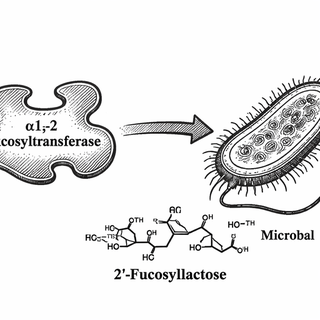
The research tackled that problem at the enzyme level. Specifically, the team focused on an alpha-1,2-fucosyltransferase called BKHT, which they describe as strictly regioselective. That regioselectivity matters because 2'-FL production depends on placing a fucose unit in exactly the right spot on lactose. If the enzyme is selective and behaves itself, you get the molecule you want. If it gets creative, your purification team gets a new reason to sigh heavily.
The Smart Part: They Did Not Bet on Just One Engineering Strategy
What makes this paper interesting is not only the result, but the way they got there. They combined rational design with semirational screening.
Rational design is the more calculated approach. You use structural information, evolutionary clues, and stability predictions to make informed guesses about which amino acid changes might improve the enzyme. It is engineering with a map.
Semirational screening adds a practical reality check. Instead of pretending we can predict everything from a computer model, it narrows the search space intelligently and then tests variants in the real world. In this study, the authors powered that screening with an engineered l-fucose-responsive biosensor. That means they built a system that could help identify promising enzyme behavior more efficiently, which is exactly the kind of tool that turns a heroic one-off experiment into a repeatable platform.
I like this combination because it has founder energy. One side says, "Let us model this carefully." The other side says, "Great, now let the biology vote."
Why the Biosensor Angle Matters
The biosensor piece deserves extra attention because it points to platform value, not just one product milestone.
A good biosensor can speed up screening dramatically by linking cellular performance to an observable signal. In practical terms, it helps researchers sort through enzyme variants faster and with less brute force. That matters because enzyme engineering usually involves a lot of "try this mutation and see whether nature approves." Nature is not famous for concise feedback.
If this screening setup is robust, it could be useful beyond this single enzyme. That is where the commercial story gets more interesting. A company does not only want a better strain for one sugar. It wants a repeatable engine for discovering better enzymes across a portfolio of glycans, specialty ingredients, or biomanufactured compounds.
What They Achieved
According to the summary, the team established a synthetic biology platform for high-titer, byproduct-free 2'-FL biosynthesis using engineered BKHT variants. That phrase "byproduct-free" is doing a lot of work here. It suggests they did not merely nudge the system in the right direction. They meaningfully addressed one of the key manufacturing pain points.
High titer also matters because industrial biotechnology is not judged on vibes. It is judged on whether the process can produce enough product per unit volume to justify tanks, utilities, staff, raw materials, and capital expenditure. A cleaner pathway plus stronger output is the kind of pairing that can shift a process from scientifically elegant to commercially plausible.
Why This Could Matter Outside the Lab
If follow-up development succeeds, this kind of work could improve how 2'-FL is produced at industrial scale. Cleaner biosynthesis can mean lower purification costs, more consistent product quality, and less waste. That is not glamorous, but it is where margins live.
It also fits a bigger pattern in modern biotech. We are moving from "can we produce the molecule at all?" to "can we produce it precisely, predictably, and cheaply enough to win?" The winners in synthetic biology will not just be the teams with a cool pathway. They will be the teams that remove operational friction molecule by molecule, step by step, until manufacturing starts looking less like alchemy and more like software deployment with stainless steel.
Well, software deployment with microbes, which is admittedly a slightly more opinionated workforce.
The Bigger Takeaway
The deeper lesson from this paper is that precision enzyme engineering is becoming a business lever. Better catalysts can reduce byproducts, unlock higher selectivity, and reshape the economics of entire categories. For nutrition ingredients like 2'-FL, that can translate into broader access, improved supply resilience, and faster iteration on next-generation formulations.
There is also a strategic point here for anyone building in the bioeconomy. Tools that combine computation, targeted library design, and fast screening are not just helping scientists publish better papers. They are laying the groundwork for better product companies. Every time a group shows they can engineer a cleaner biological conversion, they are quietly improving the playbook for scalable biomanufacturing.
That may not be headline-grabbing in the way gene editing or AI protein folding can be. But if you care about what actually ships, gets approved, and makes money, this is exactly the sort of paper worth watching.
This blog post discusses research findings and should not be taken as medical advice. If you have concerns about infant nutrition or related health questions, please consult a healthcare provider. Research discussed here represents ongoing scientific investigation and clinical validation is still in progress.
All images used in this post are decorative illustrations only and do not represent or reflect the accuracy, reality, or correctness of the referenced research.
Primary Source: A Combinatorial Strategy of Semirational Screening and Rational Design for Engineering an alpha-1,2-Fucosyltransferase toward Efficient 2'-Fucosyllactose Biosynthesis. PubMed Record 41983305. Available at: https://pubmed.ncbi.nlm.nih.gov/41983305/