
If you've ever tried to repurpose leftovers into an actually decent lunch, you already understand the basic principle behind this research. The ingredient nobody was excited about yesterday suddenly becomes valuable with the right tool, the right heat, and a little creativity. That, in spirit, is why copper-based research on converting greenhouse CO2 is so commercially interesting. We are talking about taking a waste molecule that costs us economically and environmentally, then persuading it to become something useful. Not magic. Just chemistry with startup energy.
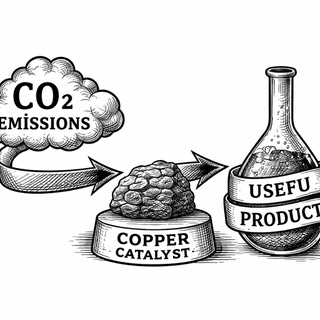
From the research snippet provided, this paper centers on the conversion of greenhouse CO2 and the role of copper, or Cu. Even with limited details, that is enough to identify the big idea: copper is one of the most talked-about catalytic materials in carbon conversion because it can help drive CO2 toward higher-value chemical products. In plain English, this is about transforming emissions from a liability into feedstock. Investors tend to like that sentence. So do manufacturers.
Why copper keeps showing up in the room
Copper has become a recurring character in CO2 conversion research for a simple reason: it is unusually versatile. Many catalysts can push CO2 toward basic products such as carbon monoxide or formate, but copper has attracted outsized attention because it may help form more reduced, more complex carbon-containing products under the right conditions. That makes it scientifically tricky and commercially tempting.
The underlying problem is that CO2 is very stable. Nature designed it like a molecule that has already put on sweatpants and declared the day over. Convincing it to react takes energy, precision, and a catalyst that does not lose the plot halfway through. Copper matters because it can influence which reaction pathways open up, which products dominate, and how efficiently the whole system runs.
That last point is where research becomes business. If a copper-based catalyst can improve selectivity, lower energy waste, or increase durability, the science does not just get cleaner. It gets closer to unit economics that someone can build a company around.
The real commercial hook
There are plenty of climate technologies that sound noble and remain allergic to profitability. CO2 conversion has a chance to be more practical than that, at least in theory, because it sits at the intersection of emissions management and chemical manufacturing.
If you can capture CO2 from an industrial source and convert it into a useful output, you are not merely reducing harm. You are creating product. Depending on the system, those products might include precursor chemicals, fuels, or industrial intermediates. That opens several possible business models:
- Carbon utilization as a service for emitters
- On-site conversion systems for factories
- Licensing improved catalyst platforms
- Integration with renewable electricity for low-carbon manufacturing
That is the part that gets founders leaning forward in their chairs. The dream is not just "less pollution." The dream is "new margin from old waste."
Of course, the dream still has homework to do.
Where the hard part lives
Copper is promising, but promising is not the same as deployable. In catalytic CO2 conversion, the biggest challenges tend to be efficiency, selectivity, stability, and scale.
Efficiency asks whether the system uses energy wisely. If it takes too much power to convert CO2, the economics can collapse unless electricity is extremely cheap and clean.
Selectivity asks whether the catalyst makes the product you want, rather than a frustrating soup of side products. Chemists call that a technical challenge. Operators call it separation cost.
Stability asks whether the catalyst keeps working over time. A catalyst that performs beautifully for a short experiment and then degrades is interesting for a lab meeting and less exciting for a factory manager with quarterly targets.
Scale asks the final rude question: can this still work outside controlled conditions, at industrial volumes, without turning into an expensive science fair project?
Any paper involving copper and CO2 conversion is entering that arena. The commercial value depends on how much it moves one or more of those constraints.
Why this kind of paper deserves attention
Even a narrowly focused materials paper can matter far beyond the bench. Small improvements in catalyst behavior can compound. A surface tweak here, a structural change there, and suddenly a process that used to be marginal starts looking investable. That is how whole categories often emerge. Not with one cinematic breakthrough, but with a stack of disciplined gains that eventually stop looking small.
What makes copper especially intriguing is that it sits in a sweet spot between familiarity and possibility. It is not an exotic material that practically requires its own security team. It is already widely known, relatively accessible, and deeply studied. That does not guarantee success, but it improves the odds that discoveries can move into engineering workflows faster than if the field were betting on something impossibly rare or expensive.
There is also a strategic angle here. If industries are pushed to decarbonize, they will need more than offsets and apologies. They will need tools that fit into real supply chains. Catalytic CO2 conversion offers a route toward circular carbon systems, where emissions are not only captured but reused. That is not a silver bullet. It is more like a better wrench - and in industry, a better wrench can make a lot of money.
What I would watch next
The most valuable follow-up questions are not philosophical. They are operational.
First, what exactly does the copper system produce, and how selectively? A catalyst that steers CO2 toward a high-demand product is much more commercially relevant than one that generates something difficult to separate or sell.
Second, how much energy does the process require? If the power bill ends up acting like an uninvited cofounder with a 60 percent equity stake, the model needs work.
Third, how durable is the catalyst? Lifetime matters. Replacement frequency matters. Maintenance matters. Industry loves elegant science right up until it has to shut down a line to baby it.
Fourth, can the process integrate with renewable electricity, existing carbon capture systems, or current chemical infrastructure? The less rebuilding required, the faster adoption can happen.
These are the questions that decide whether a paper becomes a citation, a pilot plant, or a term sheet.
The bigger picture
What I like about this research direction is that it treats climate chemistry like an engineering market rather than a morality play. CO2 is a problem, yes. But it is also a carbon source. If copper-based systems can help convert that source efficiently and predictably, then we are not just discussing environmental cleanup. We are discussing industrial redesign.
That matters because the best climate technologies are often the ones that stop asking for permission and start fitting into economics. When waste becomes input, adoption gets easier. When adoption gets easier, impact stops being hypothetical.
So even from the brief information available here, the commercial signal is clear. Copper-based CO2 conversion research sits in one of the most interesting lanes in modern applied chemistry: the place where catalysis, decarbonization, and manufacturing strategy all collide. It is a field worth watching closely, partly for the science and partly because the future chemical plant may end up looking a lot less like a smokestack and a lot more like a recycling machine with a very good PhD.
This blog post discusses research findings and should not be taken as medical advice. If you have concerns about environmental exposures or climate-related health impacts, please consult a qualified healthcare provider. Research discussed here represents ongoing scientific investigation and practical validation is still in progress.
All images used in this post are decorative illustrations only and do not represent or reflect the accuracy, reality, or correctness of the referenced research.
Primary Source: PubMed Record 41672910. Cu. Available at: https://pubmed.ncbi.nlm.nih.gov/41672910/