
Let me save you a trip to medical school: if you put a super-flexible electrode into the brain, one of the hardest parts is later figuring out exactly where that tiny noodle ended up. And that matters a lot, because if you want to match a recorded neural signal to the right brain structure, “somewhere in there” is not exactly a gold-standard scientific answer. This new research proposes a fix that is so elegant it feels mildly unfair: give each electrode bundle its own magnetic resonance identification tag, or MRID-tag, so it shows up in MRI with a unique barcode-like pattern. It is basically giving brain implants a scannable identity badge, except much smaller and with dramatically higher stakes.
Why ultra-flexible electrodes are such a big deal
Ultra-flexible electrodes are one of the more exciting directions in neuroprosthetics because they are designed to better match the softness of brain tissue. Traditional devices can be mechanically mismatched with the brain, which is not ideal when your target organ has the consistency of very fancy tofu. A more flexible implant can reduce irritation and improve biocompatibility, which is exactly what you want if you are trying to record brain activity over time.
That part is already exciting. But there has been a stubborn practical problem hiding behind the glamour: once these high-density, ultra-flexible electrode bundles are implanted, it becomes difficult to identify their exact positions in the brain. If the device is extremely thin and compliant, that is good for the tissue, but it also means tracking its path is not simple. The very feature that makes the electrode kind to the brain also makes it sneaky on imaging.
And that is where this paper gets fun.
The surprisingly clever fix: MRI-visible barcodes
The researchers developed MRID-tags, which are attached to each ultra-flexible electrode bundle. These tags create unique barcode patterns that can be seen on MRI. Not metaphorical barcodes. Actual barcode-like patterns visible in imaging that let researchers identify which bundle is which.
Wait, it gets better: the individual bars are not just there for labeling. According to the summary, they also allow accurate 3D reconstruction of the electrode bundle’s trajectory through the brain. So instead of merely saying “this is bundle A,” the MRI barcode helps reveal where that bundle traveled and where its individual electrodes are anatomically located.
That is a pretty major step, because the whole point of recording neural activity is to relate signals to specific brain structures. If you cannot confidently say where an electrode sits, your data interpretation gets shakier. You may still have beautiful recordings, but the anatomical map starts looking like someone spilled coffee on the directions.
How they make the tags
The paper reports that the MRI barcodes are generated by patterning superparamagnetic iron-oxide nanoparticles into electrode fibers that are about 10 micrometers wide. That is tiny. Tiny enough that “precision manufacturing” starts sounding less like engineering and more like a dare.
Superparamagnetic iron-oxide nanoparticles are useful here because they can create contrast in MRI. In other words, they help the implanted tag leave a detectable signature on the scan. By arranging them into distinct patterns, the researchers can make different bundles carry different identities.
This is one of those ideas that sounds obvious only after someone else has done the hard part. Of course you would want implanted electrode bundles to be image-readable and uniquely identifiable. Of course you would turn that information into a barcode. Of course you would build it directly into the fiber. But getting from “wouldn’t it be nice if” to “here is the engineered solution” is where the actual science lives.
Why this matters beyond a neat imaging trick
The real value here is not just prettier scans. It is improved confidence in what brain signals mean.
Neuroprosthetic systems depend on knowing which electrodes are recording from which anatomical regions. If one contact is near one structure and another is near a neighboring one, that difference can matter enormously for interpreting activity, designing interfaces, or optimizing stimulation strategies. Better localization could improve both research quality and eventual clinical precision.
This also matters for scale. The challenge gets worse as electrode systems become higher density and more complex. A few electrodes are one thing. Large arrays of ultra-flexible fibers are another. Once you start packing many channels into the brain, “let’s just eyeball it” stops being a method and starts being a confession.
MRID-tags address a very specific bottleneck: the need to identify each implanted bundle and reconstruct its path accurately in three dimensions. That is the kind of enabling technology that does not always get flashy headlines, but it can quietly unlock a lot of downstream progress.
What problem this research is really solving
At a deeper level, this paper is tackling a classic neurotechnology tension: we want implants that are gentler, smaller, and more adaptive to brain tissue, but those same features can make them harder to visualize and localize after implantation.
So the field has been stuck with a tradeoff. Make devices more tissue-friendly, and you risk making them harder to track. Make them easier to image, and you may compromise the properties that made them attractive in the first place.
This work suggests you may not have to pick just one. By embedding MRI-readable tags into ultra-flexible electrode bundles, the researchers are trying to preserve the benefits of soft, high-density interfaces while restoring anatomical traceability. That is not a small technical convenience. That is the difference between having a promising implant and having a promising implant you can actually interpret properly.
What could happen if this line of work succeeds
If follow-up development goes well, this could strengthen the whole pipeline for brain-machine interfaces and neuroprosthetics.
Researchers could more reliably assign recorded signals to specific structures. Device developers could design denser flexible systems without flying half-blind on localization. Clinically, if these technologies eventually move further into patient-facing applications, better anatomical mapping could support safer planning and more interpretable outcomes.
There is also something appealingly modular about the concept. A bundle carries its own identifying MRI signature. That means the imaging system is not guessing, and the researcher is not relying purely on implantation geometry or indirect reconstruction after the fact. The implant itself helps explain where it is. Which, frankly, is more cooperation than many printers offer.
The big takeaway
What I love about this study is that it solves a very modern neuroengineering problem with a solution that is both sophisticated and wonderfully legible: label the ultra-flexible electrode bundles so MRI can tell them apart, then use those labels to reconstruct where they actually go.
That may sound like a niche engineering advance, but niche engineering advances are often the gears inside bigger revolutions. Ultra-flexible electrodes are widely seen as a strong candidate for the future of neuroprosthetics because of their biocompatibility. If MRID-tags make those electrodes easier to identify and map inside the brain, they could help turn a promising platform into a much more usable one.
And honestly, any paper that makes me say “you put tiny MRI barcodes inside electrode fibers?” out loud to an empty room has done something right.
This blog post discusses research findings and should not be taken as medical advice. If you have concerns about neurological conditions, brain implants, or neuroprosthetic devices, please consult a healthcare provider. Research discussed here represents ongoing scientific investigation and clinical validation is still in progress.
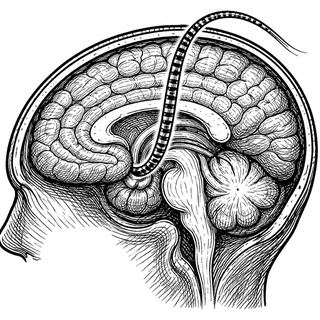
All images used in this post are decorative illustrations only and do not represent or reflect the accuracy, reality, or correctness of the referenced research.
Primary Source: Magnetic resonance identification tags for ultra-flexible electrodes. PubMed Record 42049714. Available at: https://pubmed.ncbi.nlm.nih.gov/42049714/