
Old-school periodontitis treatment is a bit like trying to clear squatters out of a crumbling apartment building with a loud warning and a mop. You scrape away the mess, maybe add antibiotics, and hope the tenants do not come back. This new approach aims for something more modern and frankly more competent: send in a material that can suppress harmful bacteria, calm inflammation, and help rebuild damaged tissue at the same time. For once, the dental pocket is not being treated like a passive hole. It is being treated like a small, badly governed ecosystem.
Why periodontitis is such a stubborn problem
Periodontitis is advanced gum disease. Bacteria gather around the teeth and below the gumline, inflammation follows, and over time the tissues and bone that support the teeth begin to break down. That is the plain-English version. The less plain-English version is that the mouth is full of tricky anatomy, hard-to-reach pockets, biofilms that act like fortified microbial apartment blocks, and an immune response that can do almost as much collateral damage as the germs themselves.
That combination makes treatment difficult. Dentists can mechanically clean the area, which matters a lot, but deep periodontal pockets are not exactly designed for easy maintenance. Antibiotics can help, but they come with familiar baggage: resistance, incomplete bacterial clearance, and the recurring medical tradition of discovering that microbes also read the memo and adapt.
So researchers have been looking for local therapies that stay where they are needed, work over time, and do more than one job. Bureaucracies love multipurpose tools, and to be fair, so does biology.
What this study built
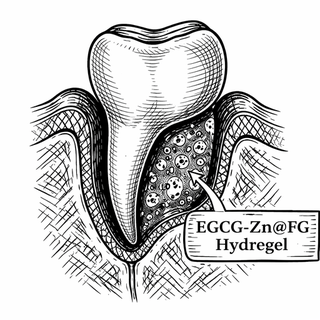
The research describes a material called EGCG-Zn@FG, a polyphenol-metal coordination hydrogel. The name sounds like something assembled by a committee, but the idea is fairly elegant.
It combines three key parts:
- EGCG, a polyphenol found in green tea, known for antimicrobial and anti-inflammatory properties
- Zinc ions, which add antimicrobial effects and are also relevant to tissue repair biology
- A plasma-derived fibrin gel, which acts as the scaffold or delivery matrix
Put together, the result is a gel designed to sit in the periodontal pocket and release helpful components over time. In theory, that gives it a practical edge over treatments that arrive in a burst and disappear before the bacterial neighborhood has even filed its appeal.
The researchers report that the antibacterial effect was stronger because EGCG and zinc worked synergistically. That means the combination was better than either component acting alone. The gel also appeared to reduce inflammation and promote osteogenic activity, which is the science-world way of saying it may support bone-forming processes. In periodontitis, where bone loss around teeth is a central problem, that part is especially interesting.
Why the delivery system matters as much as the ingredients
A lot of medical innovation is not about inventing a magical new molecule. It is about getting a decent molecule to the right place, at the right time, in the right dose, without causing fresh trouble. Which is less glamorous, but also how many real advances happen.
That is what makes the fibrin gel portion of this study worth attention. A plasma-derived gel is not just a passive blob. It can help localize the treatment inside the periodontal pocket, where disease is actually happening. That matters because periodontitis is highly local. The bacteria are not floating politely in open space, waiting to be negotiated with. They are tucked into complex surfaces and protected structures.
A local gel also offers a possible policy-friendly advantage, if future studies back it up: targeted therapy can reduce reliance on systemic antibiotics. And anytime we can solve a problem without prescribing more broad antimicrobial firepower, antimicrobial stewardship officers everywhere can unclench slightly.
The three-part appeal: bacteria, inflammation, regeneration
What stands out in this study is not just that the material fights bacteria. A toothbrush, scaling tools, and several medications already do versions of that. The bigger appeal is the combined strategy.
First, there is the antibacterial effect. The study says the gel had enhanced activity against periodontal pathogens, using the natural antimicrobial properties of EGCG plus sustained zinc release.
Second, there is the anti-inflammatory effect. That is important because periodontitis is not simply an infection. It is also a chronic inflammatory process. Even after bacterial reduction, the local immune environment matters. If the tissue remains inflamed, healing is harder and damage can continue.
Third, there is the osteogenic effect. This is the part that moves the conversation from “kill the bad stuff” to “help rebuild what was lost.” In gum disease, preventing further destruction is valuable, but supporting regeneration is the real prize. That is where the field has long been aiming, often with mixed success.
In other words, this material is trying to function less like a single-purpose drug and more like a small interagency task force. That sentence should alarm anyone who has dealt with actual interagency task forces, but in biomaterials the concept is much more promising.
Why this could matter beyond one dental paper
There is a broader lesson here. Medicine keeps running into conditions where the problem is not only infection, not only inflammation, and not only structural damage, but all three at once. Periodontitis happens to be a very visible example. It is common, chronic, and tied to real quality-of-life issues, from pain and bleeding to tooth loss.
What this study suggests is that future dental therapies may look less like one-shot interventions and more like locally engineered environments. Instead of asking a single drug to do all the work, researchers are designing materials that shape the healing process over time.
That has implications beyond dentistry. It reflects a wider move in biomedical research toward smarter delivery systems, combination therapies, and biomaterials that actively participate in treatment. The era of “apply substance, hope for best” is still with us in some corners, but it is facing competition.
The usual reality check
This is the moment where many science stories sprint toward hype, trip over a potted fern, and land in “game-changer” territory. Better to avoid that.
The research is intriguing, but it is still research. A material that performs well in controlled experimental settings does not automatically become a routine clinical therapy. Questions remain about reproducibility, manufacturing, long-term safety, regulatory pathways, cost, and how well the gel performs in the messier conditions of real patients with varying disease severity and oral hygiene patterns.
There is also the practical issue that dentistry, like the rest of healthcare, does not adopt innovations just because they are clever. They must fit workflows, reimbursement, training, and evidence standards. The science may be advanced, but the billing code eventually gets a vote.
Why this paper is worth watching
Even with those caveats, this study lands on a meaningful problem and proposes a thoughtful solution. Periodontitis treatment has long needed options that do more than temporarily suppress symptoms or lean harder on antibiotics. A plasma-derived fibrin gel carrying green-tea-derived EGCG and zinc is unusual enough to catch attention, but grounded enough in biological logic to feel plausible.
If follow-up work confirms these effects and shows they translate into real clinical benefit, the result could be a more sophisticated way to treat gum disease: one that attacks pathogens, tones down damaging inflammation, and supports tissue repair in the same hard-to-reach place. For a disease defined by persistence, that kind of layered strategy makes sense.
And that may be the quiet charm of this research. It is not trying to revolutionize dentistry with a dramatic gadget or a moon-shot headline. It is trying to solve a boring, widespread, stubborn problem with better engineering. Public health, as usual, advances one unglamorous victory at a time.
This blog post discusses research findings and should not be taken as medical advice. If you have concerns about periodontitis or gum disease, please consult a healthcare provider. Research discussed here represents ongoing scientific investigation and clinical validation is still in progress.
All images used in this post are decorative illustrations only and do not represent or reflect the accuracy, reality, or correctness of the referenced research.
Primary Source: PubMed Record 42048610. EGCG-Zn Encapsulated in Plasma-Derived Gel with Enhanced Antibacterial, Anti-Inflammatory, and Osteogenic Effects for the Therapy of Periodontitis. PubMed