
Forecast for molecular medicine: breakthrough with a chance of controversy. The latest front moving through the lab concerns the proteasome, the cell's protein shredder, recycler, and occasional chaos manager. If that sounds glamorous, it is only because biology has excellent public relations. In reality, the proteasome is more like a hospital basement disposal system: overlooked until it breaks, at which point everyone suddenly remembers it was doing quite a lot.
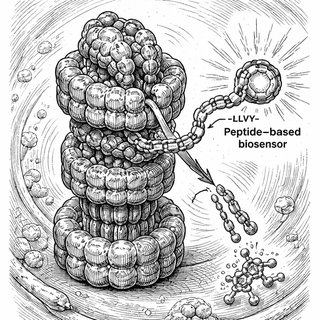
A new paper, titled A Cell-Permeable β-Hairpin Peptide Biosensor for Real-Time, Single-Cell Quantification of Proteasome Activity, tackles a stubborn problem in cell biology. Researchers can measure proteasome activity in crushed-up cell lysates well enough, but intact living cells are another story. And that matters, because cells tend to behave differently when not, in fact, pulverized. The study describes a peptide-based biosensor that can slip into live cells and report proteasome activity in real time, one cell at a time.
Why anyone cares about proteasomes
Proteasomes are large protein complexes that degrade unwanted or damaged proteins. They help cells maintain order, respond to stress, and regulate everything from the cell cycle to signaling pathways. When proteasome function changes, the consequences can be substantial. Cancer cells, for example, often depend heavily on proteasome activity to handle their metabolic mess and rapid turnover of proteins. Multiple myeloma is a classic example, which is why proteasome inhibitors have become a major treatment strategy there.
That creates an obvious need: if proteasomes are biologically and clinically relevant, we should be able to measure what they are doing inside living cells with decent precision. Preferably without asking the cell to stop everything and die for the convenience of the assay.
What this team built
The biosensor in this paper is modular, which is a polite scientific way of saying it was assembled like a very fussy molecular multitool. It includes four main parts:
- A β-hairpin cell-penetrating peptide to help it get inside cells
- A proteasome-specific recognition sequence so the right cellular machinery will cut it
- A Rhodamine 110 fluorophore that produces a measurable fluorescent signal
- A cell-penetrating peptide enhancer sequence to improve uptake
The logic is elegant. The sensor enters the cell, the proteasome recognizes and processes the peptide sequence, and fluorescence provides a readout of that activity. In principle, this lets investigators monitor proteasome function in live intact cells rather than inferring it from biochemical debris afterward.
The group synthesized two versions of the peptide biosensor. The difference between them was the enhancer sequence, specifically how many positively charged residues it carried. That may sound like molecular bookkeeping, but it turned out to matter a great deal.
The experiment, minus the melodrama
The biosensors were tested in two model cell lines known for elevated proteasome activity: OPM.2, a multiple myeloma line, and A549, a lung cancer line. The investigators evaluated performance in both cell lysates and live intact cells, using fluorometry and fluorescence microscopy.
Both sensors worked. That alone is notable. Getting a peptide probe to enter living cells, remain useful, and generate a clean interpretable signal is not trivial. Biology is usually less cooperative than a conference slide deck suggests.
But the more interesting result was comparative. One biosensor outperformed the other across practical metrics such as maximum signal, background noise, and signal-to-noise ratio. The superior version was the one with the enhancer sequence containing fewer positively charged amino acid residues.
There is a nice irony here. One might naively assume that making a cell-penetrating design "more charged, more forceful, more everything" would improve entry and therefore improve performance. Biology, as usual, declines to reward brute enthusiasm. The study suggests that the enhancer sequence does more than just help the sensor cross the membrane. It also influences the observed fluorescence signal itself, which means sequence design can shape the measurement, not just the delivery.
Why this is more than a clever fluorescent trick
This paper is interesting because it addresses a very practical bottleneck. Measuring enzyme activity in live single cells can reveal heterogeneity that bulk methods blur away. Not every cancer cell behaves the same way, even when they share a dish. Some may have higher proteasome activity, some lower, and those differences may affect stress tolerance, treatment response, or resistance.
A live-cell biosensor that works across multiple detection platforms is potentially useful far beyond a single experiment. The authors emphasize compatibility with both fluorometry and microscopy, which matters because it broadens where the tool could be used. A method that only works on one highly specialized instrument often enjoys a short and lonely career.
If follow-up development goes well, this sort of biosensor could help researchers study how proteasome activity changes during drug treatment, oxidative stress, or disease progression. It might also help distinguish cell-to-cell variability in tumor populations, which is exactly the sort of detail modern cancer biology claims to adore, right up until the analysis becomes annoying.
What still needs proving
Promising is not the same as finished, and research tools have a long tradition of looking magnificent in a figure and temperamental everywhere else.
Several questions remain. First, the work was done in model cell lines with enhanced proteasome activity. That makes sense for a proof of concept, but broader validation will matter. How well does the sensor perform in primary cells, mixed tissue systems, or cells with lower baseline proteasome activity? Second, selectivity is always the issue lurking in the background of protease-sensitive probes. The paper is designed around proteasome-specific recognition, but real intracellular environments are crowded and not especially interested in our desire for clean assays.
There is also a translational gap. A biosensor is not a therapy. It is a tool, albeit a potentially valuable one. The immediate impact is on research workflows, mechanistic studies, and drug development rather than patient care tomorrow morning. Anyone promising otherwise should perhaps spend a little less time with press releases.
The bigger picture
Even so, I like this study. It is not trying to sell a miracle. It is solving a method problem that many biologists quietly wrestle with: how to measure a dynamic intracellular process in living cells without turning the experiment into an interpretive dance of indirect proxies.
The best part may be the lesson embedded in the design. Small molecular choices matter. The cell-penetrating enhancer sequence was not just a delivery accessory tacked onto the end of the sensor like decorative trim. It changed how the system behaved. That is a useful reminder that in biosensor design, every component gets a vote, and some of them vote twice.
For anyone interested in proteostasis, cancer cell biology, or live-cell analytical tools, this is the kind of paper worth watching. It does not close the book, but it opens a much better chapter.
This blog post discusses research findings and should not be taken as medical advice. If you have concerns about cancer, abnormal protein degradation disorders, or treatment decisions, please consult a healthcare provider. Research discussed here represents ongoing scientific investigation and clinical validation is still in progress.
All images used in this post are decorative illustrations only and do not represent or reflect the accuracy, reality, or correctness of the referenced research.
Primary Source: A Cell-Permeable β-Hairpin Peptide Biosensor for Real-Time, Single-Cell Quantification of Proteasome Activity. PubMed Record 42041140. https://pubmed.ncbi.nlm.nih.gov/42041140/