
There's a quiet revolution happening in RNA medicine, and most people have no idea. While headlines tend to chase the big, cinematic parts of biotech, researchers are often fighting smaller, stranger battles: how to count microscopic ingredients inside even more microscopic delivery vehicles without turning the whole process into a lab equivalent of searching for two specific grains of rice in a bowl of confetti.
That is the territory of a recent PubMed-listed study on multiplex detection and quantification of microRNAs, or miRNAs, in lipid nanoparticles. At first glance, this sounds like highly specialized paperwork for molecules. In a sense, it is. But it is also the kind of technical advance that can quietly determine whether promising RNA therapies become scalable, reliable medicines or remain trapped in the "fascinating, but hard to manufacture" drawer.
Why miRNAs and lipid nanoparticles matter
miRNAs are tiny RNA molecules that help regulate how genes are expressed. Think of them less as blunt-force drugs and more as molecular managers. They do not usually build proteins themselves. Instead, they help control which genetic instructions get acted on, and how strongly.
That makes them appealing as therapies. If a disease involves gene activity going off-script, a therapeutic miRNA might help nudge the system back toward order. Researchers are especially interested in using more than one miRNA at a time, because biology has the annoying habit of being a network rather than a single broken switch. A combination approach can target multiple pathways at once and potentially improve efficacy.
The hitch is delivery. RNA is fragile, and the body is not exactly a welcoming transit system for loose strands of nucleic acid. Lipid nanoparticles, or LNPs, help solve that problem by packaging RNA cargo inside fatty shells that protect it and improve delivery. LNPs have become a major platform in modern drug development for exactly this reason.
Now comes the bureaucratic part of biology: if you are putting two different miRNAs into the same nanoparticle formulation, you need to know how much of each one is actually in there. Not approximately. Not spiritually. You need a reliable measurement for quality control, batch consistency, and eventually regulatory confidence.
The problem this study tries to fix
Measuring miRNAs one at a time is already tricky. Measuring two different miRNAs in the same LNP formulation is harder. Conventional methods can struggle to distinguish and quantify individual RNA components in a mixed, encapsulated system.
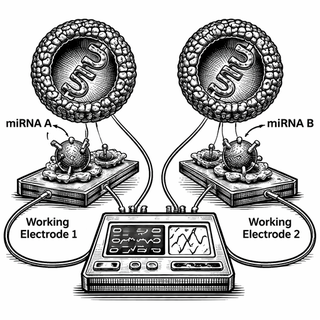
That is where this paper steps in. The researchers developed a dual-working electrochemical biosensor designed to detect and quantify two specific miRNAs, miR-4676 and miR-6503, from lipid nanoparticle formulations. The method is amplification-free, which matters because amplification steps can add complexity, time, and sometimes bias. Fewer moving parts is usually a good thing in quality control, where the dream is not glamour but reproducibility.
Their platform used a screen-printed graphite electrode with two working areas, modified with gold and equipped with methylene blue-labeled single-stranded DNA probes. After the LNPs were broken open with surfactant, the released miRNAs could hybridize with these probes. That interaction produced a signal-off electrochemical readout measured by square wave voltammetry.
"Signal-off" sounds mildly pessimistic, but in analytical chemistry it is just a detection strategy: when the target binds, the signal drops in a measurable way. Bureaucracy loves a form. Electrochemistry, apparently, loves a disappearing one.
What the sensor actually achieved
The performance is what makes this more than a neat engineering exercise.
The biosensor detected miR-4676 and miR-6503 with limits of detection of 0.96 nM and 0.98 nM, respectively. It also showed high selectivity, meaning it could distinguish the intended targets without being easily fooled by cross-reactivity. That is a very nice trait in any assay and an especially comforting one when multiple similar molecules are floating around in the same formulation.
The team also tested the sensor in real LNP preparations containing different miRNA ratios, including 1:1 and 2:1 mixtures. Compared with a standard fluorimetric assay, the electrochemical method achieved 88% and 84% quantification accuracy.
Those numbers are not a declaration that all existing quality-control systems should now retire to a coastal cottage. But they are strong enough to make the platform interesting, especially given the broader package: rapid, low-cost, portable, and able to quantify individual miRNAs within a complex mixture.
That combination matters because manufacturing tools are not judged only by elegance. They are judged by whether people can use them repeatedly, quickly, and without needing a cathedral of expensive instrumentation.
Why this is bigger than one sensor
The most interesting part of this paper may be what it says about where RNA therapeutics are heading. The field is moving beyond simple single-agent formulations toward more tailored and potentially more complex cargo designs. Once you enter the world of coformulated RNA therapeutics, analytics stop being a side issue and start becoming infrastructure.
This is a recurring theme in health policy and regulation: the science can sprint ahead, but the systems that validate, standardize, and monitor that science need to keep up. Otherwise innovation gets bottlenecked not by lack of ideas, but by lack of measurement tools. The future of medicine has a deeply unglamorous dependency on assays, standards, release testing, and quality documentation. Somewhere, a binder is always waiting.
A platform like this could help close that gap. If developers can quantify multiple miRNAs inside LNPs more easily and cheaply, it becomes more feasible to develop combination RNA products at scale. That has implications not just for lab workflows, but for manufacturing readiness, comparability studies, and eventually regulatory review.
None of that guarantees approval, of course. Regulators do not hand out gold stars because a method is clever. They want validation, reproducibility across settings, and clear performance characteristics under real-world conditions. Fair enough. History suggests that "promising early method" and "accepted industrial standard" are separated by a long corridor lined with meetings.
What still needs work
This study is promising, but it is still a platform demonstration rather than the final word. Two miRNAs were tested, not a broad library. The accuracy was good, though not perfect. And moving from a research assay to an industrial quality-control method usually requires further validation across more formulations, operators, instruments, and manufacturing contexts.
There is also the question of how well this kind of approach scales as formulations become more complex. Two analytes are manageable. More than that, and the analytical choreography gets more demanding. Biology, sadly, does not simplify itself for the convenience of compliance teams.
Still, the core concept is strong: a portable electrochemical tool that can separately quantify multiple RNA cargos from the same nanoparticle formulation without amplification. That is exactly the sort of practical advance that can make a field more manufacturable, and therefore more real.
The quiet significance
What I like about this study is that it tackles a problem many non-specialists would overlook and many specialists probably worry about constantly. It is not trying to invent RNA medicine from scratch. It is trying to make RNA medicine measurable in the way modern therapeutics need to be measurable.
And that is how a lot of real progress happens. Not with a dramatic cure headline, but with a better tool for making sure the right molecules are in the right package at the right ratio every single time. It is less Hollywood, more quality systems manual. Which, in biomedicine, is often where the actual revolution lives.
This blog post discusses research findings and should not be taken as medical advice. If you have concerns about RNA-based therapies, drug delivery systems, or any health condition, please consult a healthcare provider. Research discussed here represents ongoing scientific investigation and clinical validation is still in progress.
All images used in this post are decorative illustrations only and do not represent or reflect the accuracy, reality, or correctness of the referenced research.
Primary Source: Multiplex Detection and Quantification of miRNAs in Drug Delivery Systems Using a Signal-Off Electrochemical Platform. PubMed Record 42037292. https://pubmed.ncbi.nlm.nih.gov/42037292/