
When I saw this study title, I rolled my eyes. Then I read it. And now I regret every bit of that eye-rolling, because this paper is doing that rare thing where a very intimidating string of scientific nouns turns out to describe a genuinely elegant idea. Beneath the jargon is a strategy that basically amounts to building a tiny, multitasking rescue vehicle, loading it with a helpful compound, and then dressing it up in a cellular disguise so it can get into the brain and head toward inflammation. It is a little like sneaking a repair crew past the world's pickiest bouncer, except the bouncer is the blood-brain barrier and the repair crew is made of nanomaterials.
Why Alzheimer's Is Such a Hard Problem
Alzheimer's disease is not just one thing going wrong. That would be far too convenient. One of its hallmark features is the buildup of beta-amyloid, often written as Aβ, which forms sticky deposits associated with brain damage. But the trouble does not stop there. Aβ is tied up with oxidative stress, messed-up metal ion balance, and overactive immune responses in the brain. These processes can feed into each other and keep the damage going.
That last part matters a lot. The brain has immune cells called microglia, and under healthy conditions they help with cleanup and surveillance. In Alzheimer's, though, microglia can become excessively activated. Instead of quietly keeping order, they can start contributing to chronic inflammation. Biology loves a self-reinforcing loop almost as much as email chains love "Reply All."
So if you wanted to design a treatment that actually made sense for this mess, you would not want a one-note solution. You would want something that could handle several parts of the problem at once.
The Big Idea in This Paper
That is exactly what this study tries to do.
The researchers built a platinum-based metal-organic framework, or Pt-MOF. Metal-organic frameworks are structured materials with a lot of internal space, which makes them useful for carrying cargo. In this case, the Pt-MOF is not just a passive container. According to the summary, it has intrinsic antioxidant enzyme-mimetic activity. Translation: it can act a bit like the body's own antioxidant enzymes and help neutralize harmful reactive oxygen species.
Then the researchers loaded this Pt-MOF with quercetin.
If that name rings a bell, it is because quercetin is a naturally occurring flavonoid found in foods like onions, apples, and berries. It has attracted attention for antioxidant and anti-inflammatory properties, but getting a compound like this to the right place in the body, especially the brain, is another matter. Useful molecules often have the social skills of an unaddressed package. They exist, they matter, and they still do not reliably get where they need to go.
So the team combined the Pt-MOF with quercetin, aiming for a system that could both carry a therapeutic payload and directly reduce oxidative stress.
And then, because apparently that was not ambitious enough, they added a third layer.
The Wild Part: A Microglia Membrane Disguise
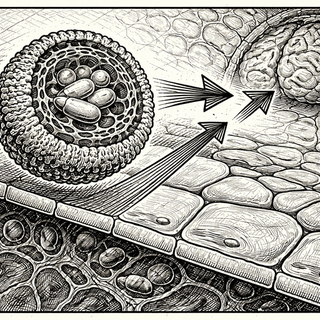
To help the nanoparticle cross the blood-brain barrier and target inflammation, the researchers coated the Pt-MOF/quercetin complex with membranes derived from microglial cells, specifically BV2 cells. This produced the final construct: Pt-MOF/Qu/BV2 nanoparticles.
This is the part that made me sit up.
Cell membrane coating is a biomimetic trick, meaning it imitates biology rather than bulldozing through it. By wrapping the nanoparticle in microglial membrane material, the researchers are trying to give it properties that make it more compatible with the body's own systems. The goal is not just to protect the payload, but to improve where it goes and how it behaves once it gets there.
For brain drug delivery, that matters because the blood-brain barrier is famously selective. It is there for good reason. You do not want every random substance circulating in the bloodstream wandering into brain tissue. Unfortunately, this also makes treatment development a headache with a PhD. If a therapeutic agent cannot cross that barrier, its brilliance is mostly theoretical.
A membrane disguise may help the nanoparticles interact more effectively with inflamed brain environments and improve delivery to where microglial dysfunction is part of the problem.
Why This Is More Interesting Than "Nanoparticles Are Cool"
What I like here is that the design seems built around the actual biology of Alzheimer's rather than a single headline target.
The paper summary points to several interconnected problems: amyloid deposition, oxidative stress, metal ion dyshomeostasis, and excessive microglial activation. This nanodrug system appears intended to push on multiple pieces of that network at once.
The Pt-MOF may help mop up oxidative stress through enzyme-like antioxidant behavior. Quercetin may add anti-inflammatory and antioxidant effects. The microglial membrane coating may improve brain delivery and inflammation targeting. Put together, this is less like throwing one wrench at Alzheimer's and more like showing up with a compact tool kit.
That does not mean it is a cure. It means the strategy is biologically thoughtful.
And honestly, that is what makes this feel exciting. A lot of disease mechanisms are tangled. If your therapy only addresses one thread, the knot usually stays a knot.
The Real-World Promise, If Everything Goes Right
If a system like this holds up in further testing, its appeal is obvious. A brain-penetrating treatment that can reduce oxidative damage, influence inflammatory dysfunction, and carry a therapeutic compound to affected areas would be a serious step forward.
It could also help with a broader challenge in neurodegenerative disease research: not just discovering helpful molecules, but delivering them effectively. Plenty of promising compounds look great until they meet real physiology and discover that the trip to the brain is less "direct flight" and more "lost luggage."
A platform like this could eventually inform how researchers design future therapies for Alzheimer's and perhaps other brain disorders where inflammation, oxidative stress, and delivery barriers overlap.
The Giant Asterisk
Now for the necessary reality check.
This is still research-stage work. Based on the summary provided, this is a sophisticated therapeutic design, not a proven treatment for patients. That distinction matters. A nanodrug system can be conceptually brilliant and still run into problems with safety, manufacturing, reproducibility, dosing, long-term effects, or actual benefit in living organisms.
There is also the fact that Alzheimer's has humbled many smart ideas before. The disease is biologically complex, and strong mechanisms on paper do not always translate into clinical success.
Still, I do not think that makes this less interesting. If anything, it makes careful, multi-pronged strategies like this more worth watching. The field does not need more simplistic silver bullets. It needs approaches that take the messiness of the disease seriously.
This one does.
This blog post discusses research findings and should not be taken as medical advice. If you have concerns about Alzheimer's disease, please consult a healthcare provider. Research discussed here represents ongoing scientific investigation and clinical validation is still in progress.
All images used in this post are decorative illustrations only and do not represent or reflect the accuracy, reality, or correctness of the referenced research.
Primary Source: A microglia membrane biomimetic platinum-based MOF-loaded quercetin nanodrug delivery system for the treatment of Alzheimer's disease. PubMed Record 42052655. https://pubmed.ncbi.nlm.nih.gov/42052655/