
Raise a glass to blood vessels - and to the researchers trying to keep our medical hardware from behaving like a dirty kitchen sponge. A new PubMed-listed study on blood-contacting devices takes aim at one of medicine’s oldest recurring headaches: the moment you put a device into the body, nature immediately starts trying to gunk it up, clot it off, or seed it with bacteria. The body is many things, but low-maintenance is not one of them.
Why blood-contacting devices are such a mess
If you have ever spent time in an ICU, cath lab, OR, or emergency department, you know the pattern. Devices that touch blood can save lives, but they also invite trouble. Catheters, tubing, and other implanted or extracorporeal surfaces can become magnets for proteins, platelets, and microbes. That means clotting, fouling, bloodstream infection, and a whole lot of expense and misery.
Hospital-acquired infections are not some minor paperwork nuisance dreamed up by administrators with clipboards. They are a real source of illness, prolonged hospital stays, antibiotic use, resistant organisms, and occasionally disaster. When bacteria set up camp on a device surface, they do not politely remain on the outside. They can build biofilms, shrug at antibiotics, and turn a helpful piece of medical equipment into a liability with tubing.
That is the practical backdrop for this paper: how do you make a device surface that blood does not want to clot on and bacteria do not want to colonize?
The basic idea: make the surface slippery, active, and mildly hostile to germs
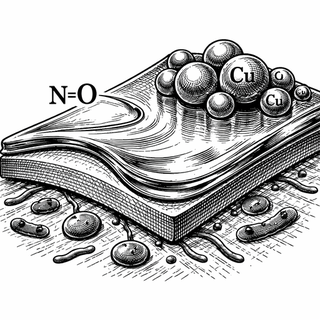
The study, titled Combinatorial Design of Slippery, Nitric Oxide-Releasing Surfaces Incorporating Copper Nanoparticles for Blood-Contacting Devices, combines three strategies into one material design.
First, the surface is made slippery through liquid infusion. Think less sandpaper, more well-buttered frying pan. If proteins, platelets, and bacteria have trouble getting a firm grip, they are less likely to accumulate and start trouble.
Second, the surface is designed around nitric oxide, or NO. This is a naturally occurring signaling molecule in the body, and it has a handy résumé: it can dilate blood vessels, reduce platelet activation, and show antimicrobial activity. In plain language, nitric oxide helps keep blood moving and discourages the kind of sticky platelet behavior that leads to clots.
Third, the researchers incorporate copper nanoparticles. Copper is not exactly beloved by microbes, and in this context it also helps catalyze nitric oxide generation or release at the surface. So instead of making a passive coating and hoping for the best, the team is building a surface that actively does something useful while also staying slick.
That combination is what makes this paper interesting. Lots of coatings do one nice trick. This one is trying to multitask, which is generally risky in medicine but occasionally brilliant.
Why nitric oxide keeps showing up in these conversations
Nitric oxide has been getting attention for years because it is already part of normal vascular biology. Healthy blood vessels use it to help regulate tone and keep the lining of the circulation from turning into a platelet traffic pileup. When researchers try to borrow that idea for medical devices, the logic is straightforward: if a device surface can mimic some of the chemistry of a healthier vessel environment, maybe blood will tolerate it better.
That matters because clotting on device surfaces is not just annoying. It can mean line failure, thrombosis, added anticoagulation, device replacement, and more risk layered onto people who usually have quite enough risk already. Nobody arrives at the hospital hoping to star in a sequel titled Complication: The Reckoning.
NO also has antimicrobial potential, which makes it particularly attractive for blood-contacting materials. A device coating that can both discourage clotting and make bacterial colonization harder is the kind of two-for-one medicine rarely seen outside a sales brochure. Here, though, the concept has a sensible scientific backbone.
What the “slippery” part adds
The liquid-infused piece is not cosmetic. Surface fouling often starts with the earliest settlers: proteins and platelets. Once those get established, bacteria can follow and the whole microscopic neighborhood goes downhill fast.
A slippery surface changes that first contact. If biological material cannot easily stick, spread, and build up, you reduce the chance of the downstream mess. It is a bit like trying to pitch a tent on an ice rink. The problem is not enthusiasm. The problem is traction.
By combining slipperiness with nitric oxide activity and copper nanoparticles, the researchers are trying to create a surface that resists the first wave of fouling while also chemically pushing back against both clotting and microbes.
Why copper is in the mix
Copper nanoparticles are doing more than just showing up for decoration. Copper has known antimicrobial properties, and in this design it contributes to the catalytic side of nitric oxide-related activity. That makes it part of the engine, not just the paint job.
Of course, any time you add metal nanoparticles to a biomedical surface, the natural questions follow. How stable is it? How controlled is the activity? How durable is the coating under real blood flow and prolonged use? Does it keep working after days or weeks, or does it fade after the laboratory equivalent of one enthusiastic handshake?
Those are not reasons to dismiss the work. They are the right questions to ask next.
What could this mean in the real world?
If this approach holds up through further testing and development, it could matter for a wide range of blood-contacting devices. Think catheters, vascular lines, tubing used in extracorporeal systems, and other surfaces that routinely battle clotting and contamination.
The dream outcome is pretty obvious: fewer device-related infections, less fouling, better blood compatibility, fewer clots, fewer replacements, and fewer opportunities for bacteria to get comfortable. In a hospital, “boring and reliable” is often the gold standard. Nobody throws a parade for the IV line that did not clot, did not infect, and did not cause a 2 a.m. phone call. They should, frankly.
There is also a larger point here. Medicine has spent decades fighting complications after they appear, often with more drugs, more procedures, and more cleanup. Smarter surfaces aim to prevent some of those complications at the material level. That is a more elegant strategy, and usually a cheaper one if it works.
The fine print that actually matters
This is materials research, not a ready-for-prime-time clinical product. That distinction matters. A promising surface in the lab is not the same thing as a device proven safe, durable, manufacturable, and effective in actual patients over time.
Still, the concept is strong. The paper tackles a real clinical problem with a layered engineering solution that makes biological sense. Slippery surface to reduce fouling. Nitric oxide to improve blood compatibility and push back on microbes. Copper nanoparticles to add antibacterial muscle and support NO-related catalysis. That is not hand-waving. That is a targeted attempt to outsmart biology using several mechanisms at once.
And biology does need outsmarting. I have met it at 3 a.m. often enough to say that with affection.
This blog post discusses research findings and should not be taken as medical advice. If you have concerns about bloodstream infections, clotting risk, or medical devices used in your care, please consult a healthcare provider. Research discussed here represents ongoing scientific investigation and clinical validation is still in progress.
All images used in this post are decorative illustrations only and do not represent or reflect the accuracy, reality, or correctness of the referenced research.
Primary Source: Combinatorial Design of Slippery, Nitric Oxide-Releasing Surfaces Incorporating Copper Nanoparticles for Blood-Contacting Devices. PubMed record 42041124. View source