
Here's a sentence I never thought I'd write: one of the more intriguing ideas in bone repair right now is a 3D-printed material that combines a heavy-duty cobalt-chromium-molybdenum alloy with hydroxyapatite, the same mineral family your skeleton has been quietly using all along. It is a bit like reinforcing a brick wall with rebar, except the wall is bone, the rebar is a surgical alloy, and everybody involved would prefer not to end up in an orthopedic complication conference.
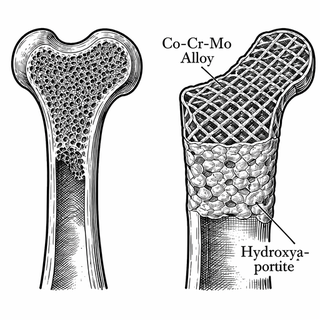
This new research looks at a CoCrMo/HA composite made by 3D printing for biomedical use. The pitch is straightforward enough to appreciate even without a materials science degree and a tolerance for acronyms. Traditional implant metals can be strong, durable, and extremely useful, but they are not exactly famous for behaving like living bone. Bone is lighter, biologically active, and deeply invested in remodeling itself over time. Metal, by contrast, tends to show up, do its job, and politely ignore the local tissue culture.
Why Bone Repair Materials Are Hard to Get Right
Repairing bone is not just about plugging a hole with something sturdy. The replacement material has to satisfy several masters at once, and medicine is not known for making things simple. It needs enough mechanical strength to tolerate real-world forces. It should not trigger excessive harm when it contacts blood and tissue. Ideally, it should also get along with cells well enough to support healing instead of merely occupying space like a very expensive tenant.
That tension explains why researchers keep trying hybrid materials. Metals are usually chosen because they are strong. Hydroxyapatite, or HA, gets attention because it resembles the mineral component of bone and is generally seen as more biologically friendly. So the logic here is appealing: take the strength of a proven alloy and pair it with a more bone-like mineral phase. Then use 3D printing to shape the material in a controlled way. Modern biomedical engineering, in other words, continues its long tradition of asking, "What if we made this both stronger and less annoying to the body?"
What This Study Actually Found
The investigators produced a CoCrMo/HA composite using three-dimensional printing technology and then evaluated its biocompatibility, blood compatibility, and mechanical properties. The most notable result was that the version containing 50 volume percent hydroxyapatite performed especially well.
According to the summary, that 50 percent HA composite showed good biocompatibility and blood compatibility, even outperforming commonly used medical materials. More interestingly, the advantage appeared to become more obvious over time. That matters because materials that look acceptable in a snapshot can behave less charmingly during longer contact with biological systems.
Strength, thankfully, was not abandoned at the altar of compatibility. The composite maintained a compressive strength of 724.4 MPa, which the authors say meets the requirements for human bone repair. That is the key balancing act here. Plenty of materials are "biological" in the sense that they coexist nicely with tissue in theory, but if they crack under load, the romance ends quickly.
Why the 50 Percent HA Result Matters
The number that jumps off the page is not just the compressive strength. It is the specific composition. Fifty percent hydroxyapatite is a substantial amount of bone-like mineral to incorporate into a metal-based composite while still preserving impressive mechanical performance.
That suggests the material may be threading a difficult needle. More HA could improve how cells and blood interact with the implant surface, making the material feel less like an industrial intruder and more like a constructive participant in repair. At the same time, the CoCrMo framework appears to preserve the structural backbone needed for load-bearing applications.
There is a nice irony here. For decades, one of the broad goals in implant design has been to create materials tough enough for the body without behaving like tiny armored vehicles parked in the skeleton. This composite seems to move in that direction by borrowing some of bone's own chemistry rather than insisting that raw metallic endurance alone will solve everything.
Why 3D Printing Is More Than a Buzzword Here
In medical technology, "3D printing" sometimes gets waved around the way a hospital brochure waves around the phrase "patient-centered." It can mean something transformative, or it can mean someone bought a shiny machine and gave a conference talk. In this case, the manufacturing method actually matters.
3D printing offers control over composition and structure in ways conventional processing may not. For bone repair, that matters because the ideal implant is not just a block of strong stuff. It may need specific architecture, tailored geometry, and material distribution that support both mechanical performance and tissue integration. A printable composite opens the door to implants that are not only stronger or more compatible, but also more customizable.
That does not mean every future fracture gets a bespoke sci-fi implant printed while the anesthesiologist finishes coffee. But it does mean the field is moving toward smarter materials that can be engineered with more precision.
What This Could Mean for Patients Someday
If follow-up work confirms these early findings, materials like this could expand options for bone repair, especially where both strength and biological performance matter. Orthopedic and reconstructive applications often force a tradeoff between robust support and tissue friendliness. A composite that narrows that gap would be genuinely useful.
The potential appeal is easy to see. Better compatibility with cells and blood could help reduce adverse reactions and improve integration. Adequate compressive strength could keep the material relevant for real skeletal demands. And 3D printing raises the possibility of patient-specific designs, which sounds futuristic until you remember how stubbornly nonstandard human anatomy can be.
Still, no one should confuse promising materials research with a ready-for-prime-time clinical solution. That leap is where many elegant lab ideas meet the blunt force of biology, manufacturing scale, regulation, and long-term safety testing.
The Questions That Still Need Answers
This study is exciting because it addresses a genuine problem in implant design, but it is still an early-stage materials story. We need to know how these composites perform over longer periods, under more realistic physiological conditions, and eventually in living systems where immune responses, remodeling, wear, and micromotion all get a vote.
Durability over time is especially important. A material can be strong in compression testing and still behave differently once it is implanted in the chemical and mechanical chaos of an actual human body. Bones do not live in a neat laboratory chart. They live in people who fall, limp, heal unevenly, and occasionally ignore postoperative instructions with Olympic-level creativity.
Even so, the direction here is compelling. A 3D-printed CoCrMo/HA composite that combines strength with improved biocompatibility and blood compatibility is the kind of idea that feels both technically clever and medically relevant. It is not a miracle. Medicine is refreshingly short on those. But it may be a practical step toward implants that act a little less like hardware and a little more like part of the repair team.
This blog post discusses research findings and should not be taken as medical advice. If you have concerns about bone repair, fractures, or implant options, please consult a healthcare provider. Research discussed here represents ongoing scientific investigation and clinical validation is still in progress.
All images used in this post are decorative illustrations only and do not represent or reflect the accuracy, reality, or correctness of the referenced research.
Primary Source: Biomedical CoCrMo/HA Composite Prepared by 3D Printing. PubMed Record 42043852. https://pubmed.ncbi.nlm.nih.gov/42043852/