
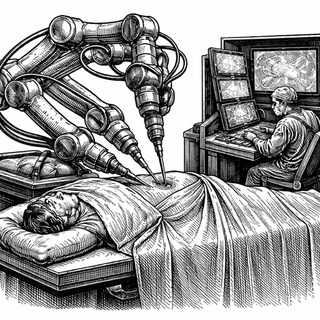
A doctor is trying to remove cancer using a robot, but the doctor might not be in the same room as the patient. That is the basic idea behind the clinical trial NCT07541066, titled Robotic Telesurgery for Prostate Cancer. It sounds a bit like letting someone play a very serious claw machine from another location, except with vastly more training, precision, and consequences.
What the trial is actually studying
According to the ClinicalTrials.gov record, this trial aims to confirm the safety and feasibility of robotic telesurgery for people undergoing treatment for prostate cancer. In plain English, the researchers want to know whether surgeons can safely perform this type of operation remotely using robotic systems, and whether the whole setup works reliably enough to be practical in real clinical care.
That may sound like a small distinction, but it matters. Early studies like this are often not asking, "Is this better than everything else?" They are first asking, "Can this be done safely, consistently, and without the technology becoming the weakest link in the room?" In data terms, this is less about victory laps and more about proving the wheels stay on the car.
The intervention here is straightforward: participants receive robotic telesurgery treatment for prostate cancer. The summary provided does not include the fuller protocol details, so the most responsible read is to stay close to that wording.
Why prostate cancer is a meaningful test case
Prostate cancer is one of the most common cancers affecting men, and surgery is a standard treatment option for many patients. It is also an area where robotic-assisted surgery is already well known. That makes it a logical place to test the next step: not just robotic surgery, but remote robotic surgery.
From a systems point of view, prostate surgery is a fascinating use case. It demands precision in a small anatomical space, where millimeters matter and nerves, blood vessels, and cancer margins are all competing for attention. If a remote robotic approach can work here, that says something important about the maturity of the technology.
There is also a healthcare access angle hiding in the numbers, even if this trial summary does not spell it out. Expertise is not evenly distributed. High-volume specialists tend to cluster in major centers, while patients do not. Medicine has been dealing with this geography problem for a long time. Telesurgery is one attempt to bend the map a little.
Why this is interesting beyond the science-fiction factor
Yes, remote surgery sounds futuristic. But the interesting part is not that it feels like science fiction. The interesting part is that it tries to solve a very practical problem: how to get expert surgical skill to more patients without requiring every patient to travel to the expert.
That could matter for people who live far from major cancer centers. It could matter during weather events, regional shortages, or overloaded hospital systems. It could even matter internationally, where specialist access varies wildly. If the technology is dependable and the clinical workflow holds up, the long-term effect could be larger than one operating room.
Of course, there is a reason nobody wants the Wi-Fi icon to become the star of the procedure. Telesurgery raises obvious concerns about latency, system reliability, cybersecurity, communication, and backup planning if anything goes wrong. The phrase "Have you tried turning it off and on again?" belongs nowhere near cancer surgery.
The core challenge this trial is trying to address
Every new medical technology eventually faces the same blunt question: does it make care better, safer, or more reachable in the real world?
For telesurgery, the obstacles are not only surgical. They are technical and operational too. A remote procedure depends on stable data transmission, responsive robotic controls, trained teams on both ends, and crystal-clear contingency plans. Even if a robot performs beautifully in one room, moving the surgeon elsewhere introduces a whole new layer of variables.
That is why safety and feasibility are the right first targets. Before anyone gets carried away imagining a borderless operating room network, researchers need evidence that the setup functions under clinical conditions and does not compromise patient care. In statistics language, this is the phase where we test whether the signal is real before writing heroic stories about the trendline.
What success could look like
If this trial succeeds, it would not mean every prostate surgery suddenly becomes remote. Medicine almost never changes in one dramatic cinematic leap. It changes in accumulated evidence, revised protocols, and many meetings that definitely needed fewer slides.
But success here could mean something important: proof that remote robotic surgery is realistic enough to keep studying, refining, and possibly scaling. That would open the door to larger trials and more detailed questions such as:
- Which patients are the best candidates?
- How does remote surgery compare with standard robotic surgery?
- What technical thresholds are acceptable for performance and safety?
- Can this model reduce access gaps without adding new risks?
Those are the kinds of questions that move a field from "interesting demo" to "real clinical option."
What to keep in mind right now
It is worth staying grounded. This ClinicalTrials.gov summary describes a study designed to assess whether robotic telesurgery is safe and feasible in the management of prostate cancer. That is promising, but still early. The summary provided here does not list the full eligibility criteria, sponsor details, recruitment status, or prespecified outcome measures, so any stronger claim would be me coloring outside the lines.
Even so, the trial is a marker of where surgical oncology may be heading. For years, medicine has been building the pieces needed for more connected care: robotics, telemedicine, faster networks, digital imaging, remote monitoring. Telesurgery is what happens when those lines finally intersect on the same graph.
And that is what makes this study so compelling. It is not just about one procedure. It is about whether expert hands can someday reach farther than the walls of the hospital.
Final thought
The cleanest way to describe this trial is also the most revealing: researchers are testing whether distance has to be part of the surgical equation at all. If the answer is yes, that changes the math for access, expertise, and where advanced cancer care can happen.
For now, the numbers are still being gathered. But this is exactly the kind of study that makes you pay attention, because sometimes the future of medicine arrives not with fireworks, but with a better connection and a steadier hand.
Disclaimer: This post is for educational purposes only and is based solely on the clinical trial summary provided. It is not medical advice and should not be used to guide diagnosis or treatment decisions.
Citation: ClinicalTrials.gov. Robotic Telesurgery for Prostate Cancer (NCT07541066). Available at: https://clinicaltrials.gov/study/NCT07541066 and https://clinicaltrials.gov/study/NCT07541066?tab=table