
The future keeps arriving in oddly specific forms, and this time it looks like tiny gold nanoclusters that can sit under near-infrared light and do two useful things at once: make heat and generate a highly reactive form of oxygen. That sounds like a prop from a very serious sci-fi movie, except the interesting part here is not just that it works. It is that researchers are trying to measure it properly, which in biomedical technology is the difference between "promising" and "promising, but with receipts."
This study focuses on ligand-protected gold nanoclusters, or Au NCs, and asks a question that is more practical than glamorous: how do we fairly compare materials that respond to light by heating up tissue or by producing singlet oxygen, especially when they are tested under very different lighting conditions? In other words, if one lab uses continuous light and another uses ultrafast pulsed lasers, are we comparing apples to apples, or apples to a microwave?
Why near-infrared light gets so much attention
Near-infrared, or NIR, light is a favorite in phototherapy research because it penetrates tissue more deeply than visible light. If you want to activate a treatment below the surface rather than just on top of it, that matters a lot. Researchers are especially interested in materials that can respond to NIR light through one-photon or two-photon excitation.
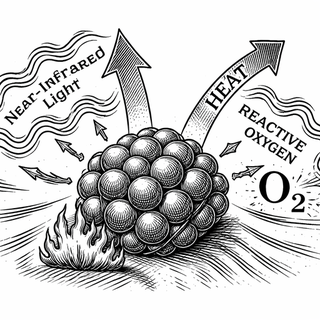
That phrase, "two-photon excitation," sounds like it was named by someone billing by the syllable, but the idea is elegant. Instead of one photon carrying enough energy to trigger a response, two photons arrive almost simultaneously and jointly do the job. This can be useful for reaching deeper tissue and for more localized activation, particularly with femtosecond pulsed lasers.
The dream scenario is a single agent that can do both of the following under NIR light:
- Convert light into heat for photothermal effects
- Generate singlet oxygen for photodynamic effects
Heat can damage targeted cells. Singlet oxygen, a high-energy reactive oxygen species, can also damage cells through oxidative stress. Put those together and you have a potentially versatile platform for deep-tissue phototherapy.
The real problem was not only chemistry
A lot of research in this area asks, "Can this material do the trick?" This paper goes a step further and asks, "Can we quantify the trick in a way that lets different studies be meaningfully compared?"
That is a bigger deal than it may sound.
Photothermal and photodynamic agents are often reported using different metrics, different illumination setups, and different assumptions. Some experiments use continuous-wave light. Others use pulsed lasers measured in femtoseconds. If every paper uses its own scoreboard, the field can end up with a pile of impressive-looking results that do not line up cleanly. Scientists are left doing interpretive dance with the numbers.
This study aims to fix that by developing unified models for both one-photon and two-photon excitation. The goal is to quantitatively assess two key outputs:
- Light-to-heat conversion efficiency
- Singlet oxygen generation efficiency
That kind of framework matters because it shifts the conversation from vague claims of multifunctionality to measurable performance. For anyone trying to design better phototherapy agents, standardized evaluation is not decorative. It is infrastructure.
What the researchers actually did
Based on the summary provided, the team synthesized atomically precise, ligand-protected gold nanoclusters and carried out comprehensive physicochemical characterization. That phrase can sound dry, but it is the scientific equivalent of checking the ingredients, structure, stability, and behavior before claiming a new material does anything useful.
Then they applied unified quantitative models under both one- and two-photon excitation conditions to evaluate how effectively these nanoclusters convert incoming light into heat and how efficiently they generate singlet oxygen.
The key contribution here is not merely "gold nanoparticles can be interesting." We knew the general neighborhood already. The contribution is a more systematic way to evaluate these dual-function materials across excitation regimes that are usually awkward to compare directly.
For a field that wants translational relevance, that is exactly the sort of nuts-and-bolts progress that quietly changes everything.
Why the numbers matter
As a data-minded person, I keep coming back to one simple rule: if a technology can do two good things, someone eventually has to ask how much of each, under what conditions, and at what tradeoff.
A phototherapy agent that generates lots of heat but very little singlet oxygen is different from one that balances both. A material that performs well under continuous-wave light may behave differently under pulsed excitation. And if two-photon activation is part of the long-term appeal for deeper or more precise treatment, then evaluation methods have to keep up with that complexity.
This paper tackles exactly that comparison problem.
That may sound like a technical footnote, but it is really the hinge of the whole story. Standardized quantitative models help researchers answer questions like:
- Which materials are genuinely efficient, not just visually impressive in one setup?
- How do performance rankings change when excitation conditions change?
- Which candidates are worth pushing toward more advanced preclinical work?
Without that framework, the field risks optimizing for whichever graph happens to look prettiest. Science has enough beauty contests already.
Why gold nanoclusters are interesting in the first place
Gold nanoclusters have a few traits that make them attractive for this kind of work. Their properties can differ substantially from bulk gold, especially at atomic precision. Ligands, which protect and stabilize the clusters, can also influence how they behave optically and chemically.
That gives researchers knobs to turn. Change the cluster structure, change the ligand environment, and you may shift how well the material absorbs NIR light, releases energy as heat, or participates in singlet oxygen generation.
The paper's emphasis on atomically precise clusters is especially notable because precision usually improves interpretability. If you know what you built at the atomic level, you have a much better chance of linking structure to function rather than just waving at a black box and hoping for reproducibility.
What this could mean in the real world
If follow-up development succeeds, work like this could support more rational design of NIR-responsive therapeutic agents for deep-tissue applications. That does not mean a clinic next Tuesday. It means the field gets better tools for deciding which materials deserve the expensive, slow climb toward real biomedical use.
Potentially, dual photothermal and photodynamic agents could offer more flexible treatment strategies. But the phrase to underline here is "could offer." This study, as described, is about quantitative evaluation and material characterization. It helps build the measurement system and the material logic needed before anyone can sensibly talk about broader application.
That is not a small achievement. In emerging biomedical technologies, cleaner measurement often arrives before cleaner headlines.
The bottom line
What makes this paper intriguing is not just the gold, the lasers, or the tiny engineered clusters doing oversized jobs. It is the attempt to bring order to a messy measurement landscape. The researchers are not only asking whether ligand-protected gold nanoclusters can produce heat and singlet oxygen under NIR excitation. They are also asking how to compare those abilities fairly across one-photon and two-photon regimes.
That is the kind of work that tends to age well. New materials come and go, but a solid framework for quantifying performance sticks around and makes the whole field sharper.
And honestly, that may be the most futuristic part of all: not tiny gold structures under laser light, but a set of numbers everyone can finally argue about on the same terms.
This blog post discusses research findings and should not be taken as medical advice. If you have concerns about cancer treatment or phototherapy-related care, please consult a healthcare provider. Research discussed here represents ongoing scientific investigation and clinical validation is still in progress.
All images used in this post are decorative illustrations only and do not represent or reflect the accuracy, reality, or correctness of the referenced research.
Primary Source: Quantitative evaluation of light-to-heat conversion and singlet oxygen generation efficiencies on ligand protected gold nanoclusters upon near-infrared excitation. PubMed record 42003584. https://pubmed.ncbi.nlm.nih.gov/42003584/