
I'll be honest, when I first read this title, I thought it sounded like a startup pitch assembled by three neuroscientists, one machine learning engineer, and a grant office running on cold brew. A "multi-region flexible neural interface" for decoding behavior in freely moving mice does not exactly scream beach read. But once you get past the impressive pile of syllables, this paper is asking a very practical question: can we reliably read brain activity across multiple regions, over long periods, and use that information to tell what an animal is doing without the whole system falling apart by Tuesday?
That is a bigger deal than it sounds. Neuroscience has spent years trying to record the brain in a way that is both broad and stable. The brain is not a single office with one fluorescent light flickering overhead. It is more like a sprawling federal complex where several departments insist they are the real decision-makers, all while exchanging memos at odd hours. If you only listen to one room, you miss the meeting.
What the researchers built
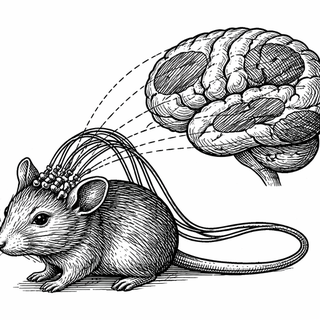
The researchers developed an integrated platform with two main parts. First, they used multi-region flexible probes, or MRFPs, that can record neural signals from 128 sites across eight brain regions over months. Second, they paired that hardware with a Conformer-based deep learning model designed to interpret brain-wide dynamics and decode behavioral states.
Those states were not exotic philosophical categories. They were concrete mouse behaviors: resting, roaming, feeding, and responding to a flash stimulus. The system reached up to 89 percent accuracy in classifying those states.
That number is attention-grabbing, but the more interesting point is how they got there. This was not just a better algorithm slapped onto familiar data. It was a hardware-and-software package built around the idea that behavior emerges from distributed brain activity, not one privileged hotspot. That sounds obvious, yet plenty of neuroscience tools still force researchers into a kind of data austerity program where they record from a narrow area and hope the missing context behaves itself.
Why "multi-region" matters
One of the study's clearest findings is that distributed sampling improves decoding. Recording from five or more regions worked better than concentrating electrodes in fewer places. Again, this sounds intuitive once stated plainly. If behavior depends on networks, then decoding behavior should benefit from listening to networks.
Still, intuition and infrastructure are not the same thing. In biomedical research, everyone loves the phrase "whole-brain" right up until they have to pay for it, implant it, stabilize it, validate it, and process the resulting data without setting the lab server on fire. This paper tackles that bottleneck directly.
Flexible probes matter here because long-term brain recordings are notoriously difficult. Rigid devices can provoke tissue responses, drift, or lose signal quality over time. A flexible interface has a better chance of staying useful across days and months, which is exactly what you need if your goal is not just a flashy one-day demo but a durable research tool.
The algorithmic headache this paper addresses
The second challenge is less visible but just as annoying: generalization. Many decoding systems work nicely on the data they were trained on and then become suspiciously less brilliant when you ask them to handle another day, another animal, or another dataset. In other words, they can be a bit like regulations written for one pilot program and then awkwardly forced onto an entire state.
This study reports that the platform generalized across days and individuals without retraining. That is a serious advance if it holds up in broader use. It suggests the model is not merely memorizing one mouse's neural quirks but extracting patterns that travel better.
That matters because science does not scale on custom one-offs. A platform that needs constant retraining for every subject and every recording session may still be publishable, but it is less useful for large longitudinal studies and much less attractive for translation into therapies. Researchers and clinicians need systems that are sturdy, repeatable, and not emotionally dependent on one perfect calibration session.
Why this is interesting beyond mouse behavior
At first glance, classifying whether a mouse is resting or feeding may seem like a niche technical exercise. It is not. Decoding internal or behavioral states from distributed brain activity is part of the foundation for future brain-computer interfaces, neuropsychiatric monitoring, and therapies for neurological disorders.
If you want devices that can eventually detect meaningful brain states in real time, whether related to movement, mood, seizure risk, or cognitive function, you need the underlying readout system to be stable and broad enough to capture the relevant signals. This paper pushes in that direction.
It also reflects a subtle but meaningful shift in the field. For a long time, the technical story in neuroscience has swung between bigger recording systems and smarter algorithms, as though one of them would eventually save us from needing the other. Bureaucracies love that kind of false choice. Reality, less so. This study argues that you need both: richer sampling across the brain and models built to handle that complexity.
The policy and systems angle
From a health policy perspective, this is the kind of preclinical work that often gets overlooked because it does not arrive with a polished patient-facing headline. There is no instant therapy here. No one is cutting a ribbon. But platform technologies like this are often what make later clinical advances possible.
Stable, generalizable neural decoding could support better development pipelines for neurotechnology. That means better tools for studying disease progression, testing interventions over time, and designing systems that do not need to be rebuilt for every new subject. In plain English, it may help move brain research from heroic artisanal craftsmanship toward something closer to scalable infrastructure.
And yes, "scalable infrastructure" is not a phrase that usually quickens the pulse. But in medicine, boring reliability is often what separates a promising concept from a real-world tool. The regulatory state, for all its forms and footnotes, is actually quite fond of devices that work the same way on Wednesday as they did on Monday. One can hardly blame it.
What to keep in mind
This is still animal research, and that matters. Freely moving mice are a useful model, not a substitute for the staggering complexity of human brains, human behavior, or human disease. Translating a system like this into clinical neurotechnology would involve very different technical, ethical, and regulatory hurdles.
There is also the usual caution about performance numbers. "Up to 89 percent accuracy" is promising, but anyone who has spent time around model metrics knows that context is everything. Which conditions were easiest? Which were hardest? How robust is performance under messier real-world variation? Those questions do not negate the result. They simply belong in the room.
Still, the study offers something more valuable than a flashy claim. It offers a practical argument that broad, stable recordings paired with a model designed for brain-wide patterns can decode behavior in a way that lasts across time and individuals. That is not glamorous, exactly. But it is how fields mature.
Why this paper sticks with me
What I like most here is that the paper does not pretend the brain can be understood by staring harder at one tiny patch of it. It treats behavior as a network problem and builds the technology accordingly. That may sound like a modest insight, but a surprising amount of biomedical progress comes from finally aligning the tool with the biology instead of asking the biology to please fit the tool.
For anyone watching the future of brain-computer interfaces, longitudinal neuroscience, or neural disorder therapies, this is the sort of study worth tracking. It is a reminder that real progress often looks less like a sci-fi leap and more like competent systems engineering with better electrodes, better models, and fewer assumptions. Not glamorous, perhaps. But then again, neither is most meaningful reform.
This blog post discusses research findings and should not be taken as medical advice. If you have concerns about neurological or behavioral health conditions, please consult a healthcare provider. Research discussed here represents ongoing scientific investigation and clinical validation is still in progress.
All images used in this post are decorative illustrations only and do not represent or reflect the accuracy, reality, or correctness of the referenced research.
Primary Source: A multi-region flexible neural interface for behavioral state decoding in freely moving mice. PubMed Record 42045176. https://pubmed.ncbi.nlm.nih.gov/42045176/