
Pack your bags, because we're taking a scenic detour through the messy, sticky, protein-clogged backroads of biosensor engineering - a place where even the most brilliant detection technology can get blindsided by biological gunk. Our destination? A clever new dual-mode immunoassay that fights fouling with forked peptides and reads signals two different ways, just to make sure it isn't lying to itself.
The paper in question describes ultrasensitive antifouling sensors built around bifunctional signal probes and Y-shaped biopeptides. If that sounds like a mouthful, don't worry. By the end of this trip, you'll know exactly why each of those words matters - and why a few of them deserve a healthy squint of skepticism.
The Fouling Problem: Biology's Unwanted Souvenir
Here's the thing about trying to detect biomarkers in real biological samples like blood serum: the stuff is filthy. Not in a hygiene sense, but in a there are thousands of proteins and lipids and other molecular hitchhikers constantly glomming onto your sensor surface sense. This non-specific adsorption - called biofouling - is the bane of immunoassay development. It's like trying to hear someone whisper your name across a stadium during a rock concert. The signal is there, but the noise is overwhelming.
Traditional approaches to antifouling have leaned on polyethylene glycol (PEG) coatings, bovine serum albumin (BSA) blocking, and zwitterionic polymers. They work, to varying degrees. But they can also interfere with the very signals you're trying to detect, add complexity to sensor fabrication, or degrade over time. So the hunt for better antifouling strategies remains very much open (Chen et al., 2024; Lowe et al., 2023).
Enter the Y-Shaped Biopeptides
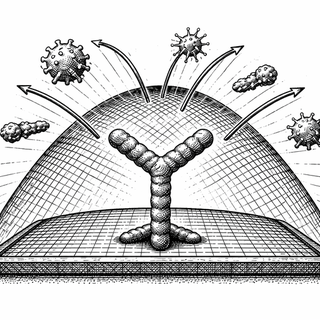
This research introduces Y-shaped biopeptides as the antifouling layer - a branched peptide architecture designed to resist the adhesion of unwanted proteins while still leaving the sensor surface accessible for target binding. Think of them as tiny molecular umbrellas planted across the sensor interface, letting the rain of background proteins slide right off while the analyte of interest slips through.
The "Y" shape is more than aesthetic branding. Branched peptide structures increase the density of hydrophilic residues presented at the surface, creating a hydration barrier that proteins struggle to penetrate. It's a well-established principle in surface chemistry, and applying it through a peptide framework is a smart move - peptides are relatively easy to synthesize, customize, and conjugate to electrode surfaces.
Let's pump the brakes for a moment, though. Peptide-based antifouling is promising, but real-world performance depends heavily on the complexity of the sample matrix. Serum from a healthy volunteer and serum from a patient with an inflammatory condition can behave very differently on a sensor surface. The proof will be in how these Y-shaped peptides hold up across diverse clinical samples, not just the curated ones in a proof-of-concept study.
Bifunctional Signal Probes: Two Readings Are Better Than One
The other half of this sensor's personality comes from its bifunctional signal probes, built around copper-doped carbon dots and Cu-CeO₂ nanocomposites. Carbon dots (CDs) are nanoscale carbon particles with tunable fluorescence - they glow when you excite them, and doping them with copper tweaks their optical and electrochemical properties. Cu-CeO₂, meanwhile, brings catalytic muscle to the table, capable of mimicking peroxidase activity for colorimetric or electrochemical signal amplification.
The result is a dual-mode immunoassay - the sensor can read out results through two independent signal channels. This is genuinely useful. Single-mode sensors are vulnerable to false positives and negatives caused by matrix effects, instrument drift, or reagent variability. A dual-mode approach lets you cross-reference: if both channels agree, your confidence in the result goes up significantly. If they disagree, you know something's off before you report a result to a clinician (Wei et al., 2023; Zhang et al., 2022).
That said, dual-mode doesn't automatically mean double the accuracy. The two channels need to be truly independent in their sources of error. If biofouling or matrix interference affects both readouts in the same way, you're just getting the same wrong answer twice with extra steps.
The Copper Connection
Copper plays a starring role here, showing up in both the carbon dots and the cerium oxide support. Copper-doped CDs have been gaining traction in biosensing because copper ions enhance both the fluorescent quantum yield and the electrochemical activity of the dots. Meanwhile, CeO₂ is a well-known nanozyme - a nanomaterial that mimics enzymatic behavior - and doping it with copper can boost its catalytic turnover rate.
The synergy is appealing on paper. You get signal amplification from the nanozyme activity and a distinct optical signature from the fluorescent dots, all packaged into one probe. The fabrication, however, requires careful optimization. Copper doping levels, nanoparticle size distribution, and surface chemistry all need to land in a narrow window for everything to work harmoniously. Reproducibility across batches is the quiet question lurking behind many nanomaterial-based sensor papers, and this one is no exception.
So, How Sensitive Are We Talking?
The paper claims "ultrasensitive" detection, which in biosensor literature is a word that gets thrown around like confetti at a parade. To be fair, combining antifouling peptides with signal-amplifying nanoprobes and dual readout modes is a recipe that should push detection limits down. The antifouling layer reduces background noise, the bifunctional probes amplify the signal, and dual-mode verification filters out spurious results. It's a well-reasoned architecture.
But "ultrasensitive in buffer" and "ultrasensitive in a hospital lab processing 200 samples a day" are different animals entirely. Scalability, shelf stability, and performance in complex matrices under real-world conditions are the hurdles that separate a clever proof-of-concept from a clinically useful tool. We've seen many beautifully engineered nanobiosensors stall at this translational gap (Mahato et al., 2024).
The Verdict: Clever Engineering, Cautious Optimism
This is solid, creative work. The combination of Y-shaped antifouling peptides with copper-based bifunctional probes for dual-mode detection tackles multiple real problems in immunoassay design simultaneously. The materials chemistry is interesting, the rationale is sound, and the dual-mode strategy adds a layer of analytical rigor that single-channel sensors lack.
Just don't mistake a promising laboratory demonstration for a finished diagnostic tool. The road from "works on the bench" to "works in the clinic" is long, potholed, and littered with the remains of sensors that couldn't survive the trip. This one has packed some smart gear for the journey - let's see if it makes it to the destination.
This blog post discusses research findings and should not be taken as medical advice. If you have concerns about diagnostic testing or biosensor technologies, please consult a healthcare provider. Research discussed here represents ongoing scientific investigation and clinical validation is still in progress.
All images used in this post are decorative illustrations only and do not represent or reflect the accuracy, reality, or correctness of the referenced research.
Primary Source: Ultrasensitive Antifouling Sensors Based on Bifunctional Signal Probes and Y-Shaped Biopeptides for Dual-Mode Immunoassays. PubMed. 2025. PMID: 42029682