
Somewhere in a hospital, a cancer patient receives a cutting-edge immunotherapy infusion. Hours later, a nurse checks their temperature - normal. Four hours after that, another check - still fine. But somewhere in between those readings, the patient's temperature quietly spiked to 102°F for forty-five minutes before settling back down. Nobody noticed. And that invisible spike? It might have been the first distress signal of a potentially life-threatening immune reaction called cytokine release syndrome. The question that researchers at the National Institutes of Health are now asking: what if we just... never stopped watching the thermometer?
When Your Immune System Throws a Tantrum
Let's talk about cytokine release syndrome, or CRS, because it's one of those medical phenomena that sounds like it was named by a committee (it was) but behaves like a toddler who found the espresso machine.
Here's the deal. Some of the most promising cancer treatments we have - CAR-T cell therapy, bispecific antibodies, certain immunotherapies - work by supercharging your immune system to attack cancer cells. Fantastic idea. The problem is that sometimes the immune system gets a little too enthusiastic and starts flooding the body with signaling proteins called cytokines. This cytokine deluge can trigger fever, dangerously low blood pressure, difficulty breathing, and in severe cases, organ failure (Shimabukuro-Vornhagen et al., 2018).
CRS affects a significant percentage of patients receiving these therapies. Studies have shown that up to 93% of patients receiving CAR-T cell therapy experience some grade of CRS, with severe cases (grade 3 or higher) occurring in roughly 13-46% of patients depending on the specific treatment (Lee et al., 2019). The current grading system, established by the American Society for Transplantation and Cellular Therapy (ASTCT), relies heavily on fever as the defining symptom - specifically, a temperature of 100.4°F (38°C) or higher.
And here's where it gets interesting. We grade and catch CRS primarily through fever. But in most hospitals, temperature is checked every four to eight hours. That's like checking your smoke detector twice a day and hoping for the best.
Enter the Glorified Band-Aid (That Might Change Everything)
A new clinical trial at the NIH Clinical Center (NCT07499128) is testing whether continuous temperature monitoring can catch fever - and therefore CRS - before it escalates into something serious.
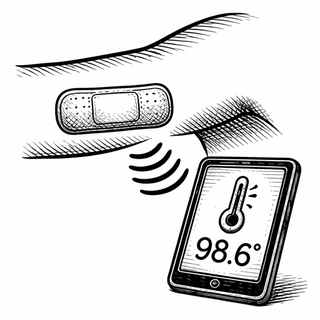
The star of the show is TempTraq, an FDA-cleared wearable patch that looks like an oversized Band-Aid and sticks under your arm. It continuously reads your body temperature and wirelessly sends data to a tablet. No more waiting for a nurse with a thermometer. No more gaps in the data. Just a constant, unblinking stream of temperature readings, 24 hours a day, for up to 15 days.
The trial is enrolling adults (18+) with cancer who are being admitted to the NIH clinic for treatment with drugs or cell therapies known to carry CRS risk. Participants wear the patch throughout their hospital stay while still receiving all their regular temperature checks - the patch is an addition, not a replacement. Think of it as a safety net beneath the safety net.
There's also an optional bonus feature: VitalTraq, an app that uses the tablet's camera to measure blood pressure, heart rate, and respiratory rate. Patients hold the screen up to their face for about a minute (yes, like taking a very serious selfie), and the app pulls vitals from subtle changes in skin color and movement. Once daily, or more often if symptoms appear.
Why Catching Fever Early Actually Matters
You might be thinking: "So they're watching a thermometer more often. Big deal." But the timing of intervention in CRS is everything.
Research has shown that early intervention with drugs like tocilizumab (an IL-6 receptor blocker) can prevent mild CRS from cascading into the severe, life-threatening variety (Frey & Porter, 2019). The challenge has always been knowing when to intervene. Fever is the canary in the coal mine, but if you only check on your canary every few hours, you might find it already on its back with its little feet in the air.
Continuous monitoring could reveal patterns invisible to periodic checks - like a slow temperature rise that hints at brewing trouble, or brief fever spikes that resolve before the next scheduled reading. Studies on predictive biomarkers for CRS have emphasized that the trajectory of physiological changes, not just single data points, holds the key to anticipating severe reactions (Teachey et al., 2016).
The Bigger Picture: Wearables Meet Oncology
This trial sits at a fascinating intersection of two trends. On one side, immunotherapy and cell therapy are exploding in oncology - the number of patients at risk for CRS is growing every year as these treatments move from last-resort options to earlier lines of care. On the other side, wearable health technology has matured from fitness tracking novelty to legitimate clinical tool.
The implications go beyond just CRS. If continuous monitoring proves effective here, it could reshape how hospitals handle post-treatment surveillance across oncology. Imagine a world where subtle vital sign changes trigger automated alerts to the care team, where AI algorithms learn to predict CRS hours before symptoms become obvious to the patient or their nurse.
There's also a quality-of-life angle that's easy to overlook. Current monitoring protocols often mean waking patients at odd hours for temperature checks. A passive monitoring patch that does its job silently? That's a win for sleep, stress levels, and general sanity during what is already one of the most anxiety-inducing experiences a person can have.
What Comes Next
The trial will collect participants' feedback about wearing the patch, which matters more than you'd think. The fanciest monitoring technology in the world is useless if patients rip it off because it's itchy or annoying. The fact that participants who complete the study and return for future treatments can re-enroll suggests the researchers are also interested in long-term usability and whether continuous data across multiple treatment cycles reveals even deeper patterns.
This isn't going to cure cancer. It's not even going to cure CRS. But it might give clinicians the one thing they desperately need when managing these powerful new therapies: time. Even a few extra hours of warning before CRS escalates from "manageable fever" to "ICU admission" could be the difference between a rough day and a catastrophic one.
And if that difference comes from something that looks like a large Band-Aid and talks to a tablet? Well, sometimes the most important innovations aren't the flashiest ones. Sometimes they're just... sticky.
Clinical Trial Information:
- Trial ID: NCT07499128 | Table View
- Sponsor: National Institutes of Health (NIH)
- Location: NIH Clinical Center
References:
1. Lee, D.W., et al. (2019). ASTCT Consensus Grading for Cytokine Release Syndrome. Biology of Blood and Marrow Transplantation, 25(4), 625-638. https://doi.org/10.1016/j.bbmt.2018.12.758
2. Shimabukuro-Vornhagen, A., et al. (2018). Cytokine release syndrome. Journal for ImmunoTherapy of Cancer, 6, 56. https://doi.org/10.1186/s40425-018-0343-9
3. Teachey, D.T., et al. (2016). Identification of Predictive Biomarkers for Cytokine Release Syndrome after Chimeric Antigen Receptor T-cell Therapy. Cancer Discovery, 6(6), 664-679. https://doi.org/10.1158/2159-8290.CD-16-0040
4. Frey, N. & Porter, D. (2019). Cytokine Release Syndrome with Chimeric Antigen Receptor T Cell Therapy. Biology of Blood and Marrow Transplantation, 25(4), e123-e127. https://doi.org/10.1016/j.bbmt.2018.12.768
Disclaimer: This blog post is for informational and educational purposes only. It does not constitute medical advice. Clinical trials are research studies and outcomes are not guaranteed. Always consult your healthcare provider regarding treatment decisions. For more information about this trial, visit ClinicalTrials.gov.