
In the time it takes you to read this sentence, your body just fired off roughly 100 billion neural signals, your heart squeezed out about a quarter cup of blood, and your skin stretched and compressed over dozens of micro-movements you didn't even notice. Now imagine a squishy, stretchy gel made partly from corn starch picking up on all of that. That's not a fever dream from a materials science lab at 2 AM. That's real research. And honestly? I'm a little obsessed.
Wait, Hydrogels Do What Now?
Okay, let's back up. Conductive hydrogels - basically squishy, water-rich gels that can conduct electricity - have been quietly becoming the darlings of wearable sensor research. Think of them as the lovechild of Jell-O and a circuit board. They're soft, flexible, and can conform to skin in ways that rigid electronics absolutely cannot. The dream is a sensor that feels like a second skin, tracks your body's tiniest movements, and doesn't make you feel like you're wearing a medical device from a 1990s sci-fi movie.
The problem? Most hydrogels are kind of wimpy. They tear easily, dry out, can't handle the cold, and their electrical conductivity leaves a lot to be desired. It's like having a sports car with no engine. Looks great, goes nowhere.
Enter: The Starch Squad
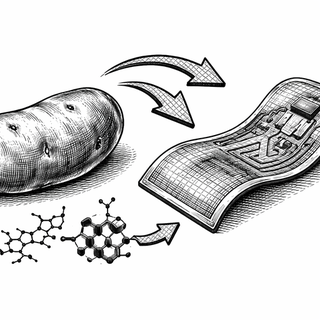
Here's where this paper made me do a double take. A team of researchers decided to build a hydrogel using amylopectin - that's one of the two main components of starch, the same stuff that makes your pasta water cloudy. They combined it with poly(acrylamide-acrylic acid), a well-known synthetic polymer, and something called a deep eutectic solvent, or DES.
Deep eutectic solvents are having a real moment in materials science right now. Think of a DES as a designer liquid created by mixing two solid compounds that, when combined, melt into a liquid at a much lower temperature than either would alone. They're cheap, biodegradable, and kind of magically versatile. In this case, the DES serves double duty: it helps crosslink the hydrogel's internal structure (making it tougher) while also boosting its ability to conduct electrical signals.
The result? A physicochemical dual-crosslinked hydrogel - meaning it's held together by both physical entanglements and chemical bonds. If single crosslinking is a handshake, dual crosslinking is a handshake plus a bear hug. The gel is stronger, stretchier, and way more durable because of it.
The Numbers That Made Me Spill My Coffee
The team didn't just make a squishy gel and call it a day. They threw the full characterization toolkit at this thing - scanning electron microscopy, FTIR, Raman spectroscopy, XPS, and even density functional theory calculations to model the molecular interactions. This is the materials science equivalent of bringing a full forensics lab to investigate a cookie recipe. I respect it deeply.
And the results? The hydrogel sensor hit a gauge factor of 12.08. For the uninitiated, gauge factor is basically how sensitive a strain sensor is - higher numbers mean the sensor picks up smaller movements more reliably. For context, traditional metal foil strain gauges sit around 2. Commercial flexible sensors often hover between 1 and 5. A gauge factor of 12 puts this starch-based gel firmly in "okay, this actually works really well" territory.
Wait, it gets better.
The sensor could reliably detect facial expressions. Subtle ones. Like the tiny muscle movements involved in swallowing. It tracked finger bending, wrist rotation, and knee flexion. It even showed sensitivity to compression and temperature changes. All from a gel that's partially made of something you could find in your pantry.
Why Starch, Though?
This is the part that really gets me fired up. The push toward biopolymer-based electronics isn't just a nice-to-have. It's becoming a necessity. The global wearable sensor market is exploding, and most of these devices end up in landfills. Traditional conductive materials involve metals, petroleum-derived polymers, and processing methods that aren't exactly Mother Nature's favorites.
Starch is dirt cheap. It's renewable. It's biodegradable. It's biocompatible, meaning your skin won't freak out when it's in contact with the stuff. The fact that researchers are finding ways to make it electrically functional while maintaining those green credentials is genuinely exciting for the future of sustainable electronics.
Previous attempts at starch-based sensors often hit a wall: the mechanical properties were too poor for real-world use, or the conductivity was too low to get meaningful data. This study's approach of using a DES to simultaneously solve both problems is clever engineering at its finest.
The Bigger Picture
Let's zoom out for a second. Right now, health monitoring is moving fast toward continuous, non-invasive, wearable systems. We want sensors that can track rehabilitation progress, monitor elderly patients for falls, detect early signs of neurological conditions through movement changes, or simply help athletes optimize performance.
For any of that to work at scale, the sensors need to be cheap, comfortable, environmentally responsible, and sensitive enough to catch the small stuff. A starch-based hydrogel that checks all those boxes? That's not just a cool lab result. That's a potential platform technology.
Of course, this is still early-stage research. There's a long road between "works beautifully in the lab" and "available at your local pharmacy." Questions about long-term stability, manufacturing scalability, and performance under real-world conditions (sweat, friction, that time you accidentally sleep on your sensor) all still need answers. But the foundation laid here - particularly the theoretical framework using DFT calculations to understand why the DES works so well with amylopectin - gives future researchers a clear roadmap to build on.
The Takeaway
Someone took corn starch, mixed it with a designer solvent and some polymer chemistry, and made a wearable sensor that can detect you raising an eyebrow. The sensor is stretchy, tough, works in freezing temperatures, handles repeated use without falling apart, and is friendly to both your skin and the planet. If that doesn't make you at least a little bit excited about the future of wearable tech, I genuinely don't know what will.
Materials science doesn't always get the spotlight it deserves. But studies like this remind me that sometimes the most revolutionary technologies start with the most humble ingredients. In this case, literally the stuff of bread and potatoes.
This blog post discusses research findings and should not be taken as medical advice. If you have concerns about wearable health monitoring or skin-contact materials, please consult a healthcare provider. Research discussed here represents ongoing scientific investigation and clinical validation is still in progress.
All images used in this post are decorative illustrations only and do not represent or reflect the accuracy, reality, or correctness of the referenced research.
Primary Source: Amylopectin/poly(acrylamide-acrylic acid)/deep eutectic solvent hydrogels with good mechanical property, conductivity, freezing/fatigue resistance and biocompatibility for wearable sensors. PubMed. 2026. PMID: 41941901