
You probably didn't know this, but your cells are constantly sending tiny molecular signals that can reveal whether something is going wrong long before a scan or symptom does. The trouble is that many of those signals are more whisper than shout. Cancer, unhelpfully, is not in the habit of wearing a name tag. So when researchers build a tool that can pick out a faint tumor signal inside a living cell and amplify it without getting fooled by healthy cells, that gets my attention fast.
A new study, titled A dual-locked and self-feedback CHA-DNAzyme nanomachine for tumor-specific molecular imaging in living cells, describes exactly that kind of tool. The name is a mouthful, yes. It sounds a bit like a spy gadget designed by a committee of biochemists. But the idea is elegant: create a DNA-based nanomachine that stays quiet unless it encounters the right cancer-related signal, then turns on a self-reinforcing reaction that makes that signal much easier to see.
Why finding faint signals matters
In cancer care, earlier detection usually gives us more options. That is true whether we are talking about screening, diagnosis, monitoring, or understanding how a tumor behaves. Inside cells, biomarkers can act like clues left at the scene. Some are abundant and easy to detect. Others are scarce, fleeting, or buried in a noisy cellular environment.
That last part is the problem. Living cells are busy places. Molecules are bumping around, reacting, folding, and generally behaving like commuters in a train station at rush hour. If you want to identify one low-abundance biomarker in that crowd, your probe needs to be both highly specific and highly sensitive. Miss the target, and you get a false signal. Need too much target to turn on, and you miss early disease.
Traditional single-locked DNA probes have helped, but they can still be triggered in ways that reduce accuracy. That is not ideal if the goal is tumor-specific imaging. Medicine has enough ambiguity already.
So what did the researchers build?
The team designed a dual-locked, self-feedback catalytic hairpin assembly-DNAzyme cascade platform called hMNS@SCD. That label may not win any branding awards, but the underlying design is clever.
At its core, this is a DNA-based nanomachine. DNA is useful here not because it carries genes, but because it is programmable. Researchers can design DNA strands to fold into precise shapes, recognize specific sequences, and react in controlled ways. Think less “genetics class” and more “molecular Lego with rules.”
This platform has two especially interesting features.
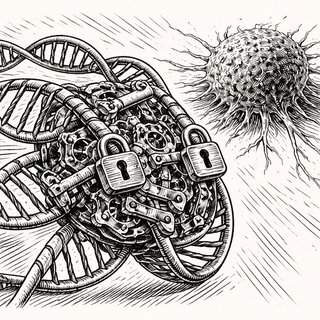
First, it is dual-locked. In plain language, that means it has two layers of control before it activates. Instead of one simple trigger, the system is engineered to require more specific conditions to turn on. That helps reduce accidental activation in normal cells. If a single lock is like a front door key, dual-locking is more like needing both a keycard and a passcode. Annoying at the gym, useful in cancer imaging.
Second, it uses a self-feedback cascade amplification strategy. Once the right biomarker is detected, the signal does not just appear once. The system amplifies it through a catalytic hairpin assembly process and a DNAzyme-driven cascade. In practical terms, that means a tiny molecular clue can produce a much larger readable output. For low-abundance biomarkers, this is exactly what you want. A whisper goes in, a much louder molecular announcement comes out.
What makes this more than a neat lab trick?
The study reports that this nanomachine could distinguish cancer cells from normal cells while performing tumor-specific molecular imaging in living cells. That is the key result. Not merely “we saw something interesting in a tube,” but “we built a system designed to work in living cellular environments and show us where tumor-associated signals are present.”
From a clinical research perspective, that matters because specificity is everything. A test that lights up everywhere is not helpful. It is the molecular equivalent of a smoke detector that goes off every time someone makes toast. Technically functional, practically maddening.
The dual-lock design aims to improve diagnostic accuracy by reducing off-target activation. The cascade amplification aims to improve sensitivity by boosting weak signals. Put together, the platform tries to solve two stubborn problems at once: false positives and missed low-level targets.
Why DNA is such an attractive material here
One of the quiet strengths of this work is the use of nucleic acid engineering itself. DNA-based probes are biocompatible, relatively easy to synthesize, programmable, and able to recognize specific molecular sequences with remarkable precision. That makes them appealing for intracellular sensing.
This is where basic science and patient impact start to shake hands. If we can reliably detect and image low-abundance tumor biomarkers in living cells, we may eventually improve how we identify cancers earlier, classify them more precisely, or monitor response to treatment in smarter ways. No, this is not tomorrow morning’s clinic workflow. But it is the kind of technical foundation that future diagnostics are built on.
And there is another appealing point: the authors note that because nucleic acid probes are programmable, this strategy could be adapted to other low-abundance biomarkers. That raises the possibility of a flexible platform rather than a one-off gadget. In translational medicine, reusable platforms are often where things get interesting.
The bigger picture for patients
Patients rarely ask whether their diagnostic tool uses catalytic hairpin assembly or a DNAzyme cascade. Fair enough. What they ask is simpler and more profound: Can you find the cancer earlier? Can you tell what kind it is? Can you do it accurately? Can you avoid unnecessary worry and extra procedures?
Research like this speaks directly to those questions, even if it is still at an early stage. Better tumor-specific imaging at the molecular level could eventually support earlier detection and more tailored care. It might also help researchers study tumor biology in living cells with greater precision, which matters because better understanding usually comes before better treatment.
Of course, there is a long road between a promising cellular imaging platform and routine clinical use. Systems like this must be validated across more models, tested for robustness, assessed for safety and reproducibility, and eventually compared against existing diagnostic approaches. Biology has a way of humbling elegant designs. It is very consistent about that.
What is the real takeaway?
This study is intriguing because it tackles a very real diagnostic challenge with a smart piece of molecular engineering. Rather than relying on a single-trigger probe, the researchers built a dual-locked system with self-feedback amplification to improve both precision and sensitivity. That is the sort of design thinking we need more of in cancer diagnostics.
Will this nanomachine change patient care tomorrow? No. But could it help move the field toward more accurate tumor-specific imaging and earlier cancer detection? Absolutely, and that is worth paying attention to.
Sometimes progress in medicine arrives with a dramatic breakthrough. More often, it arrives as a better lock, a sharper sensor, and a quieter signal finally made visible. Not flashy, perhaps. But then again, some of the most useful tools in medicine are the ones that know when to stay silent until the right moment.
This blog post discusses research findings and should not be taken as medical advice. If you have concerns about cancer or abnormal test results, please consult a healthcare provider. Research discussed here represents ongoing scientific investigation and clinical validation is still in progress.
All images used in this post are decorative illustrations only and do not represent or reflect the accuracy, reality, or correctness of the referenced research.
Primary Source: A dual-locked and self-feedback CHA-DNAzyme nanomachine for tumor-specific molecular imaging in living cells. PubMed record 41791813. https://pubmed.ncbi.nlm.nih.gov/41791813/