
"Just spin-coat it. Thin films are faster, cheaper, and the cells love them."
"Sure, for about five minutes. Then your cells hit a wall - literally. You need a 3D scaffold if you actually want bone."
"But the surface chemistry is practically identical!"
"Identical chemistry, completely different destiny. That's the whole point."
I've been eavesdropping on variations of this argument in biomaterials labs for the better part of three decades. And I have to say, a recent study has finally given both sides of the debate something concrete to wave at each other during coffee breaks.
Two Polymer Blends Walk Into a Lab
The polymers in question are PBAT (poly(butylene adipate-co-terephthalate)) and PHBV (poly(3-hydroxybutyrate-co-3-hydroxyvalerate)). If those names make your eyes glaze over, just think of them as two biodegradable plastics that, when blended together in the right proportions, make rather hospitable real estate for bone cells. PHBV brings natural origin credibility and stiffness, while PBAT adds flexibility and processability. Together in a 50:50 blend, they form what materials scientists call a "cocontinuous morphology" - imagine two intertwined sponge networks, each polymer forming its own continuous phase. It's the biomaterials equivalent of a really well-marbled steak.
The twist? Researchers took this same 50:50 recipe and processed it two completely different ways, then watched what happened when bone cells moved in.
The Great Processing Showdown
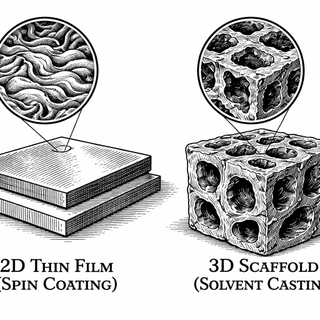
Method one: spin coating. You dissolve the polymers, drop the solution onto a spinning disc, and centrifugal force flings it outward into an ultra-thin film. It happens so fast that the PHBV molecules don't have time to organize into crystals. The technical term is "kinetic trapping" - basically, the material solidifies before the molecules can get their act together. The result is a fully amorphous, glassy 2D film. Think of it as polymer flash-freezing.
Method two: solvent casting with porogens (salt particles that get washed out later to leave pores). This is the slow-and-steady approach. The solvent evaporates gradually, giving PHBV all the time it needs to crystallize into nice, orderly semicrystalline domains. You end up with a chunky, porous 3D scaffold - a miniature apartment complex for cells, if you will.
Same ingredients. Same ratio. Radically different architecture.
The Plot Thickens: Surface Roughness and the Wenzel Effect
Here's where things get interesting for the materials nerds among us. The spin-coated films turned out to be more hydrophilic (water-loving) than you'd expect from their chemistry alone. Why? Nanoscale surface roughness. The rapid solidification creates a textured topography that amplifies the material's inherent wettability through something called the Wenzel model. In plain English: tiny bumps on the surface make water spread out more, and cells generally appreciate a surface that doesn't repel their watery environment.
Old Wilhelm Wenzel published his roughness-wettability theory back in 1936, and here it is, still earning its keep nearly a century later. I remember teaching it to students who thought it was a quaint relic. Nature, it seems, disagrees with their assessment.
The Cellular Verdict: A Tale of Two Timelines
Both formats passed the first test with flying colors: neither was cytotoxic. Your cells won't die on contact, which is the absolute bare minimum for a biomaterial. (You'd be surprised how many promising materials fail this spectacularly low bar.)
But then the story splits.
The spin-coated 2D films, particularly the 50:50 blend, showed impressive early biocompatibility and rapid initial cell proliferation. Cells landed, spread out, and started multiplying with genuine enthusiasm. For a surface coating application - say, making an existing implant more bio-friendly - this is fantastic news.
However, cells on a flat surface eventually run into what biologists call contact inhibition. Once every square micrometer of real estate is claimed, the cells essentially stop dividing. It's like a boomtown that runs out of land. Exciting at first, then stagnant.
The 3D porous scaffold? Slower start, but logarithmic proliferation that just kept going. Cells could migrate into the pore network, colonize new territory, and keep growing. The numbers tell the story: approximately 160% increase in alkaline phosphatase (ALP) activity - a key marker of bone cell maturation - and a staggering 228% higher terminal mineralization compared to the 2D films. Mineralization, for the uninitiated, is the part where cells actually start laying down the calcium-rich matrix that becomes real bone. It's the difference between cells that act like bone cells and cells that actually make bone.
Why This Matters Beyond the Lab Bench
Bone tissue engineering has been promising to revolutionize fracture repair and defect reconstruction for years. The fundamental challenge hasn't changed: you need a scaffold that degrades at the right rate, supports cell attachment, encourages maturation, and has the right mechanical properties. Using biodegradable polymer blends like PBAT/PHBV is appealing because you can tune the properties by adjusting the blend ratio, and neither component leaves behind problematic degradation products.
What this study elegantly demonstrates is that processing method isn't just a manufacturing detail - it fundamentally determines biological outcome. Same chemistry, same ratio, but the 2D film is best suited as a bioactive surface coating (quick application, resource-efficient, good initial cell response), while the 3D scaffold is the real contender for actual bone regeneration.
This is useful information for the field because it means researchers don't have to choose between the two approaches - they serve different purposes. A spin-coated PBAT/PHBV film could enhance an existing metallic implant's surface, while a solvent-cast scaffold could fill a bone void. Different tools for different jobs, from the same toolbox.
The Bigger Picture
We're still in the in vitro phase here - these are cells in dishes and scaffolds in incubators, not patients in clinics. The jump from lab bench to operating room remains one of the longest and most treacherous in all of biomedical science. Animal studies, mechanical testing under physiological loads, degradation kinetics in vivo, immune response characterization - the to-do list is substantial.
But studies like this one, which carefully unpick the relationship between how you make something and what it does biologically, are exactly the kind of foundational work that keeps the whole enterprise moving forward. As I used to tell my graduate students: if you don't understand why your scaffold works, you'll never know why it doesn't when it inevitably misbehaves in a new context.
Both sides of that coffee-break argument were right, as it turns out. They usually are. That's what makes polymer science so maddening and so wonderful.
This blog post discusses research findings and should not be taken as medical advice. If you have concerns about bone health or tissue engineering treatments, please consult a healthcare provider. Research discussed here represents ongoing scientific investigation and clinical validation is still in progress.
All images used in this post are decorative illustrations only and do not represent or reflect the accuracy, reality, or correctness of the referenced research.
Primary Source: Physicochemical and Osteoinductive Comparison of 2D Spin-Coated Films and 3D Porous Solvent-Cast Scaffolds of Poly(3-Hydroxybutyrate-co-3-Hydroxyvalerate)/Poly(Butylene Adipate-co-Terephthalate) Blends. PubMed. 2026. PMID: 41962034