
"You're telling me they want to blast someone's arm with sound waves to make it stop seizing up?"
"It's not blasting. It's focused acoustic energy delivered through a precisely calibrated-"
"Sound waves. You're describing sound waves."
"...Yes. Fine. Sound waves."
"And this is supposed to help?"
"It's called focused extracorporeal shockwave therapy, and it might actually change how we treat spasticity in spinal cord injury patients."
"Sound. Waves."
Look, I get it. After two decades in the ER, I've heard my share of treatments that sounded like someone lost a bet at a medical conference. But this one? This one has legs. Or, more accurately, it has arms - because a new pilot trial (NCT07501429) is investigating whether focused extracorporeal shockwave therapy (f-ESWT) can tackle upper-limb spasticity in people living with spinal cord injuries. And before you write it off, hear me out.
The Problem: When Your Own Muscles Turn Against You
Roughly 305,000 Americans are living with a spinal cord injury right now. Sixty percent of them have tetraplegia - meaning all four limbs are affected - and a huge chunk of those people deal with spasticity. For the uninitiated, spasticity is what happens when muscles decide to go rogue. They contract involuntarily, stiffen up, and generally make life miserable. Imagine trying to feed yourself, type an email, or hold your kid's hand while your arm has its own agenda.
Spasticity isn't just annoying. It causes pain. It triggers depression. It interferes with rehab. It can land people back in the hospital. And for someone with tetraplegia, spasticity in the arms and hands can be the difference between some level of independence and complete dependence on others. A systematic review by Holtz et al. (2017) found that spasticity prevalence in SCI populations ranges from 65% to 78%, making it one of the most common secondary complications after injury (DOI: 10.1080/10790268.2016.1207189).
The Current Playbook (And Why It's Not Great)
The standard approach to spasticity reads like a "greatest hits" of medicine's most lukewarm solutions:
- Physical therapy: Stretching and exercise. Helpful, but often not enough on its own.
- Baclofen: An oral medication that can make you drowsier than a cat on a radiator. Works for some, barely touches others.
- Botox injections: Yes, that Botox. Except instead of erasing your worry lines, it's paralyzing overactive muscles. Effective? Sometimes. But it's invasive, wears off in 3-4 months, and comes with side effects including muscle weakness (which, for someone already dealing with limited function, is a real gut punch).
A meta-analysis by Andringa et al. (2019) underscored the challenges, noting that while botulinum toxin reduces spasticity on clinical scales, the translation to meaningful functional improvement remains inconsistent (DOI: 10.1016/j.jns.2019.116516). In other words, the numbers look better on paper, but patients don't always feel better in real life.
So physicians are stuck in a cycle: inject, wait, repeat, adjust, hope. It's the medical equivalent of rebooting your router every three months and calling it a solution.
Enter the Sound Waves (No, Seriously)
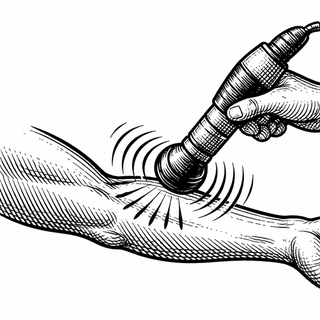
Focused extracorporeal shockwave therapy - f-ESWT for those of us who value our breath - works by delivering high-pressure acoustic waves through the skin directly into the spastic muscle. Think of it like ultrasound's rowdier cousin. An applicator gets placed on the skin, the device fires focused shockwaves, and the whole thing is done without needles, incisions, or existential dread.
The technology isn't exactly new. ESWT has been used since the 1980s to pulverize kidney stones (lithotripsy, for the trivia enthusiasts). Over the years, it found its way into treating plantar fasciitis, tennis elbow, and various musculoskeletal complaints. Then someone had the bright idea to point it at spastic muscles, and things got interesting.
A systematic review by Cabanas-Valdés et al. (2020) examined ESWT for post-stroke spasticity and found significant reductions in muscle tone as measured by the Modified Ashworth Scale, with effects that in some cases outlasted those of botulinum toxin (DOI: 10.1080/10749357.2019.1654242). Dymarek et al. (2020) echoed these findings in a qualitative systematic review, highlighting ESWT's potential as a safe, non-invasive adjunct to traditional spasticity management (DOI: 10.2147/CIA.S221032).
But here's the catch - and it's a big one. Almost all of this research has been done on stroke patients. People with spinal cord injuries? Barely a blip on the radar. The mechanisms behind spasticity differ between stroke and SCI. The neural circuitry is damaged in different places, the reflex arcs behave differently, and what works for one population doesn't automatically transfer to the other.
What This Trial Actually Does
This pilot study (NCT07501429) is designed to fill exactly that gap. Researchers are measuring spasticity from multiple angles - clinical assessments like elbow and wrist range of motion, plus the patient's own experience of how their arms and hands are functioning (or not). It's the kind of dual-perspective approach that actually tells you something useful, because a doctor's rating scale and a patient's daily reality don't always agree.
It's a pilot trial, which means this isn't the final answer. It's the "let's see if this idea holds water" phase. But pilot trials are where revolutions start. Every treatment you've ever benefited from was once a small study with a handful of brave participants and a researcher who thought, "What if?"
Why This Matters More Than You Think
If f-ESWT proves effective for SCI-related upper-limb spasticity, the implications are genuinely exciting. We're talking about a treatment that is:
- Non-invasive - no needles, no anesthesia, no "hold still while I inject toxin into your forearm"
- Minimal side effects - some transient discomfort during application, and that's basically it
- Potentially longer-lasting - early stroke studies suggest effects may persist longer than Botox
- Repeatable - without the cumulative concerns that come with repeated toxin injections
For the 180,000-plus Americans with tetraplegia, getting even modest improvement in arm and hand function can be transformative. We're talking about being able to grip a fork, operate a wheelchair joystick, or use a phone without assistance. These aren't small things. These are the things that make a life feel like your life.
The Bottom Line
Is this trial going to cure spasticity? No. Is it going to replace everything we currently do? Almost certainly not. But if focused shockwave therapy can offer even a fraction of the benefit it's shown in stroke populations - without the invasiveness, the side effects, and the quarterly Botox appointments - it would be a genuine addition to a toolbox that, frankly, could use some new tools.
Sometimes the best ideas in medicine sound a little absurd at first. Mold that kills bacteria. Electricity that restarts hearts. Sound waves that calm down muscles throwing a tantrum.
I've been doing this long enough to know: don't bet against the weird ones.
This article is for educational purposes only and does not constitute medical advice. Individuals with spinal cord injuries or spasticity should consult their healthcare provider for personalized treatment recommendations. Clinical trial information referenced from ClinicalTrials.gov (NCT07501429).
References:
-
Holtz KA, Lipson R, Noonan VK, et al. "Prevalence and Effect of Problematic Spasticity After Traumatic Spinal Cord Injury." Arch Phys Med Rehabil. 2017. DOI: 10.1080/10790268.2016.1207189
-
Andringa A, van de Port I, van Wegen E, et al. "Effectiveness of Botulinum Toxin Treatment for Upper Limb Spasticity Poststroke Over Different ICF Domains: A Systematic Review and Meta-Analysis." J Neurol Sci. 2019. DOI: 10.1016/j.jns.2019.116516
-
Cabanas-Valdés R, Calvo-Sanz J, Urrùtia G, et al. "The Effectiveness of Extracorporeal Shock Wave Therapy to Reduce Lower Limb Spasticity in Stroke Patients: A Systematic Review and Meta-Analysis." Top Stroke Rehabil. 2020. DOI: 10.1080/10749357.2019.1654242
-
Dymarek R, Ptaszkowski K, Ptaszkowska L, et al. "Shock Waves as a Treatment Modality for Spasticity Reduction and Recovery Improvement in Post-Stroke Adults - Current Evidence and Qualitative Systematic Review." Clin Interv Aging. 2020. DOI: 10.2147/CIA.S221032