
Let's be real - treating damaged cartilage kind of sucks. Here's why. Your options basically boil down to: manage the pain until you can't anymore, then let someone saw open your joint and bolt in some titanium. Physical therapy helps, steroid injections buy you time, and hyaluronic acid shots give your knees a few months of "meh, that's slightly better." But actual cartilage regeneration? That's been the white whale of orthopedics for decades. Cartilage is famously terrible at healing itself, which is a real design flaw if you ask me. So when a team of researchers figures out how to jury-rig a natural molecule into a tiny drug-delivery vehicle that could coax your body into growing new cartilage, I sit up and pay attention.
The Cartilage Problem (It's Worse Than You Think)
Osteoarthritis affects over 500 million people globally, according to the World Health Organization, and that number keeps climbing. It disproportionately hammers low-income communities, where access to joint replacement surgery ranges from "long waitlist" to "not happening." In many parts of the world, a worn-out knee means a lifetime of limited mobility, lost wages, and cascading health consequences. If we could develop non-surgical interventions that actually regenerate cartilage tissue rather than just manage symptoms, we'd be looking at a genuine game-changer for health equity.
The fundamental challenge is that cartilage has almost no blood supply. No blood supply means no easy way to deliver healing factors to the damage site. It's like trying to mail a package to a house with no address and no road leading to it.
Enter the Tiny Delivery Trucks
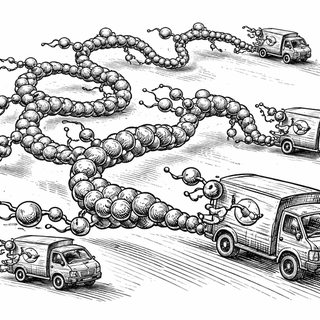
A new study published in 2025 tackles this problem with an elegantly nerdy approach: systematically modifying hyaluronic acid (HA) - a molecule your body already knows and loves - by attaching fatty alkyl chains of different lengths and densities to create what are essentially microscopic delivery vehicles (DOI: 10.1016/j.ijbiomac.2025.143955).
Think of hyaluronic acid as a long, water-loving noodle that naturally exists in your joints. On its own, it's great at lubrication but not so great at carrying drugs to specific targets. The researchers' trick was to attach greasy little tails (alkyl chains) to this noodle, making it amphiphilic - meaning it has both water-loving and fat-loving parts. When you do this, the modified HA molecules spontaneously clump together into tiny aggregates called polyelectrolyte nanoparticles, with greasy cores that can trap hydrophobic drug molecules inside.
The real innovation here isn't just making these particles. It's the systematic part. The team didn't just slap on random modifications and hope for the best. They methodically varied both the length of the alkyl chains and the degree of substitution (how many chains they attached per HA molecule), then rigorously characterized what each variation produced. Different chain lengths and densities created particles with different sizes, stability profiles, and drug-loading capacities.
Kartogenin: The Drug That Tells Stem Cells to Build Cartilage
The drug they loaded into these particles is kartogenin (KGN), and it's a fascinating little molecule. Discovered in 2012 by researchers at the Genomics Institute of the Novartis Research Foundation, KGN has a remarkable ability to promote chondrogenesis - the process by which stem cells differentiate into cartilage-producing cells called chondrocytes (DOI: 10.1126/science.1222451). It works by modulating the CBFβ-RUNX1 signaling pathway, essentially flipping a molecular switch that tells mesenchymal stem cells, "Hey, become cartilage."
The catch? KGN is moderately hydrophobic (it doesn't dissolve well in water) and needs a delivery system to get it where it needs to go in sufficient concentrations for a long enough period. You can't just inject it freely into a joint and expect it to stick around. It would disperse too quickly, like dropping a sugar cube into a swimming pool.
That's where the modified HA carriers come in. The alkyl-modified HA nanoparticles efficiently encapsulated KGN within their hydrophobic cores, creating a controlled-release system that keeps the drug concentrated at the target site over time.
The Results: Cartilage Markers Go Up
When the researchers tested their KGN-loaded HA carriers on cell cultures, the results were genuinely encouraging. Specific formulations - notably those with optimized alkyl chain length and substitution ratios - significantly upregulated key chondrogenic markers in both standard 2D cultures and more physiologically relevant 3D culture systems. In plain English: the cells started behaving like cartilage cells, producing the proteins and matrix components characteristic of healthy cartilage tissue.
Not all formulations worked equally well, which is actually the most interesting part. The specific pattern of alkyl modification mattered enormously. This tells us that we're not just throwing spaghetti at the wall - there's a rational design space here that can be optimized. The relationship between carrier chemistry and biological response gives researchers a tunable system they can refine further.
Why This Matters for the Rest of Us
Previous studies have explored HA-based drug delivery for joint diseases, including work on HA-KGN conjugates and HA-based hydrogels for cartilage repair (DOI: 10.1016/j.actbio.2019.05.025). What distinguishes this study is the systematic approach to understanding how carrier architecture affects drug delivery and biological outcomes. It's the difference between finding one recipe that works and understanding why it works so you can make it better.
This is still early-stage research - we're talking cell cultures, not clinical trials. The team acknowledges that in vivo testing, expanded biocompatibility studies, and refined formulation strategies are next on the agenda. But the foundation is solid, the approach is rational, and the target condition affects hundreds of millions of people who desperately need better options than "take ibuprofen until your liver files a complaint, then schedule surgery."
For underserved populations who may never have access to a $50,000 joint replacement, an injectable therapy that promotes actual cartilage regeneration could be transformative. Imagine a treatment that a community health worker could administer in a clinic - no operating room, no anesthesiologist, no weeks of inpatient recovery. We're not there yet, but studies like this are the stepping stones.
The Bottom Line
Cartilage regeneration remains one of orthopedic medicine's toughest puzzles. This research won't solve it overnight. But by demonstrating that carefully engineered HA carriers can deliver chondroprotective drugs effectively and that the carrier design itself can be rationally optimized, it adds a genuinely useful piece to that puzzle. The next steps - animal models, longer-term studies, and eventually human trials - will determine whether this approach graduates from "promising lab result" to "actual treatment." I'm cautiously optimistic, which in science is basically the equivalent of doing cartwheels.
This blog post discusses research findings and should not be taken as medical advice. If you have concerns about cartilage health or osteoarthritis, please consult a healthcare provider. Research discussed here represents ongoing scientific investigation and clinical validation is still in progress.
All images used in this post are decorative illustrations only and do not represent or reflect the accuracy, reality, or correctness of the referenced research.
Primary Source: Tailoring alkyl modification patterns in hyaluronic acid derivatives serving as carriers for enhanced kartogenin delivery and chondrogenic responses. International Journal of Biological Macromolecules. 2025. DOI: 10.1016/j.ijbiomac.2025.143955