
The dentist just told you everything looks perfectly normal. Your bloodwork? Unremarkable. Oral exam? Clean bill of health. And yet your mouth feels like you swished hot sauce, held it for an hour, and then did it again for fun. You sit in the exam chair, tongue throbbing, staring at a poster about flossing, quietly wondering if you've invented a medical condition that exists only for you.
You haven't. Prevalence estimates for burning mouth syndrome (BMS) and oral dysesthesia range from 0.7% to 15% of the general population, depending on the study and demographic sampled (Kohorst et al., 2014). That's an absurdly wide confidence interval, and if you're the kind of person who notices things like absurdly wide confidence intervals, it tells you something revealing: we haven't been studying this problem nearly enough. A new Phase II clinical trial - NCT07506018 - aims to change that by testing a product called MucoLock™ Oral Rinse on patients with stomatitis characterized by oral dysesthesia. And honestly, it's about time.
What Oral Dysesthesia Actually Is (Besides Awful)
Oral dysesthesia is a chronic burning, tingling, or pain sensation in the mouth - most commonly the tongue, palate, and lips - without any visible lesion or obvious clinical cause. It's the phantom limb pain of dentistry, except the limb is right there in your mouth and everyone can see it looks fine.
The condition clusters heavily among postmenopausal women, with some studies reporting a female-to-male ratio as high as 7:1 (Scala et al., 2003). Hormonal changes, neuropathic mechanisms, psychological factors, and peripheral nerve damage have all been proposed as contributors, but no single mechanism has emerged as the definitive culprit. It's a classic case of "we have twelve hypotheses and confidence in none of them" - which, if you've spent time in biomedical research, is a depressingly familiar state of affairs.
The real kicker? The standard treatment landscape is, to put it charitably, sparse. Clonazepam rinses, alpha-lipoic acid supplements, cognitive behavioral therapy, and capsaicin applications have all been tried with varying and often underwhelming results. A systematic review of BMS treatments found that most interventions showed limited evidence of sustained benefit, with many studies plagued by small sample sizes and inconsistent outcome measures (Liu et al., 2018). Translation: doctors have been throwing a lot of things at this wall, and not much has stuck.
Enter MucoLock™: The Swish-and-Spit Solution
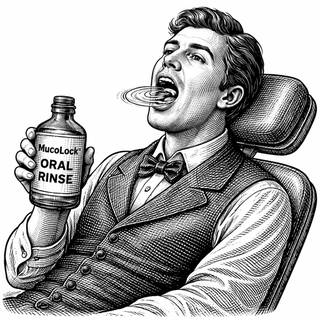
This is where the new trial gets interesting. MucoLock™ is a topical oral rinse designed to be used as a "swish and spit" solution - basically mouthwash, but with therapeutic intent. Participants in the trial swish the solution for five minutes, three times per day, over a 28-day treatment period.
The approach targets mucosal protection directly at the site of discomfort. Think of it as applying a temporary shield to the lining of your mouth rather than trying to rewire the nervous system or adjust hormones from the inside out. For a condition where the pain is localized but the underlying cause is maddeningly diffuse, a topical barrier strategy has a certain elegant logic to it. You can't fix what you can't find, but you can try to protect the tissue that's screaming at you.
The Phase II, open-label design means all participants receive the active treatment (no placebo group this round), and the primary goals are evaluating tolerability and preliminary efficacy. In clinical trial language: Can people actually stand using this stuff three times a day, and does the burning dial down? Both are genuinely important questions. A treatment that works brilliantly but tastes like liquid regret is not going to help anyone in the real world.
Why This Matters More Than You'd Think
Here's a number that should bother you: multiple studies have documented that BMS patients wait an average of 2-5 years before receiving a correct diagnosis, often cycling through multiple specialists (Tait & Ferguson, 2017). Five years of your mouth burning with no explanation. That's not just a medical inconvenience - it's a quality-of-life catastrophe. Depression, anxiety, sleep disruption, and social withdrawal are all significantly elevated in this population.
The economic burden is similarly underappreciated. Repeated specialist visits, trial-and-error prescriptions, unnecessary dental procedures undertaken in desperation - these costs add up quietly. BMS doesn't make headlines the way cancer or cardiovascular disease does, but for the millions of people worldwide living with chronic oral pain, it dominates their daily experience.
A Cochrane systematic review of interventions for BMS highlighted the urgent need for well-designed trials with standardized outcome measures (McMillan et al., 2016). NCT07506018, while modest in scope as a Phase II open-label study, represents exactly the kind of focused, rigorous inquiry the field needs. Every well-designed trial moves the needle, and the needle has been stuck for a while.
What Happens If the Numbers Look Good
If MucoLock™ demonstrates meaningful tolerability and symptom reduction, the next step would typically be a randomized, placebo-controlled Phase III trial - the gold standard for establishing efficacy. Given that the current treatment toolkit for oral dysesthesia reads like a list of "things we tried because we didn't have anything better," a validated topical option would be genuinely transformative.
Even a moderate effect size would be clinically meaningful here. We're not talking about shaving seconds off a marathon time; we're talking about potentially giving people back the ability to eat breakfast without wincing. The bar for "life-changing" is lower than you'd think when the baseline is chronic daily pain that nobody else can see.
For the data-minded among us, keep an eye on the trial's outcome measures as results become available. Patient-reported pain scores, tolerability metrics, and treatment adherence rates will tell the real story. The plural of anecdote isn't data, but a well-run Phase II trial? That's the beginning of an answer.
The Bottom Line
Oral dysesthesia is common, poorly understood, undertreated, and genuinely miserable. The MucoLock™ trial won't solve the entire puzzle, but it's asking the right questions with the right methodology at a time when patients desperately need new options. Sometimes the most exciting thing in medicine isn't a breakthrough - it's someone finally deciding to run the experiment.
Disclaimer: This blog post is for informational and educational purposes only and does not constitute medical advice. Always consult a qualified healthcare provider for diagnosis and treatment decisions. Clinical trial participation should be discussed with your physician. For full trial details, visit ClinicalTrials.gov (NCT07506018).
References:
- Kohorst JJ, et al. "The Prevalence of Burning Mouth Syndrome: A Population-Based Study." Mayo Clinic Proceedings. 2014;89(11). DOI: 10.1016/j.mayocp.2014.09.003
- Scala A, et al. "Update on Burning Mouth Syndrome." Critical Reviews in Oral Biology & Medicine. 2003;14(4):275-291. DOI: 10.1177/154411130301400405
- Liu YF, et al. "Burning Mouth Syndrome: A Systematic Review of Treatments." Oral Diseases. 2018;24(3):325-334. DOI: 10.1111/odi.12660
- Tait RC, Ferguson M. "Management of Burning Mouth Syndrome." British Dental Journal. 2017;222:37-40. DOI: 10.1038/sj.bdj.2017.2
- McMillan R, et al. "Interventions for Treating Burning Mouth Syndrome." Cochrane Database of Systematic Reviews. 2016. DOI: 10.1002/14651858.CD002779.pub3