
Raise your hand if you've ever squinted at a home pregnancy test, a COVID rapid test, or a pool pH strip and thought, "Is that line pink or is that just the lighting in my bathroom?" Welcome to the messy, ambiguous world of colorimetric sensing, where a billion-dollar diagnostics industry sometimes boils down to whether your eyes can distinguish salmon from magenta.
Now imagine a sensor that doesn't just show you a faint line but shifts its entire visible color like a chameleon doing a catwalk strut. That's essentially what a team of researchers just pulled off by smashing together two of materials science's coolest toys: liquid crystals and photonic crystals. Think of it as the Voltron of optical sensing - two things that are already pretty cool on their own, but together? Unstoppable.
Your TV Screen's Weird Cousin
You probably interact with liquid crystals (LCs) every day without thinking about it. Your phone screen, your laptop, that weird calculator your dad still uses - they all rely on liquid crystals twisting and reorienting in response to electrical signals. But here's the thing: LCs don't just respond to electricity. They respond to molecules. When a target biomolecule lands on a surface coated with liquid crystals, it disrupts their alignment, and that disruption changes how light passes through them. It's like dropping a bowling ball onto a perfectly arranged set of dominos - suddenly the whole pattern shifts, and you can see it.
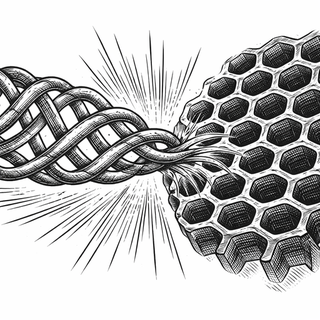
LC-based biosensors have been around for a while, and the concept is beautiful in its simplicity. No batteries, no electronics, no PhD required to read the result. The problem? They're about as durable as a sandcastle at high tide. Traditional LC sensors use flat glass slides treated with chemicals to align the liquid crystal molecules, and those setups are fragile, hard to customize, and about as portable as a grand piano.
Enter the Inverse Opal: Nature's Cheat Code
This is where inverse opals come in, and honestly, they're one of the most satisfying structures in all of materials science. Picture a opal gemstone - that gorgeous play of rainbow colors comes from its internal structure: tiny silica spheres packed together like oranges at a grocery store. Now imagine removing all the oranges and keeping just the spaces between them. That's an inverse opal - a three-dimensional honeycomb of perfectly ordered, interconnected pores.
When you make inverse opals out of inorganic materials like titanium dioxide (TiO2), you get a photonic crystal - a structure that manipulates light the way a semiconductor manipulates electrons. Specific wavelengths of light get reflected based on the pore size, giving you a "structural color" that doesn't fade, doesn't bleach, and doesn't care about your bathroom lighting. It's the same principle that makes butterfly wings iridescent and morpho butterflies the envy of every materials scientist alive.
The Mashup Nobody Knew We Needed
The research team's breakthrough - published recently and available on PubMed - was realizing that the inverse opal doesn't have to be just a passive scaffold holding liquid crystals in place. It can actively control how the LCs orient themselves. This is the "paradigm shift" the authors describe, and it's a big deal.
Think of it like the difference between a picture frame and a director. Traditional LC biosensor substrates are picture frames - they hold the LC in place and that's about it. The inverse opal substrate is more like Peter Jackson on the set of Lord of the Rings - it's actively directing every liquid crystal molecule, telling it exactly where to point and how to behave.
By tuning the chemistry and geometry of the inverse opal pores, the researchers could precisely control the LC orientation from the inside out. When a target molecule enters the pores and interacts with the LC, the reorientation cascades through the entire structure, producing a vivid, unambiguous color change visible to the naked eye. We're talking full-on mood ring vibes, but backed by rigorous physics.
Why This Isn't Just Another Lab Curiosity
There are three things that make this work stand out from the graveyard of "cool in the lab, useless everywhere else" sensor papers.
Robustness. Because the LCs are nestled inside a rigid inorganic framework rather than sitting exposed on a flat glass slide, they're mechanically protected. You could probably put this thing in your pocket without ruining it. Try that with a traditional LC sensor and you'll get a very expensive smear.
Customizability. By changing the inverse opal material, pore size, or surface chemistry, you can tune the sensor for different targets. Need to detect a specific protein? Tweak the surface. Want a different color response range? Adjust the pore diameter. It's like having a universal adapter for molecular detection.
Universality. The team demonstrated that this isn't a one-trick pony - the strategy works across different inorganic materials, meaning it can be adapted for a wide range of sensing applications, from detecting environmental toxins to diagnosing diseases.
The Bigger Picture: Sensors Without Batteries
We live in an age where we expect our medical diagnostics to be fast, cheap, portable, and idiot-proof. (No offense - I include myself in that category when I'm trying to read a test result at 6 AM.) LC-based photonic sensors check all those boxes. They need no power source, produce results visible to the naked eye, and could theoretically be manufactured at scale using existing materials processing techniques.
Imagine a world where a first responder could test water quality after a natural disaster with a sensor card that changes from blue to red in the presence of lead. Or where a patient in a rural clinic could get a preliminary disease screening without a single piece of electronic equipment. That's the promise of this kind of technology, and this research brings it meaningfully closer to reality.
What's Next?
As with all early-stage materials research, there's still a gap between "works beautifully in the lab" and "available at your local pharmacy." The team will need to demonstrate detection of specific, clinically relevant biomarkers, validate performance across real-world conditions (temperature, humidity, that mysterious sticky stuff at the bottom of your bag), and figure out scalable manufacturing. But the foundation they've laid - proving that inverse opals can universally and controllably regulate LC behavior - is the kind of platform technology that other researchers can build on.
In the meantime, I'll be over here marveling at the fact that the same basic physics that makes opals sparkly and TV screens work is being repurposed to potentially save lives. Science, man. It never gets old.
This blog post discusses research findings and should not be taken as medical advice. If you have concerns about biosensor technology or diagnostic testing, please consult a healthcare provider. Research discussed here represents ongoing scientific investigation and clinical validation is still in progress.
All images used in this post are decorative illustrations only and do not represent or reflect the accuracy, reality, or correctness of the referenced research.
Primary Source: Universal Integration of Liquid Crystals with Inorganic Inverse Opals: Robust and Customizable Regulation for Optical Sensing. PubMed. 2026. PMID: 41860581