
Somewhere right now, an orthopedic surgeon is staring at an X-ray of a failed hip implant, wondering why a device that performed beautifully in lab tests crumbled inside an actual human being. The patient trusted the numbers. The surgeon trusted the numbers. The manufacturer definitely trusted the numbers. But here's the thing about numbers in biomaterials: we've been measuring the wrong things at the wrong scales, and our implants have been paying the price.
A new review published in the biomedical engineering literature finally puts a name to this problem and offers something resembling a solution. It's called "data-driven multiscale design," and if that sounds like buzzword soup, stick with me. The math actually makes sense this time.
The Scale Problem (Or Why Your Implant Doesn't Care About Lab Tests)
Here's a number that should bother you: composite biomaterials need to perform across length scales spanning roughly nine orders of magnitude. That's from the nanometer level (where individual molecules are doing their molecular thing) all the way up to centimeters (where your actual skeleton lives).
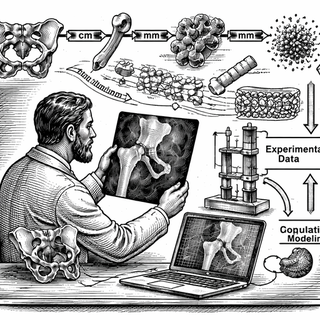
Traditional testing? It mostly happens at one or two scales. We measure bulk mechanical properties - how strong is this chunk of material when we squeeze it? - and call it a day. But biological tissues are spectacularly unhelpful in their complexity. Bone, for instance, has a hierarchical architecture that would make a Gothic cathedral look like a shoebox. Mineralized collagen fibrils bundle into fibers, fibers organize into lamellae, lamellae stack into osteons, and osteons assemble into the cortical bone that keeps your femur from snapping when you step off a curb.
Each level contributes to the overall mechanical behavior. Miss one, and your fancy synthetic composite might have the right stiffness but terrible damage tolerance. Or perfect toughness but biological compatibility that makes cells run screaming in the other direction.
What the New Framework Actually Does
The researchers behind this review have synthesized an approach that connects experiments, 3D imaging, and computational modeling into something coherent. Think of it as building a complete dataset across all those nine orders of magnitude, then actually using it.
The experimental side pulls together some heavy artillery: nanoindentation for probing mechanical properties at tiny scales, bulk mechanical tests for the macro stuff, dynamic mechanical analysis (DMA) for understanding time-dependent behavior, and rheology for materials that flow. Each technique captures different aspects of how these composites will actually behave inside a human body.
But here's where it gets interesting. They're combining these measurements with advanced 3D imaging - think micro-CT and similar technologies that let you see the internal architecture of materials without destroying them. You can map porosity, fiber orientation, and structural features at multiple scales simultaneously.
Then the computational modeling ties it all together. Feed the structural data and mechanical measurements into simulations, and you can start predicting how materials will behave under conditions you haven't tested yet. Novel loading patterns. Long-term fatigue. The specific mechanical environment inside someone's knee joint during a jog.
Why Nature Had This Figured Out Already
The review spends considerable time examining natural tissues, and honestly, it's a bit humbling. Evolution has been running this optimization problem for several hundred million years, and the solutions are elegant.
Take bone's damage tolerance mechanism. When cracks start forming (and they always do - your skeleton is constantly developing microcracks just from daily activity), the hierarchical structure deflects and bridges those cracks at multiple length scales. Energy gets dissipated through dozens of mechanisms working in parallel. It's not just tough; it's specifically tough in ways that prevent catastrophic failure.
Synthetic composites have historically been designed without this level of architectural sophistication. We pick a matrix material, add some reinforcing fibers, optimize for one or two properties, and hope for the best. The data-driven approach flips this: start with understanding what nature does, measure it at every relevant scale, then systematically design synthetics that replicate those mechanisms.
The Scaffolding Challenge
Medical implants aren't just mechanical devices anymore. Tissue engineering scaffolds need to do everything at once: provide structural support, guide cell behavior, degrade at appropriate rates, and integrate with surrounding tissue. The mechanical, biological, and functional demands are completely entangled.
Previous approaches often optimized these separately. Make it strong enough. Check. Make it biocompatible. Check. Hope the two requirements don't conflict. Cross fingers.
The multiscale framework acknowledges that these properties emerge from the same underlying structure. Change porosity to improve cell infiltration, and you've also changed mechanical properties. Modify surface chemistry for better cell adhesion, and you might affect degradation kinetics. Everything connects.
By building comprehensive datasets that capture these interconnections, researchers can navigate tradeoffs more intelligently. Want 40% porosity for cell migration but need specific stiffness values to match native tissue? The computational models can identify architectural configurations that achieve both, or clearly demonstrate that the combination is physically impossible (which is also valuable information).
Where the Data Actually Comes From
Let's talk characterization techniques, because this is where the rubber meets the road (or the titanium meets the femur, as it were).
Nanoindentation lets you poke materials with a tiny diamond tip and measure local mechanical properties. You can map stiffness variations across a sample surface, identifying weak spots that bulk tests would completely miss. For composite materials with multiple phases, this reveals how load transfers between components.
DMA applies oscillating forces and measures the response, capturing how materials behave under cyclic loading. This matters enormously for implants, which experience millions of loading cycles over their lifetime. A material that seems fine under static loads might accumulate damage under dynamic conditions.
Rheology characterizes flow behavior, which is relevant for injectable biomaterials and understanding how composites process during manufacturing. Viscosity, elasticity, and time-dependent responses all factor into whether a material will actually work in clinical applications.
The key insight is integrating these measurements systematically. Each technique provides a partial view; the framework combines them into something comprehensive.
The Computational Glue
Raw data is just data. The modeling component transforms it into predictive capability.
Finite element analysis takes the 3D structural information from imaging and simulates mechanical behavior under specified conditions. But these simulations are only as good as the material properties fed into them. By combining nanoindentation data (local properties) with bulk measurements (aggregate behavior) and structural imaging (architecture), the models gain accuracy across scales.
Machine learning approaches are increasingly entering this space, identifying patterns in large datasets that might escape traditional analysis. If you've characterized a hundred different composite formulations across multiple testing modalities, ML can extract relationships between composition, structure, processing, and performance that inform the next generation of designs.
It's iterative: design, fabricate, characterize, model, predict, verify, refine. Each cycle adds to the dataset and improves the models.
What This Means for Patients
Let me bring this back to that failed hip implant. Under the old paradigm, failures often prompted a forensic investigation - what went wrong? - followed by incremental modifications to the existing design. The new approach aims for predictive failure: understanding beforehand which conditions will cause problems and designing around them.
This doesn't mean implants will become perfect. Biology is messy, patients are variable, and the mechanical environment inside a human body is genuinely hostile to foreign materials. But "we didn't anticipate this failure mode" should become increasingly rare.
The timeline for clinical impact is measured in years, not months. New design frameworks need validation, regulatory approval has its own pace, and clinical trials take time. But the foundational work is happening now, and the methodology is sound.
For researchers in the field, this review provides something valuable: a coherent framework for organizing the many techniques and approaches that have developed somewhat independently. Instead of choosing between experimental characterization, imaging, or computational modeling, the field is moving toward systematically combining all three.
The numbers, it turns out, were always there. We just needed to collect them at the right scales and put them together properly.
This blog post discusses research findings and should not be taken as medical advice. If you have concerns about biomaterial implants or orthopedic devices, please consult a healthcare provider. Research discussed here represents ongoing scientific investigation and clinical validation is still in progress.
All images used in this post are decorative illustrations only and do not represent or reflect the accuracy, reality, or correctness of the referenced research.
Primary Source: Data-driven multiscale design of composite biomaterials: Integrating experiments, imaging, and computational modeling for biomedical engineering. PubMed. 2025. DOI: https://pubmed.ncbi.nlm.nih.gov/41732390/