
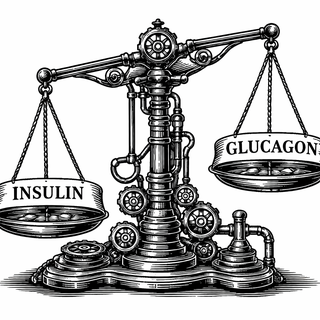
Here's a fun party fact that will make everyone slowly back away from you: your pancreas is basically running a two-person buddy cop movie 24/7. Insulin is the serious one, always pushing your blood sugar down. Glucagon is the wild card, yanking it back up when things get too low. They bicker, they balance each other out, and somehow you don't die. It's beautiful, really.

Now here's the thing that's been bothering diabetes researchers for decades: every artificial pancreas system on the market only hired one of those cops. It's like watching a buddy cop movie where one guy is on permanent vacation and the other is just... sweating a lot and making questionable decisions alone.
A clinical trial in Spain just wrapped up testing what happens when you finally give diabetes tech both hormones. Spoiler: it goes pretty well.
The Problem With Going Solo
If you have type 1 diabetes, you're probably familiar with the current generation of "closed-loop" systems from Medtronic, Tandem, or Omnipod. They're genuinely impressive - a glucose sensor talks to an algorithm that talks to an insulin pump, and together they try to keep your blood sugar in range without you having to do mental math every time you look at a sandwich.
But here's the catch. These systems only have insulin. They can push your blood sugar down, but when it drops too low? The best they can do is stop delivering insulin and maybe flash an angry alert at you while you shakily unwrap a juice box at 2 AM.
It's like having a car with only a gas pedal. Sure, you can take your foot off the gas to slow down, but wouldn't it be nice to have actual brakes?
Enter: The Buddy Cop Reunion
The clinical trial NCT06082973, led by researcher Jorge Bondia at Universitat Politecnica de Valencia, tested a dual-hormone system that delivers both insulin AND glucagon automatically. When blood sugar starts dropping, the system doesn't just stop insulin - it actively pushes glucagon to bring levels back up.
Fifteen adults with type 1 diabetes went through 12-hour supervised sessions where researchers basically tried to break the system. They made participants exercise for 30 minutes without warning the algorithm. They fed them meals. They did everything short of hiding candy in their pockets to see how the system would handle real-world chaos.
Half the time, participants used the dual-hormone setup. The other half, they used a single-hormone system that could only recommend "hey, maybe eat some carbs?" when blood sugar tanked.
Why Exercise Is the Ultimate Diabetes Troll
Anyone with type 1 diabetes has a complicated relationship with exercise. On one hand, it's healthy. On the other hand, your muscles suddenly become insulin-sponges the moment you start moving, and if you have any insulin on board from the last few hours, your blood sugar can nosedive faster than you can say "I should have eaten more."
Current single-hormone systems try to predict exercise and dial back insulin, but it's like trying to stop a train by removing the coal you put in an hour ago. The insulin is already there, doing its thing.
A 2018 study found that dual-hormone systems cut exercise-related hypoglycemia down to just 3.4% of the time, compared to 8.3% with insulin-only systems (Castle et al., 2018). That might not sound like much, but if you've ever had to abandon a workout to sit on the gym floor drinking apple juice while strangers look at you with concern, you know every percentage point matters.
The Numbers That Made Researchers Excited
A landmark trial from the Netherlands - the APPEL 5 study - compared their bihormonal system against standard insulin pumps. Time in the target glucose range jumped from a sad 53.9% with regular pumps to a much happier 86.6% with the dual-hormone setup (Blauw et al., 2021).
Another study looked at people who'd had their entire pancreas removed (yes, you can live without one, though I wouldn't recommend it as a lifestyle choice). The dual-hormone system boosted their time in range from 57.4% to 78.3% while slashing hypoglycemia (van Veldhuisen et al., 2022).
As one review paper put it, adding glucagon gives the algorithm a "brake pedal" to complement insulin's "gas pedal" (Infante et al., 2021). Revolutionary? Maybe not. Obvious in hindsight? Absolutely.
The Catch (There's Always a Catch)
Before you start demanding your endocrinologist give you glucagon immediately, there are some hurdles.
First, glucagon has historically been a drama queen about stability. The stuff used to come as a powder you had to mix fresh because it would degrade in liquid form within hours. Not exactly pump-friendly. Newer formulations from companies like Xeris and Zealand Pharma have mostly solved this, but it's still an extra complication.
Second, dual-hormone systems need more hardware. Two reservoirs, two infusion sites, more complex algorithms. That's more things that can fail, more things to carry, and probably a bigger dent in your wallet.
Third, we need more long-term data. The trials so far have been impressive but relatively short. Regulatory agencies want years of evidence before they'll greenlight something for widespread use, which is probably fair given we're talking about automatically injecting hormones into people.
What This Actually Means For Real People
The artificial pancreas field has moved shockingly fast. Ten years ago, automatic insulin delivery sounded like science fiction. Now hundreds of thousands of people use it daily while barely thinking about it. Dual-hormone systems are the logical next step - not because they're flashy, but because they're how your body actually works.
Imagine exercising without fear of crashing. Eating without obsessive carb-counting. Sleeping through the night without your pump screaming at you like an angry smoke detector. That's the promise here.
The Inreda system already has approval in Europe, making it the first commercial dual-hormone artificial pancreas. As more data rolls in from trials like the one in Valencia, the path to broader availability gets clearer.
Your pancreas evolved over millions of years to use two hormones for a reason. Maybe it's time our technology caught up with biology.
References
-
Blauw H, et al. Fully Closed Loop Glucose Control With a Bihormonal Artificial Pancreas in Adults With Type 1 Diabetes. Diabetes Care. 2021;44(3):836-838. DOI: 10.2337/dc20-2106
-
Castle JR, et al. Randomized Outpatient Trial of Single- and Dual-Hormone Closed-Loop Systems. Diabetes Care. 2018;41(7):1471-1477. DOI: 10.2337/dc18-0228
-
Infante M, et al. Dual-hormone artificial pancreas for management of type 1 diabetes. Artif Organs. 2021;45(9):968-986. DOI: 10.1111/aor.14023
-
van Veldhuisen CL, et al. Bihormonal Artificial Pancreas After Total Pancreatectomy. JAMA Surg. 2022;157(10):950-957. DOI: 10.1001/jamasurg.2022.3702
This blog post is for educational purposes only and does not constitute medical advice. If you're interested in clinical trials or changing your diabetes management, talk to your endocrinologist - they went to school for a very long time for exactly this reason.
Images and graphics are for illustrative purposes only and do not depict actual medical devices, procedures, mechanisms, or research findings from the referenced studies.