
If this biosensor were a household gadget, it would be the smoke alarm that knows the difference between a real fire and my old attempt at making garlic bread. That, in plain English, is the big idea behind a new research paper on microbial detection: build a test that is not just sensitive, but smart enough to avoid false positives.
The study describes a photoelectrochemical, or PEC, biosensor that uses a signal-polarity-switching strategy, along with bacterial imprinting technology, to detect microbes with very high sensitivity and selectivity. That sounds like a sentence built in a lab centrifuge, so let’s unpack it without making everybody suffer.
Why detecting microbes is harder than it sounds
In medicine, food safety, and environmental testing, spotting bacteria quickly matters a lot. A contaminated sample, a brewing infection, or a missed pathogen can turn into a bad day fast. Back in EMS, I learned that speed matters, but so does accuracy. A monitor that cries wolf all the time is not helpful. It is just noisy equipment with commitment issues.
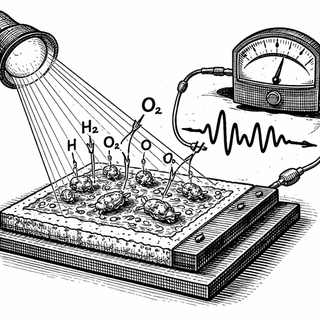
That is the problem many biosensors run into. They can be sensitive enough to pick up tiny signals, but tiny signals are messy. Background interference, nonspecific binding, and chemical noise can make a test light up when the actual target is not there. In real life, false positives waste time, trigger unnecessary follow-up, and chip away at trust in the tool.
So when a paper promises “false-positive-free” microbial detection, that gets attention.
What this sensor is actually doing
At the center of the paper is a PEC biosensor. PEC sensors work by converting light-triggered chemical activity into an electrical signal. Think of it like a tiny referee watching a reaction under a spotlight and then raising a flag based on what it sees.
This team adds a clever twist: instead of just making the signal stronger or weaker, they make it switch polarity. In other words, the signal can flip direction. That matters because a flipped signal is much harder to confuse with background noise than a signal that merely gets a little bigger or smaller. It is the difference between hearing one extra fan in a crowded stadium versus watching the scoreboard change from home to away.
The paper calls this a “binary” strategy, and that is a useful way to think about it. Rather than living in the fuzzy gray zone of “maybe positive,” the system is designed to behave more like an on-off switch. For diagnostics, that is attractive. Biology loves ambiguity. Clinicians generally do not.
The “host-guest” part is not a hotel joke
The sensor also uses supramolecular chemistry with a host-guest system. That sounds intimidating, but the concept is pretty relatable. A “host” molecule is shaped to hold onto a “guest” molecule, a bit like a lock built for a particular key or a parking space sized for one weirdly specific compact car.
In this setup, that host-guest interaction helps regulate the sensor’s behavior. It is part of what allows the signal to change in a controlled way when the right target is present. The value here is precision. Instead of relying on a blunt chemical event, the system uses a more structured molecular interaction to decide when to switch states.
That kind of fine control is a big deal in biosensor design. The more specific the molecular handshake, the better the odds that the sensor responds to the intended target and not some random chemical cousin loitering nearby.
What bacterial imprinting brings to the table
The study also integrates bacterial imprinting technology. This is one of those ideas that sounds futuristic but is actually pretty intuitive. The sensor surface is engineered with recognition sites shaped by the target bacteria, almost like making a mold from an object and then using that mold to recognize the same shape later.
That gives the biosensor a kind of physical memory for the target microbe. If the right bacteria show up, they fit those recognition sites better than unrelated organisms do. The result is better selectivity, which is the lab-world version of not mistaking every tall guy in a baseball cap for your cousin at a crowded game.
Put that together with polarity switching, and you get a two-part strategy: one feature helps the sensor recognize the right target, and another helps the output behave in a cleaner, more decision-friendly way.
Why this is interesting beyond the bench
A lot of diagnostic research focuses on becoming more sensitive. That matters, of course. If your test cannot detect small amounts of bacteria, it is not much use early on. But chasing sensitivity alone can backfire if you also make the system more twitchy.
What makes this paper interesting is that it is tackling sensitivity and false positives at the same time. That is a more practical target. In the real world, the best test is not the one with the fanciest mechanism on a figure panel. It is the one that gives a trustworthy answer when the sample is messy, the clock is running, and nobody has time for interpretive dance with the data.
If follow-up development goes well, this kind of approach could matter in settings where rapid, selective microbial detection is valuable: clinical labs, food inspection, water safety, and possibly point-of-care tools down the line. I would not jump straight to “revolutionary” because that word gets thrown around like free pens at a conference, but the design logic here is strong.
The catch: elegant chemistry still has to survive real life
As promising as this sounds, there is always a gap between a polished research sensor and a tool that survives contact with actual workflows. Real samples are ugly. Blood, saliva, wastewater, food extracts, and environmental samples are full of compounds that do not care about your elegant assay design.
There are also the usual next-step questions. How reproducible is the sensor from batch to batch? How stable is it over time? How expensive is it to manufacture? Can it handle different microbes, or is it highly tuned to one target? Does it perform as well outside controlled experimental conditions?
Those are not flaws in the paper. They are just the toll booths every promising biosensor eventually has to pass through.
The bigger picture
What I like about this work is that it treats false positives as a design problem, not just an annoyance to be cleaned up later. That is smart. In emergency medicine, a monitor alarm that goes off for nonsense conditions people to ignore it. Diagnostics can drift into the same trap. If a test throws too many fake flags, confidence drops, and usefulness goes with it.
This biosensor’s binary-style polarity switching is an attempt to build a cleaner yes-no signal into the system from the start. Pairing that with molecular recognition and bacterial imprinting gives it a layered strategy that feels less like brute force and more like good engineering.
No, this is not a device you will see on every hospital cart next week. Science rarely moves that way, despite what headlines and stock photos of gloved hands might suggest. But as a proof of concept, it points toward a future where microbial detection gets faster, more selective, and less vulnerable to the biochemical equivalent of phantom smoke alarms.
That would be useful in just about any setting where bad bugs and bad data both cause problems. Which, to be fair, is a pretty long list.
This blog post discusses research findings and should not be taken as medical advice. If you have concerns about infection or microbial exposure, please consult a healthcare provider. Research discussed here represents ongoing scientific investigation and clinical validation is still in progress.
All images used in this post are decorative illustrations only and do not represent or reflect the accuracy, reality, or correctness of the referenced research.
Primary Source: PubMed Record 42008555. A Host-Guest-Regulated Photocurrent Polarity Switching with a "Binary" Strategy for False-Positive-Free Microbial Detection. Available at: https://pubmed.ncbi.nlm.nih.gov/42008555/