
Quick - name the last time you thought about reminiscence therapy. If the answer is "literally never," you're in excellent company. But here's the thing: reminiscence therapy has been one of the most studied non-drug approaches for dementia for decades, and a new clinical trial just took it and gave it a very 2026 upgrade. We're talking a virtual therapist powered by a large language model. Yes, the same family of technology behind your favorite chatbot might soon be sitting across from your grandmother, gently coaxing out her favorite memories from 1962.
And honestly? The science behind it is more promising than you might expect.
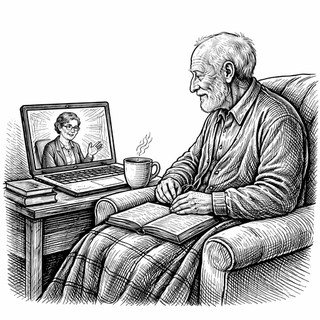
What Exactly Is Smart Virtual Reminiscence Therapy?
The trial, registered as NCT07499570 on ClinicalTrials.gov, is testing something called Smart Virtual Reminiscence (SVR) therapy on older adults living with Alzheimer's Disease and Related Dementias (ADRD). The intervention pairs a virtual therapist - think an on-screen conversational agent - with multi-modal large language model technology to guide patients through structured reminiscence sessions.
Reminiscence therapy itself isn't new. The idea is straightforward: help people recall and discuss past personal experiences, often using prompts like old photographs, music, or familiar objects. It's been used in dementia care since the 1960s, and a major Cochrane systematic review by Woods et al. (2018) found that it can improve mood, cognitive function, and overall well-being in people with dementia, particularly when delivered in a structured, individualized way.
The problem has always been scale. Trained therapists are expensive. Caregiver burnout is real. And the roughly 55 million people worldwide living with dementia can't exactly all get a weekly one-on-one session with a specialist. That's the gap SVR is designed to fill - a tireless, endlessly patient virtual therapist that can be available when human resources aren't.
Why This Matters More Than You'd Think
Let's talk about BPSD - Behavioral and Psychological Symptoms of Dementia. These include agitation, anxiety, depression, aggression, wandering, and sleep disturbances. They affect up to 90% of people with dementia at some point during their illness, and they are, to put it mildly, absolutely brutal for both patients and caregivers.
The 2020 Lancet Commission on dementia prevention, intervention, and care (Livingston et al., 2020) emphasized that non-pharmacological interventions should be the first-line treatment for BPSD. Why? Because the drugs we have for these symptoms - mainly antipsychotics - come with a genuinely alarming list of side effects in older adults, including increased stroke risk and higher mortality. Giving someone with dementia a sedating antipsychotic because they're anxious is a bit like using a sledgehammer to hang a picture frame. It technically works, but the collateral damage is hard to justify.
So any intervention that can meaningfully reduce BPSD without drugs? That's not just interesting. That's potentially life-changing for millions of families.
The LLM Angle - Why Now?
You might be wondering: why not just play old music on a tablet and call it a day? What does a large language model actually bring to the table?
The answer is conversation. Real, responsive, adaptive conversation.
Traditional reminiscence therapy works best when there's a skilled human asking follow-up questions, gently redirecting when a patient gets confused, and knowing when to linger on a happy memory versus when to move on from a painful one. That kind of nuanced, context-aware interaction was impossible for a computer program even five years ago.
LLMs changed the game. A multi-modal system (meaning it can process not just text but also images, audio, and potentially video) can look at an old family photograph with a patient and ask, "Who's the woman in the blue dress? She looks like she's having a wonderful time." It can remember that the patient mentioned their daughter's wedding three sessions ago and circle back to it naturally. It can detect frustration or confusion in a patient's voice and adjust its pace.
Recent research on AI-driven interventions for older adults has shown promising results. A systematic review by Khosravi et al. (2016) in Ageing Research Reviews (DOI: 10.1016/j.arr.2016.01.006) found that socially assistive technologies can reduce loneliness and improve engagement in elderly populations. The SVR trial is essentially the next evolution of this concept, supercharged with modern AI capabilities.
The Challenges Nobody Wants to Talk About
Let's be honest about the hurdles here, because they're real.
First, there's the trust problem. Will older adults with cognitive impairment actually engage with a virtual therapist? Some studies suggest they will - people with dementia can sometimes interact more freely with technology than with humans, since there's no fear of judgment. But others find the opposite, especially in populations that didn't grow up with screens.
Second, there's the accuracy problem. LLMs hallucinate. They make things up with the confidence of a toddler explaining where the cookies went. In a reminiscence therapy context, having an AI confidently misremember a patient's life details could be confusing, distressing, or counterproductive.
Third, privacy. We're talking about deeply personal conversations with vulnerable adults being processed by AI systems. The ethical framework for this needs to be airtight, not duct-taped together after launch.
And finally, there's the "is this actually therapeutic or just a fancy chatbot" question. The whole point of this clinical trial is to answer that question with data rather than assumptions, which is exactly the right approach.
What Happens If It Works?
If SVR therapy proves effective at reducing BPSD, the implications are enormous. You're looking at an intervention that could be deployed in nursing homes, assisted living facilities, and even private homes at a fraction of the cost of human-delivered therapy. It could work in any language. It could be available at 3 AM when sundowning hits and no therapist is awake. It could give overwhelmed family caregivers an actual, evidence-based tool instead of the current reality, which for many is a Google search and a prayer.
It could also reshape how we think about AI in healthcare more broadly. Not as a replacement for human connection, but as a bridge - something that fills the massive gap between what patients need and what our healthcare system can actually deliver.
I'll be watching this trial with genuine curiosity. Because if a virtual therapist powered by AI can help someone with Alzheimer's smile while remembering their wedding day, their first car, or the taste of their mother's cooking - that's not just good science. That's the kind of future worth building toward.
Disclaimer: This blog post is for informational and educational purposes only. It does not constitute medical advice, diagnosis, or treatment. Clinical trials are experimental by nature, and outcomes are not guaranteed. Always consult qualified healthcare professionals regarding medical decisions. For more information about this trial, visit ClinicalTrials.gov (NCT07499570).
References:
-
ClinicalTrials.gov. Multi-modal Large Language Model-Empowered Talk Therapy for Older Adults With ADRD. Identifier: NCT07499570. Available at: https://clinicaltrials.gov/study/NCT07499570
-
Woods B, O'Philbin L, Farrell EM, Spector AE, Orrell M. Reminiscence therapy for dementia. Cochrane Database of Systematic Reviews. 2018;(3). DOI: 10.1002/14651858.CD001120.pub3
-
Livingston G, Huntley J, Sommerlad A, et al. Dementia prevention, intervention, and care: 2020 report of the Lancet Commission. The Lancet. 2020;396(10248):413-446. DOI: 10.1016/S0140-6736(20)30367-6
-
Khosravi P, Rezvani A, Wiewiora A. The impact of technology on older adults' social isolation. Ageing Research Reviews. 2016;28:19-33. DOI: 10.1016/j.arr.2016.01.006