
If you've ever tried to listen to two people talking at once in a noisy room, you already understand the basic principle behind this research. The trick is not making everyone shout louder. The trick is separating the signals without turning the whole situation into a migraine. That, in a nutshell, is what this paper is trying to do for gene detection, and frankly it does it with more elegance than most hospital IT upgrades.
The study describes a new way to detect two genes at the same time without using fluorescent labels, which are the usual laboratory equivalent of sticking glow sticks on everything and hoping the machine sorts it out. Instead, the researchers combined enzymatic recombinase amplification, or ERA, with a fiber-optic sensor made from an in-line tapered microfiber. Yes, that is a mouthful. No, you do not need to memorize it to understand why it matters.
What Problem Are They Solving?
A lot of modern diagnostics depend on finding tiny amounts of genetic material quickly and reliably. If you're hunting for a virus, for example, you want a test that can spot it fast, ideally before the patient has had time to infect the family, the office, and half the waiting room.
ERA is attractive because it amplifies nucleic acids at a constant temperature. That means you do not need the full thermal cycling rigmarole used in PCR. In practical terms, it can be faster, simpler, and potentially easier to use outside a big centralized lab.
But multiplexing, meaning testing for more than one target at once, gets messy. Standard approaches often use different fluorescent labels for each target. That works, but it adds cost and optical complexity. Every extra dye and optical channel is another opportunity for technical fussiness, which in diagnostics is a bit like adding extra moving parts to a lawnmower and acting surprised when someone loses a toe.
The Clever Bit
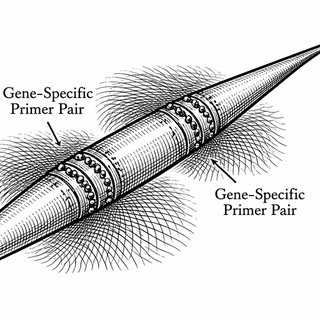
This group took a different route. They used an in-line tapered microfiber as a sensing platform. Think of it as a very skinny optical fiber engineered to be especially sensitive to changes in its local environment. On separate sections of that fiber, they immobilized different gene-specific primer pairs using click chemistry.
That detail matters. By placing different primers in different physical zones, the system can selectively trigger ERA for each target in its own little patch of real estate. No fluorescent label needed. When amplification happens, it changes the local refractive index around the fiber, and that causes measurable shifts in the optical signal.
So instead of asking, "Which glowing color do I see?" the system asks, "How did the optical properties change here versus there?" Cleaner question. Less costume jewelry.
How It Reads Two Targets at Once
Now for the genuinely neat engineering. Because both sensing regions contribute to the optical output, the signal is composite. In other words, it contains both conversations at once. The researchers used fast Fourier transform and frequency-selective filtering to separate those overlapping patterns and monitor each target in parallel in real time.
That sounds technical because it is technical, but the underlying logic is simple. If two bells ring at different tones, you can tell them apart even if they ring together. Here, the microfiber system gives each sensing region its own optical signature, and the signal processing untangles them.
This is the kind of paper that reminds you science often advances not by shouting louder, but by listening better.
Why Hepatitis B and C Make Sense Here
The authors used hepatitis B virus and hepatitis C virus genes as example targets. That's a sensible proving ground. These are clinically meaningful viral targets, and simultaneous detection matters because real patients do not come labeled with a neat single-problem sticker.
In the emergency department, people arrive with symptoms, risk factors, half-finished medical histories, and a talent for showing up at 2:13 a.m. when the charting system freezes. A platform that can distinguish between multiple infectious targets quickly could eventually be useful in settings where time, clarity, and simplicity all matter.
The paper reports simultaneous detection and discrimination within 20 minutes. In diagnostics, that is fast enough to get attention. Nobody in medicine complains when a result comes back before the coffee gets cold.
Why Label-Free Detection Is a Big Deal
Label-free approaches are attractive for a few reasons.
First, they may reduce assay cost by avoiding fluorescent tags and some of the hardware needed to read them. Second, they simplify the optical setup. Third, they may make scaling multiplex tests a little less painful, because you are not constantly adding more labels and more channels and more opportunities for the machine to have a tiny existential crisis.
A label-free system also has a certain engineering elegance. You're not bolting on an external marker just so the instrument can see what's happening. You're measuring the physical consequence of the biology itself. When it works, that's efficient in the best way: less decoration, more signal.
What Makes This Interesting Beyond the Lab Bench
There are plenty of papers that are "interesting" in the same way a conference tote bag is interesting. This one has more substance than that.
What stands out is the combination of molecular biology and optical sensing into a platform that tries to solve a practical bottleneck. Diagnostics are full of tradeoffs. Fast versus accurate. Multiplexed versus simple. Sensitive versus affordable. Portable versus sophisticated. This work is interesting because it is clearly aimed at trimming those tradeoffs instead of just admiring them from across the room.
If the system can be developed further, it points toward compact tests that detect multiple nucleic acid targets quickly without the bulk and expense of traditional fluorescence-heavy designs. That could matter for infectious disease testing, field-deployable diagnostics, or resource-limited settings where complexity is not a badge of honor, it's a liability.
The Fine Print That Always Matters
This is still research, not a clinic-ready gadget you can toss onto every hospital counter by Tuesday.
A promising sensing platform has to survive a few uncomfortable questions. How robust is it outside controlled laboratory conditions? How reproducible is it across batches and operators? What happens with messy real-world samples, not just tidy proof-of-concept material? How many targets can it multiplex before the signal separation starts resembling a family argument at Thanksgiving?
And there is one limitation in the summary we have here: the stated detection range appears truncated. So while the paper clearly signals sensitivity and speed, the exact lower and upper performance bounds are not fully available in the provided text. That is the sort of detail I like to know before I start calling something a revolution.
Still, the core idea is strong. Use spatially separated primers on a microfiber. Let ERA do the amplification. Read refractive-index changes instead of fluorescence. Then use signal processing to sort the targets in parallel. No fireworks, just competent science doing its job.
The Bottom Line
This paper offers a smart, lean approach to dual-gene detection. It cuts away some of the clutter that usually comes with multiplex nucleic acid assays and replaces it with a label-free optical readout that is both clever and potentially practical.
For general readers, the takeaway is straightforward: the researchers built a way to detect two genetic targets at once on a tiny optical fiber, without relying on fluorescent labels, and they did it fast. For clinicians and diagnostics folks, the more interesting question is whether this approach can scale, hold up in real samples, and move from elegant demonstration to reliable tool.
That leap is where many lovely ideas go to die. But this one at least walks into the room wearing sensible shoes.
This blog post discusses research findings and should not be taken as medical advice. If you have concerns about hepatitis B, hepatitis C, or infectious disease testing, please consult a healthcare provider. Research discussed here represents ongoing scientific investigation and clinical validation is still in progress.
All images used in this post are decorative illustrations only and do not represent or reflect the accuracy, reality, or correctness of the referenced research.
Primary Source: In-Line Tapered Microfiber Sensors for Label-Free Simultaneous Detection of Dual Genes via Enzymatic Recombinase Amplification. PubMed Record 41909915. PubMed: 41909915