
Somewhere in a bioengineering lab, a researcher is trying to squeeze living cells through a nozzle the width of a human hair - fast enough to build a structure before the bio-ink dries, but gently enough that the cells don't pop like tiny water balloons. This is the central tension of bioprinting, and it turns out the bottleneck isn't the cells, the software, or even the materials. It's the printhead. A new comprehensive review digs into exactly why the nozzle end of the printer is where dreams of 3D-printed organs go to get... complicated.
Wait, We're 3D Printing Living Tissue Now?
Sort of! Extrusion-based bioprinting works on the same basic principle as the desktop 3D printer collecting dust in your garage: material gets pushed through a nozzle, layer by layer, to build a three-dimensional structure. Except instead of melted plastic, researchers are extruding "bio-inks" - goopy mixtures of hydrogels, growth factors, and actual living cells. The goal? Fabricate complex tissues, organ-on-a-chip models, scaffolds for wound healing, and eventually (optimistically) transplantable organs.
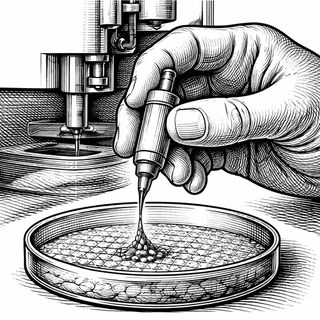
Extrusion-based methods have become the go-to approach in the bioprinting world, largely because they're versatile, relatively affordable, and can handle a wide range of materials. They've already produced some impressive results - functional skin grafts, cartilage constructs, vascularized tissue models. But if you zoom in on the hardware doing all the work, things get tricky fast.
The "Goldilocks" Problem of Bioprinting
Here's where it gets fun. Bioprinting has a set of trade-offs so brutal they'd make a game designer cry:
Speed vs. survival. Push the bio-ink through the nozzle faster, and you can build structures in reasonable timeframes. But faster extrusion means higher shear stress on the cells, and cells are not fans of being aggressively squeezed. Too much force and you end up printing a beautifully shaped structure full of dead cells. Not ideal.
Resolution vs. material range. Want finer details? Use a smaller nozzle. But smaller nozzles can only handle materials within a narrow range of viscosities. Too thick and it clogs. Too thin and it oozes everywhere like a toddler's soft-serve cone. Most extrusion-based systems are stuck processing materials in a limited "viscoelastic sweet spot," which constrains what you can actually build.
Multi-material complexity. Real biological tissues aren't made from one material - they're intricate composites. Printing with multiple bio-inks means swapping or mixing materials mid-print, and current systems do this with all the grace of a fast-food soda fountain that hasn't been cleaned in a month. Cross-contamination, slow switching times, and wasted material are persistent headaches.
The Printhead: Where the Magic (and the Frustration) Happens
This review makes a compelling case that the printhead - the component that controls how material is delivered to the build surface - is the single most impactful piece of hardware in the whole system. It's not just a passive funnel. Modern printheads incorporate heating elements, mixing chambers, pressure regulators, and increasingly clever nozzle geometries that try to thread the needle (pun intended) between all those competing demands.
Recent breakthroughs highlighted in the review include coaxial nozzles that can extrude one material inside another (think of it as printing a tube of toothpaste where the stripe is a different cell type), microfluidic printheads that mix materials on the fly with precise ratios, and multi-nozzle arrays that print multiple materials simultaneously without the slow process of swapping syringes.
Some groups have developed "core-shell" nozzle designs that protect fragile cells in a soft inner stream while a stiffer outer shell provides structural support. Others have created printheads with built-in UV or ionic crosslinking right at the nozzle tip, so the bio-ink solidifies the instant it exits - no more sad, slumping layers.
So What's Still Missing?
Despite the progress, the review is refreshingly honest about what hasn't been solved. Spatial resolution remains limited compared to other techniques like inkjet or laser-based bioprinting. Most extrusion systems struggle to consistently print features below about 100 micrometers - and real tissue architecture involves structures at the 10-micrometer scale and below.
There's also the question of scalability. Lab demonstrations are one thing; printing a clinically relevant volume of tissue with high cell viability, multiple materials, and fine resolution is another entirely. Current printheads often sacrifice one parameter to optimize another, and nobody has cracked the design that does everything well simultaneously.
The authors lay out a roadmap for next-generation printhead engineering: smarter nozzle geometries informed by computational fluid dynamics, integrated sensors for real-time monitoring of cell health during printing, adaptive systems that adjust extrusion parameters on the fly, and modular designs that let researchers swap nozzle configurations mid-build without pausing the print.
Why Should You Care?
Because the implications are enormous. If printhead technology catches up to the ambition of the field, we're looking at patient-specific tissue implants, better drug testing platforms that reduce reliance on animal models, and eventually - maybe - printed organs that could ease the transplant shortage crisis. The gap between "cool lab demo" and "clinical reality" is largely an engineering problem, and this review maps out exactly where the engineering needs to go.
The fact that researchers are now treating the printhead as a design challenge worthy of its own dedicated review - rather than an afterthought bolted onto a standard 3D printer frame - feels like a sign that the field is maturing. We've moved past "can we bioprint?" and into "how do we bioprint well?"
And honestly? The idea that the future of regenerative medicine might hinge on getting really, really good at nozzle design has a satisfying, roll-up-your-sleeves practicality to it. Sometimes the most transformative breakthroughs aren't conceptual leaps - they're someone finally engineering a better way to squeeze stuff through a tiny hole.
This blog post discusses research findings and should not be taken as medical advice. If you have concerns about bioprinting technologies or regenerative medicine, please consult a healthcare provider. Research discussed here represents ongoing scientific investigation and clinical validation is still in progress.
All images used in this post are decorative illustrations only and do not represent or reflect the accuracy, reality, or correctness of the referenced research.
Primary Source: Advances in extrusion-based bioprinting enabled by advanced printhead and nozzle designs. PubMed. 2026. PMID: 41769382