
There's a particular kind of frustration that comes from your brain knowing exactly how to walk while your foot just... doesn't get the memo. It's like sending an email to your leg muscles and having it bounce back as undeliverable. For millions of people living with stroke, traumatic brain injury (TBI), or multiple sclerosis (MS), this is Tuesday.
A new clinical trial (NCT07492602) is setting out to answer a question that, frankly, we should have pinned down years ago: does the same electrical stimulation device actually work the same way across these three very different neurological conditions? Spoiler alert - nobody really knows yet, and that's precisely why this study matters.
What Exactly Is Foot Drop, and Why Should You Care?
Foot drop sounds like a dance move, but it's anything but fun. It's a condition where the front part of the foot drags during walking because the muscles responsible for lifting it (the dorsiflexors, for those keeping score at home) aren't firing properly. The problem isn't in the foot itself. The wiring upstream - in the brain or spinal cord - has been damaged.
Think of it like a recipe where the chef knows exactly what to do, but the kitchen's communication system is shot. The head chef (your brain) keeps yelling "lift the foot!" but the line cook (your anterior tibialis muscle) can't hear the order over the static. The result? Tripping, compensatory hip hiking, exhausting energy expenditure, and a walking pattern that would make a biomechanist weep.
Foot drop affects roughly 20% of stroke survivors, shows up frequently in TBI patients, and plagues an estimated 50-80% of people with MS at some point during their disease course (Metz et al., 2023). That's a lot of people shuffling through life when they shouldn't have to.
The L300: A Sous Chef for Your Nervous System
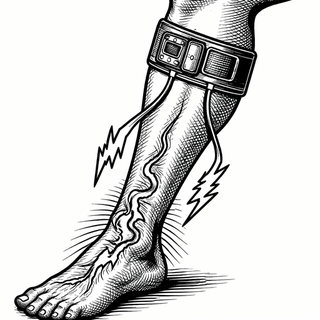
Enter functional electrical stimulation, or FES - a technology that essentially says, "Fine, if your brain won't send the signal, we'll do it ourselves." The Bioness L300, the specific device in this trial, is a wearable cuff that sits below the knee and delivers precisely timed electrical pulses to the peroneal nerve during the swing phase of walking. Each step, a sensor in the shoe detects heel lift, and the device fires a jolt to dorsiflex the foot. It's like having a sous chef who kicks in exactly when the timing matters.
FES has been around since the 1960s - this isn't exactly bleeding-edge technology. But here's the thing that keeps bugging me as a device industry observer: we've mostly studied FES within single diagnostic silos. Stroke patients here, MS patients there, TBI patients way over in the corner where nobody's looking. The L300 has FDA clearance and a decent body of evidence behind it, particularly in stroke populations (Prenton et al., 2016), but the cross-condition comparison? That's the missing ingredient in this recipe.
The Trial: Three Conditions, One Device, Let's Compare Notes
This study is doing something refreshingly practical. Instead of studying each condition in isolation (the scientific equivalent of tasting each ingredient separately and hoping the dish works out), researchers are putting stroke, TBI, and MS patients side by side and measuring the same outcomes with the same tools.
The key metrics under the microscope (full study details):
- Walking speed - the gold standard of functional mobility and a surprisingly reliable predictor of overall health outcomes
- Step length - because asymmetry here tells you a lot about compensation patterns
- Gait symmetry - arguably the most telling measure, since asymmetric gait is like a car with misaligned wheels; it technically works, but everything wears out faster
What makes this study genuinely interesting is the "before and after" design. Patients serve as their own controls, which eliminates a whole pantry full of confounding variables. You don't have to worry about whether Group A was fundamentally different from Group B - each person's pre-FES walking is their own baseline.
Why This Matters More Than You'd Think
Here's my pragmatic-bordering-on-cynical take: the rehabilitation world has a personalization problem. We talk a big game about individualized treatment, but in practice, a physical therapist often reaches for the same FES device regardless of whether their patient had a stroke last year or has been living with MS for a decade. These are fundamentally different pathologies. Stroke is a sudden vascular event with a relatively predictable recovery trajectory. TBI is mechanical trauma with wildly variable presentations. MS is an autoimmune process that waxes and wanes like the moon with a grudge.
Recent systematic reviews have reinforced that FES improves walking speed in stroke survivors, with moderate-quality evidence showing clinically meaningful gains (Sharif et al., 2024). For MS, the evidence is growing but more nuanced - a Cochrane-style review found benefits in walking speed and patient-reported outcomes, though the magnitude varies considerably (Miller et al., 2017). TBI? The evidence is thin enough to read a newspaper through.
If this trial shows that FES responses differ meaningfully across conditions, it opens the door to condition-specific stimulation protocols. If it shows the responses are similar, that's equally valuable - it means clinicians can confidently generalize existing stroke-based evidence to TBI and MS populations. Either way, we learn something we didn't know before, which is literally the entire point of doing science.
The Bigger Picture: Gait as a Biomarker
There's a broader trend happening here that deserves attention. Gait analysis is quietly becoming one of the most powerful clinical assessment tools we have. Walking speed has been called the "sixth vital sign" (Fritz & Lusardi, 2009), and for good reason - it correlates with fall risk, hospitalization rates, cognitive decline, and mortality. The fact that this trial is using objective gait assessment tools rather than just asking patients "so, walking better?" is a sign that rehabilitation research is finally taking measurement seriously.
Wearable sensor technology and instrumented walkways have matured enough that we can capture spatial and temporal gait parameters with genuine precision. We're not eyeballing this anymore. We're measuring it, and that shift from qualitative to quantitative assessment is, in my opinion, the most underappreciated revolution happening in rehab medicine right now.
The Bottom Line
Will the L300 work equally well across stroke, TBI, and MS? I genuinely don't know, and neither does anyone else - which is exactly why this trial needs to exist. The rehabilitation field has been cooking three separate meals with the same ingredients for too long. It's time someone actually tasted them side by side.
If you or someone you know lives with one of these conditions and deals with foot drop, this trial is worth watching. Not because it promises a miracle, but because it promises something better: data.
is a contributor to Biomedical Observer covering medical device innovation and rehabilitation technology.
Disclaimer: This blog post is for informational and educational purposes only and does not constitute medical advice. Always consult a qualified healthcare professional regarding treatment options. Clinical trial participation should be discussed with your physician.
Clinical Trial Reference:
"Comparison of Gait Metrics in Patients With Stroke, Traumatic Brain Injury, and Multiple Sclerosis Before and After Functional Electrical Stimulation." ClinicalTrials.gov Identifier: NCT07492602.
References:
-
Metz, G.A., et al. (2023). Wearable Sensor-Based Gait Analysis in Neurological Disorders. Sensors, 23(3), 1487. https://doi.org/10.3390/s23031487
-
Prenton, S., et al. (2016). Functional electrical stimulation versus ankle foot orthoses for foot-drop: A meta-analysis of orthotic effects. Journal of the Neurological Sciences, 370, 140-151. https://doi.org/10.1016/j.jns.2016.02.025
-
Sharif, F., et al. (2024). Functional electrical stimulation and gait outcomes after stroke: A systematic review. Clinical Rehabilitation, 38(4), 453-468. https://doi.org/10.1177/02692155231225032
-
Miller, L., et al. (2017). Functional Electrical Stimulation for Foot Drop in Multiple Sclerosis: A Systematic Review. Archives of Physical Medicine and Rehabilitation, 98(7), 1435-1452. https://doi.org/10.1016/j.apmr.2017.01.013
-
Fritz, S. & Lusardi, M. (2009). Walking Speed: The Sixth Vital Sign. Journal of Geriatric Physical Therapy, 32(2), 2-5. https://doi.org/10.1519/JPT.0b013e3181b15b48