
In the ongoing battle between the human skull and traumatic injury, surgery, or disease, the skull loses more often than you'd think. And when it does, surgeons need to patch the hole with something that acts like bone but isn't bone. Welcome to the surprisingly competitive world of cranioplasty materials, where a team of researchers just dropped a second-generation skull patch that's basically a titanium sandwich - and honestly, it's kind of brilliant.
The Hole Problem (Literally)
When a chunk of skull gets removed - whether from trauma, tumor surgery, or decompressive procedures after a stroke - you're left with a defect that needs covering. As a former paramedic, I saw my share of patients with craniectomy sites, and let me tell you, watching someone's scalp pulse with their heartbeat where bone should be is the kind of thing that stays with you.
Current cranioplasty options read like a menu nobody wants to order from. You've got autologous bone grafts (using the patient's own bone, which sometimes gets reabsorbed by the body like a terrible magic trick), PMMA (polymethyl methacrylate, basically medical-grade acrylic), PEEK (polyether ether ketone), and titanium mesh. Each has its own highlight reel of problems. Titanium is strong but way stiffer than bone. PMMA is moldable but brittle and doesn't play well with surrounding tissue long-term. It's like choosing between a pickup truck with no suspension and a sports car with no engine.
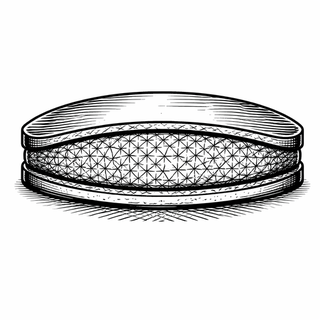
Enter the Sandwich
A new study published in the journal ACS Applied Materials & Interfaces introduces what they're calling bioactive hybrid sandwich materials - a Ti/polymer/Ti architecture designed specifically for cranial reconstruction. Think of it like an Oreo, but instead of chocolate wafers you've got thin titanium sheets, and instead of cream filling you've got a tunable polymer core.
The "tunable" part is where things get interesting. In their first-generation design, the researchers used a straight PMMA core. This time around, they swapped it for a P(MMA-co-) copolymer system - essentially a customizable blend that lets them dial in the mechanical properties they want. It's like going from a fixed-gear bike to one with a full Shimano groupset. Same basic concept, way more control over performance.
Why Your Skull Is a Tough Customer
Here's something most people don't appreciate: the human skull isn't uniform. It varies in thickness, curvature, and mechanical behavior depending on where you measure. The frontal bone handles loads differently than the temporal or parietal regions. So slapping on a one-size-fits-all implant is like using the same tire pressure for a Formula 1 car and a dump truck - technically possible, but you're going to have a bad time.
The sandwich architecture addresses this by letting engineers adjust the core polymer's composition to match the mechanical properties of the specific skull region being repaired. The titanium outer layers provide structural integrity and biocompatibility (titanium is one of the few metals your body genuinely tolerates), while the polymer core absorbs and distributes forces in a way that mimics natural bone behavior.
Scalable Fabrication: From Lab Bench to Operating Room
One of the persistent headaches in biomaterials research is the gap between "this works great on a lab bench" and "we can actually manufacture this at scale." Plenty of promising implant designs have died in that valley. This team specifically engineered their sandwich composites with scalable fabrication in mind, focusing on processes that could translate to real-world manufacturing without requiring a PhD and a prayer to reproduce.
The formability aspect matters too. Surgeons need to shape implants to match each patient's unique cranial geometry. A material that's mechanically perfect but can't be contoured to fit a specific skull defect is about as useful as a screen door on a submarine.
The Bioactive Angle
The "bioactive" label isn't just marketing. The researchers engineered these composites to promote biointegration - meaning the surrounding bone and tissue should actually grow into and bond with the implant rather than just tolerating its presence. This is the difference between a houseguest who does dishes and one who barricades themselves in the guest room. Both are technically living in your house, but one is a lot more integrated into the household.
Traditional titanium implants often end up encapsulated in fibrous tissue - the body's version of building a wall around something it can't evict. Bioactive surfaces encourage actual bone apposition and cellular attachment, which should translate to better long-term stability and fewer complications.
What This Means Going Forward
This is still early-stage work, and nobody should expect these sandwich composites in operating rooms next Tuesday. But the approach represents a genuine step forward in thinking about cranioplasty materials as engineered systems rather than single-material compromises.
The ability to tune mechanical properties while maintaining bioactivity and manufacturability hits a trifecta that previous designs have struggled to achieve. If clinical validation bears out the lab results, we could be looking at implants that behave more like the bone they're replacing and less like the hardware-store solutions that have dominated the field.
For the roughly 50,000 patients who undergo cranioplasty procedures annually worldwide, better materials mean fewer revision surgeries, fewer infections, and better cosmetic and functional outcomes. That's a scoreboard worth watching.
This blog post discusses research findings and should not be taken as medical advice. If you have concerns about cranioplasty or cranial reconstruction, please consult a healthcare provider. Research discussed here represents ongoing scientific investigation and clinical validation is still in progress.
All images used in this post are decorative illustrations only and do not represent or reflect the accuracy, reality, or correctness of the referenced research.
Primary Source: Design and Scalable Fabrication of Bioactive Ti/Polymer/Ti Sandwich Composites with Controlled Mechanics for Cranioplasty. ACS Applied Materials & Interfaces. 2025. DOI: PMID 41941542